- The olive harvest began some time ago. If you’re an olive oil producer, you’ll know that what you send to the mills isn’t always returned to you as it should be; many mix your oil with lower-quality oil, and it’s difficult to monitor this.
- Blending extra virgin olive oil from different vintages is not, in itself, a prohibited practice. The problem arises when a new oil is used to ‘rejuvenate’ an old oil, presenting the blend as a new harvest. Pyrophytins (PPP) and diacylglycerols (DAG) are very useful indicators. Here’s how to interpret the data correctly
- The 18 months set as the minimum shelf life for extra virgin olive oil are calculated from the date of bottling. But the oil ages sooner
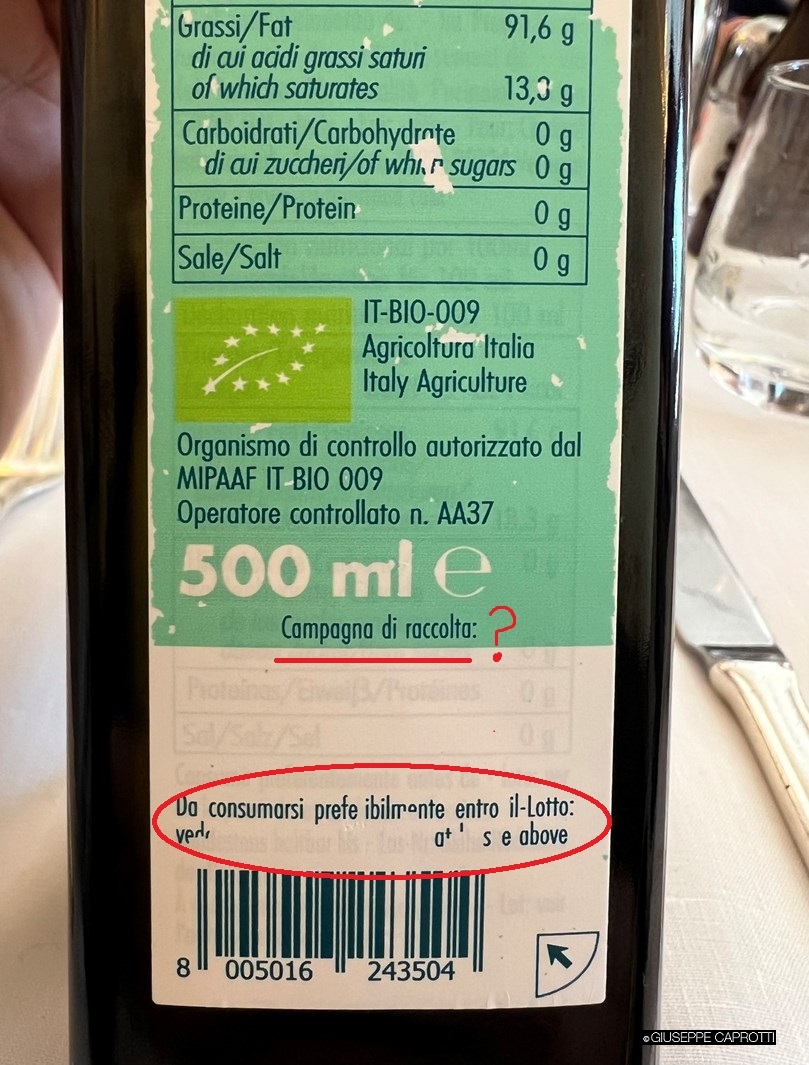
The label provides no clarity on the date the olives were harvested: the oil shown below may have been harvested in 2024.

After pressing, the oil is stored in tanks whilst awaiting bottling. This can take several months, or even a year. If the producer specifies a minimum shelf life of 18 months from the date of bottling, it is difficult to work backwards to the year of harvest. Yet, by looking only at the minimum shelf life, the buyer might think they still have plenty of time to consume it.
The harvest year changes everything
Alberto Grimelli, director of Teatro Naturale, draws attention specifically to theharvestyear. For Italian olive oils produced entirely from a single harvest, the law requires the year to be stated on the label. If we see the words ‘2025/2026’, it means that almost all the olives were harvested in the autumn of 2025 and the oil is about a year old. It should therefore be consumed as soon as possible, as there is a universal rule that everyone knows: olive oil should be consumed within a year, even if the label indicates a much longer ‘use-by’ date.
If you want to be sure you’re consuming fresh, new oil – the sort that’s just come out of the mills in the last few days – you’ll need to find the following wording on the label of 100% Italian extra virgin olive oil: ‘2026/2027 production season’. However, the requirement to state the harvest year does not apply to blends of Italian oil from different harvest years, nor to bottles containing blends of Italian, European or non-European oils – which, incidentally, account for 90 per cent of the market. The phrase ‘100% Italian’, therefore, is not sufficient to guarantee that the harvest year is stated on the label.
To be sure you are consuming fresh, new-crop oil, the label of 100% Italian extra virgin olive oil must bear the wording: “2026/2027 production season”.
Olive harvest in Tuscany

The flavour changes before the date
“Olive oil is a living product,” observes Grimelli, “and as time passes, it loses its aroma, freshness and intensity. Oxidation can lead to a rancid flavour and compromise the requirements of extra virgin olive oil.” ..
Why such long ‘use-by’ dates for extra virgin olive oil?
According to Grimelli, the practice of stating a minimum shelf life of 18 months on the label meets the requirements of the export market, particularly to the United States: transport times, distribution and the expectations of those who want a product that lasts a long time. However, this is a commercial requirement that in no way guarantees the preservation of flavour.
After pressing, the oil remains in tanks awaiting bottling for several months, even up to a year
For domestic consumption, notes the director of Teatro Naturale, the advice remains to consume the oil within a year of production, or better still sooner. Grimelli is particularly critical of commercial oils made from European or non-European blends, which are now sold for as little as four to five euros a litre.…
“Once the oil starts to oxidise, there’s no stopping it,” explains Grimelli. “Better storage tanks, temperature control and protection from oxygen can slow down the deterioration. However, they do not reset the oil’s age and, on their own, do not guarantee quality right up to the printed date.”
Eighteen months. From when?
Automatically assigning 18 months from the date of bottling, without taking into account how much the oil has already aged, is absurd…
- Remember to check the oil labels, even in restaurants: below is the labelling for oil at a well-known restaurant in Venice.
I think it speaks for itself (*) and illustrates why the olive oil sector has regressed over time whilst the wine sector has followed a diametrically opposite trajectory, moving upwards: there will never be a ‘vintage’ in olive oil, and that is a real shame.