We are talking about a vital substance to ensure abundant harvests of wheat and cereals, the mainstays of our diet. With the war in Iran turning the straits into a shooting gallery, the situation has become critical. Prices are out of control: urea has risen by 25% in just one week, putting spring sowing at risk If with the Russian invasion the problem affected wheat and sunflower oil, the war in Iran shifts the critical issues to fertilisers.
‘If the situation continues, consumers could see higher prices for bread within six to ten weeks, for eggs within a few months, and for pork and broiler chicken within six months, estimates Raj Patel, a food systems expert at the Lyndon B. Johnson School of Public Affairs’.
Source: the Financial Times, which adds:‘The Middle East is one of the world’s biggest fertiliser producers, while the Strait of Hormuz is a crucial sea route for exports.
According to CRU data, about 35 per cent of global urea exports pass through this waterway. Urea is the most widely used nitrogen fertiliser, which in turn supports about half of the world’s food production.
The route also handles 45 per cent of global exports of sulphur, a key ingredient used to produce phosphate fertilisers, as well as significant volumes of ammonia, a key ingredient for nitrogen fertilisers,’ he says. Moreover, according to recent work, oil and gas price increases of similar amounts to those observed so far, if sustained over time, would lead to a price increase of 1.4 per cent one year from now, compared to a scenario without the shock.
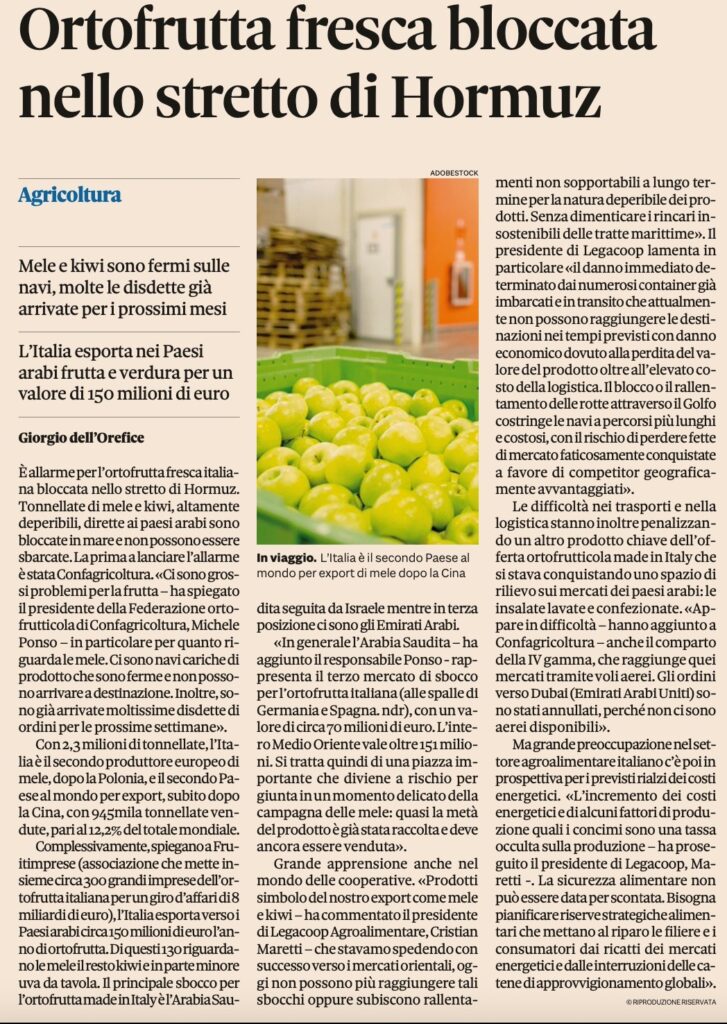
In the article in Il Sole 24 Ore of 6 March below, the problems of the fruit and vegetable sector are highlighted.