


Drafted on 29 June, updated on 8 August 2026
Some Italian commentators bear a striking resemblance to those African leaders who studied in Moscowat the Russian University of Friendship of Peoples
Founded in 1960 at the height ofthe Cold War, its primary objective was to provide higher education and vocational training to young people fromThird World nations, particularly in Asia, Africa and South America, although over the years numerous students from developed countries have also studied there.
The university was founded by the governmentof the Soviet Union on 5 February 1960 in response to requests from former colonial countries. On 22 February 1961, it was renamed in honour of Patrice Lumumba, the leader of what later became the Democratic Republic of the Congo, who had been overthrown and killed in a coup d’état a few days earlier. In its first year, 539 foreign students from 59 countries were enrolled, in addition to 57 Soviet students…
Then there are the Catholics.
Whilst Europe seeks to rearm, Italians remain deeply divided by a strong pacifist current
Europeans, war and peace
In Italy, Catholic and Communist traditions unite in rejecting the idea of war, and the overwhelming majority of Italians are opposed to the rearmament of their own country and of Europe.
By Allan Kaval (Rome , correspondent). Published on 25 March 2025
A trace of an idea that persists; at times, it can still be seen flying from the windows of buildings, on the walls of some cafés and restaurants, and brandished in large numbers during public demonstrations organised in response to the war in Ukraine and the rise in geopolitical tensions across the European continent. The rainbow flag bearing the word ‘peace’ in capital letters – a popular cultural reference and a symbol of unity for Italian pacifists for over six decades – remains visible in the public sphere of 2025, signifying the fundamental opposition of a large section of public opinion to the use and build-up of military force.
In Italy, the mere mention of the idea of peace, detached from any historical or political context, can become a self-contained slogan. Beyond the streets of the major cities and the multicoloured flags flying everywhere, this reality is confirmed by opinion polls: the overwhelming majority of Italians are opposed to the rearmament of their own country and of Europe.
A poll published on Thursday 20 March by the magazine *Le Grand Continent* highlighted this peculiarity. Thus, 62 per cent of Italians surveyed believe there are more urgent areas of public spending than defence, compared with an average of 34 per cent across the selection of European Union (EU) countries covered by the poll. They are also the most likely (at 53 per cent, compared with 39 per cent overall) to reject the idea of extending French deterrence to the whole of the EU.
57 per cent of Italians support neither Russia nor Ukraine
Furthermore, 62 per cent of Italians surveyed are in favour of signing a peace treaty that includes territorial concessions to Russia, whilst only 37 per cent of them support greater military engagement with Ukraine, placing them last among the Europeans surveyed.
According to another Ipsos poll, published on 15 March, 57 per cent of Italians support neither Russia nor Ukraine in the conflict – with a marked decline in support for Kyiv – and 39 per cent of them are opposed to the European Commission’s ‘Rearm Europe’ plan, whilst 28 per cent are in favour.
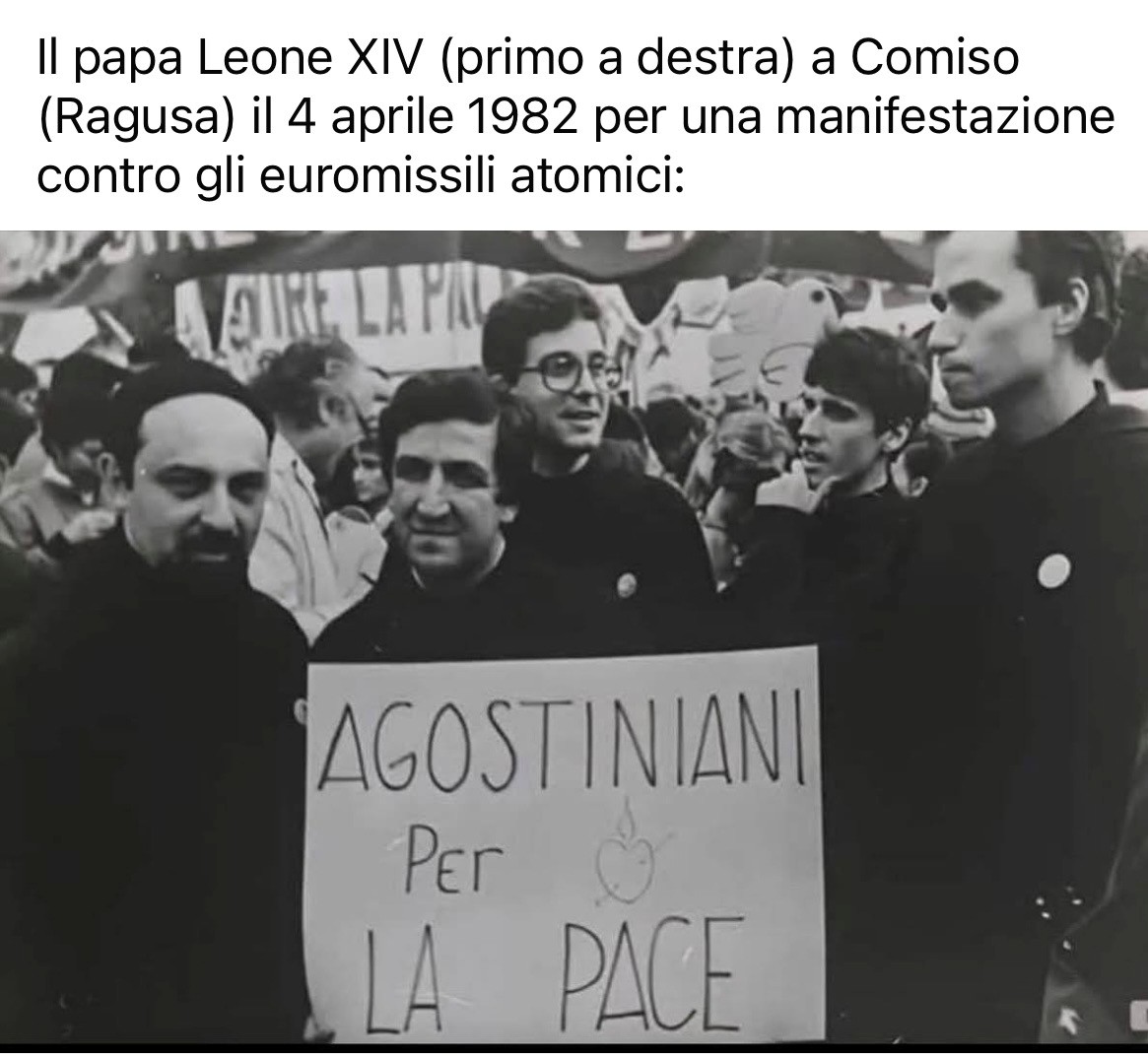
Background: in response to the Soviet decision to deploy SS-20 missiles, NATO adopted the ‘twin-track approach’: deploying missiles in Europe whilst simultaneously negotiating disarmament with the USSR. Italy chose Comiso Airport as a base for 112 Cruise missiles. The deployment caused extremely high tensions between 1981 and 1983 and gave rise to a major peace movement. Catholic and left-wing.
‘Mistrust of the use of force is a constant feature of Italian public opinion, which not even events such as the Buchá massacre have managed to shake”, explains Francesca Farruggia, a sociologist at La Sapienza University in Rome and secretary-general of the Disarmament Archive – Institute for International Research.
The researcher sees this as the result of cultural factors rooted in a long history: “Italy endured a disastrous experience during the Second World War, marked by military defeats, occupation and civil conflict between fascists and anti-fascists. For Italians, war is one of the evils that the transition from Mussolini’s regime to the Republic was meant to consign to the past.” Indeed, Article 11 of the 1948 Constitution states that “Italy repudiates war as an instrument of aggression against the freedom of other peoples and as a means of resolving international conflicts ”.
An attitude “resistant to the idea of a just war”
The Italian Constitution was the result of a compromise between the various anti-fascist forces engaged in the struggle against the dictatorship and the German occupiers. Among these were the Christian Democrats and the Communists, two political families that shaped Italy after the Second World War and whose pacifist legacy outlived their disappearance as political parties.
“As pacifists, we have no platform on which to publicise our actions other than in *Avvenire* , the Catholic Church’s daily newspaper, and *Il Manifesto*, a far-left daily,” observes Francesco Vignarca, coordinator of the Italian Network for Peace and Disarmament.
A myriad of organisations from the Catholic world and the left identify with this pacifist rhetoric and the rainbow banner.
It was first unfurled in 1961 during a peace march organised between Perugia and Assisi, at the height of the Cold War, and steeped in religious references as its organisers had chosen the city of St Francis as their destination.
“Italian public opinion is traditionally reluctant to accept the idea of a just war,” explains Mario Giro, head of international relations at Sant’Egidio, a highly influential religious movement committed to humanitarian work and conflict mediation. “There is an inability to think of war as a means of restoring justice or upholding moral rights,” he says.
This attitude towards armed conflicts, he argues, is part of a realistic view of international affairs that rules out the idea that war can serve as a means of pursuing a moral ideal, but sees conflicts as purely cynical clashes between powers.
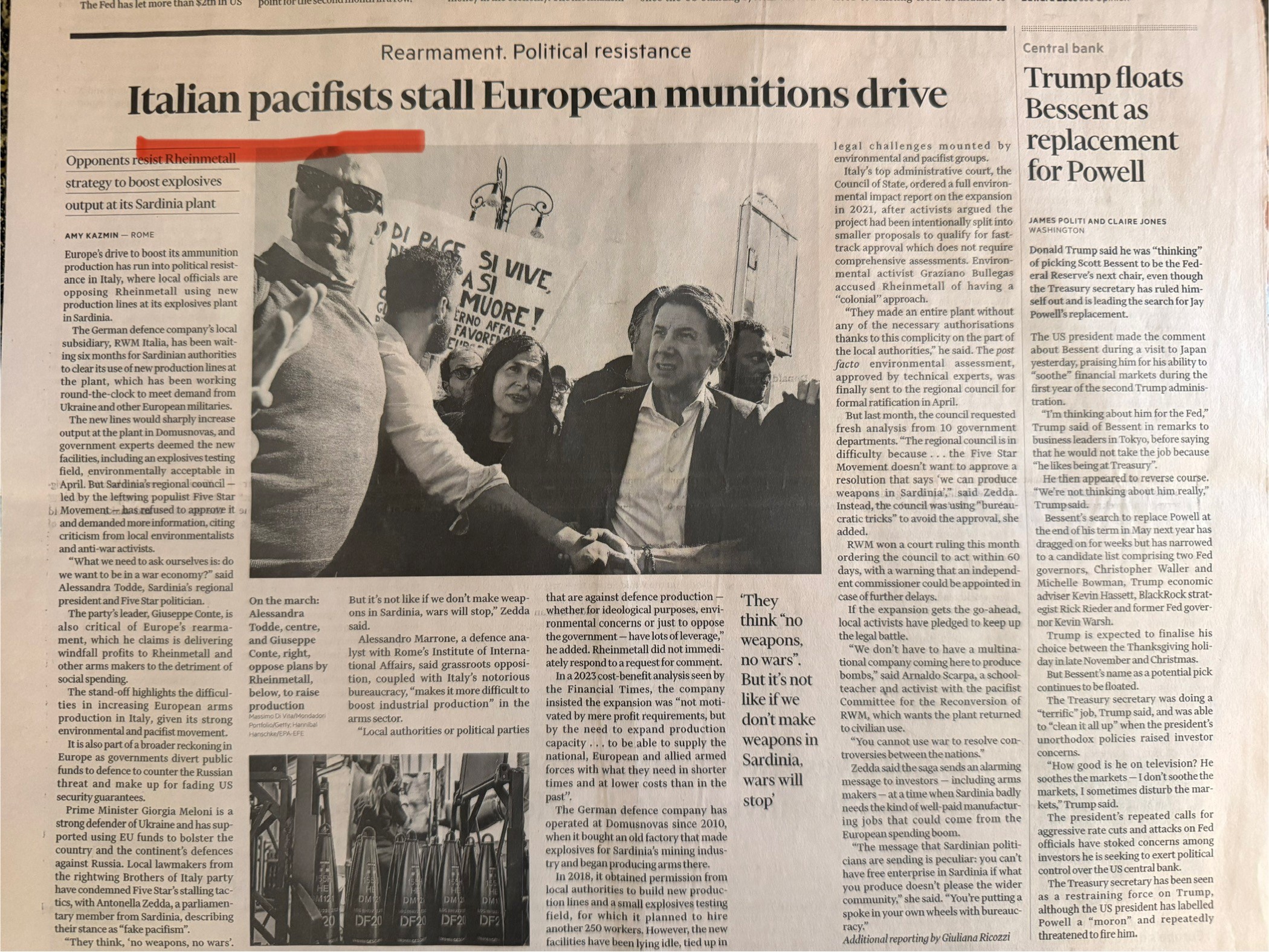
Below: Italian pacifists are blocking Europe’s plan to increase munitions production
A natural disaster
War is therefore often denounced as a ‘pointless slaughter’, as Pope Benedict XV put it in 1917, referring to the First World War. In this context, it is comparable to a natural disaster that must inevitably be endured, in which people are always objects and victims, never agents driven by principles.
“We can say that the Italian approach to war is both Machiavellian in nature, because it is very realistic, and Catholic in nature, because it is pacifist, in line with the Vatican’s positions,” concludes Giro. This Italian pacifism is, in fact, in line with the positions taken by Pope Francis, which could be interpreted, at the start of the conflict in Ukraine, as a desire to maintain an equal distance from the two belligerents.
In the context of the war in Ukraine, these structural factors are compounded by the refusal, on the part of significant sections of public opinion, to perceive Russia as a threat to Italy and Europe. The Italian Communist Party was, in the post-war period and up until the early 1990s, the most powerful party in Western Europe, projecting a positive and benevolent image of Moscow into the country’s culture – an image that has endured.
Despite the Cold War, cultural and economic exchanges never ceased. For example, the Sanremo Music Festival, one of the most important events of the year in Italy, was one of the few Western programmes to be broadcast in the Soviet Union. In the world of culture, the famous Neapolitan street artist Jorit still makes no secret of his support for Vladimir Putin. The Russian president, a close friend of former Prime Minister Silvio Berlusconi, never misses an opportunity to publicly declare his respect for the Italian people, in contrast to their government, which supports Kyiv.
On Saturday 15 March, the pro-European demonstrations inspired by Michele Serra, a journalist and essayist for *La Repubblica*, highlighted the divisions within the pro-European parties, which are split between supporters and opponents of rearmament and support for Ukraine. “It was a diverse demonstration that showed that a section of public opinion has mobilised to defend Europe from Trump and Putin, ” said Serra.
The nature of this defence, however – its military dimension – lies at the heart of deep disagreements that divide both the majority, dominated by Giorgia Meloni’s far-right party, and the opposition. According to Arturo Varvelli, head of the Rome office of the think tank European Council on Foreign Relations, “the downside of Italian pacifism is the tendency to always side, for the sake of convenience, with the strongest party and to not want to be disturbed by the voices circulating around the world. Sometimes it boils down to saying that Ukraine is far away and that, ultimately, Russia has no intention of harming Italy. Many Italians, therefore, do not feel concerned”.
On social media, the campaign began in 2022, and the pro-Russian stance of some is slimy and hypocritical, as no one but Vladimir Putin can decide to stop the war. In some cases, it descends into jokes because people have, to some extent, realised who is on the invader’s side.
But then, on a more serious note, there is this 2022 investigation: ‘The Kremlin pays commentators on Italian talk shows’, according to intelligence reports. This is how Russian propaganda finds its way onto our TV
Russian Foreign Minister Sergei Lavrov during his interview on Sunday 1 May on Rete4
Copasir suspects this and will ask talk show producers who selects the guests. The case of 1 May, when Lavrov and Solovyev were on air at the same time
The presence of foreign commentators on Italian talk shows is not merely a matter of journalism. Nor is it a coincidence.
Rather ,it is “an organised disinformation operation planned in advance by members of the Russian government”.
This isthe suspicion held by Copasir, the Parliamentary Committee for the Security of the Republic, which has scheduled a series of hearings in the coming days: the director of AISI, Mario Parente (11 May); the CEO of RAI, Carlo Fuortes (12 May); And the chairman of AGCOM, Giacomo Lasorella (on 18 May).
This suspicion has not arisen by chance but from a series of circumstances that emerged during the latest hearings. It is certain that some of the foreign commentators invited onto Italian talk shows are on the payroll of Putin’s government.
Take the case of Nadana Fridirkhson, a regular guest on certain programmes (she recently appeared on *Carta Bianca*), who works for the Russian Ministry of Defence’s television channel.
But our sources have provided similar information regarding at least three other individuals…
And so, looking at the news, especially on social media, one discovers that the Russian Foreign Minister, Sergei Lavrov – albeit remotely – has a very ‘strong presence’ in Italy. It is striking that the agreement between United Russia and Matteo Salvini’s League is still in force today.
The only clear-headed person in this chaos seems to be Carlo Calenda: “Are there politicians being paid by foreign powers?”
To the politicians, I would add a few commentators. Many are simply ideologically driven, politically post-Soviet, as I said at the start, but others might genuinely be on the payroll of a hostile foreign state.
The list of ‘biased’ commentators is not particularly long, but these are prominent figures who are in constant contact with a very wide audience through press conferences, newspaper articles, events, festivals and gatherings (including international ones, such as the Venice Biennale), television programmes, social media campaigns, etc.
Some are openly ‘pacifists’ (= pro-Putin), whilst others simply ‘favour dialogue’ or believe they are contributing to an ‘exchange of views’ (by giving a platform to pro-Putin figures)..
We’re talking about Tomaso Montanari, Giuseppe Onofrio, Angelo Bonelli, Pierluigi Bersani, Dario Carotenuto, Mario Tozzi, Andrea Orlando, Rita De Crescenzo, Alessandra Todde, Elena Basile, Francesco Boccia, Paola Taverna, Roberto Fico, Toni Capuozzo, Virginia Raggi, Marco Travaglio, Donatella Di Cesare, Heather Parisi, Ornella Muti, Al Bano, Pupo, Angelo D’Orsi, Vauro Senesi, Claudio Borghi, Michele Santoro, Giuseppe Conte, Alessandro Orsini, Alessandro Barbero, Gianfranco Pagliarulo, Lucio Caracciolo, Massimo Cacciari, Marco Rizzo, Alessandro Di Battista, Nicola Fratoianni, Angelo Bonelli, Vincenzo De Luca, Matteo Salvini, Diego Fusaro, Barbara Spinelli, Antonio Padellaro, Bruno Vespa, Pietrangelo Buttafuoco, Fabio Mini,Roberto Vannacci,Lilli Gruber, Pietro Benassi, Giorgio Bianchi, Manlio Dinucci, Maurizio Vezzosi, Vito Petrocelli, Laura Ruggeri, Manlio Di Stefano, Cesare Sachetti, Claudio Giordanengo, Moni Ovadia, Carlo Freccero, Luca Telese, Marianne Aprile, Goffredo Bettini, Jacopo Gargano, Paolo Nori, Giulietto Chiesa, Pietro Stramezzi, Andrea Lucidi, Alessandro Alfieri, Fiammetta Cucurnia, Carmen Betti, Mark Innaro, Vincenzo Lorusso, Iain Chambers, Laura Salmon, Ugo Mattei, Aldo Giannuli, Demostenes Floros, Ruggero Giacomini, William Gambetta, Lara Ballurio, Paolo Desogus, Franca Balsamo, Diana Carminati, Pier Giorgio Ardeni, Giulio Di Donato, Piero Bevilacqua, Glauco Della Sciucca, Federico Greco, Gianni Fresu, Andrea Catone, Sandro Teti, Franco Coppoli, Roberto Passini, Marina Rota, Giulio Chinappi, Cristina Alziati, Francesco Toscano, Pino Cabras, Amedeo Feniello, Paolo Becchi, Loris Caruso, Vito Petrocelli, Alexander Höbel, Leonardo Fredduzzi, Massimo Zucchetti, Francesca Chiarotto, Claudio Grassi, Roberto Passini, Clara Statello, Andrea Lucidi, Sara Reginella, Stefano Orsi, Giuseppe Salamone, Alberto Fazolo, Guido Liguori, Fabrizio Marchi, Carmelo Buscema, Tania Di Malta, Antonino Salerno, Emanuela Ligarò, Margherita Furlan, Angelo Caputo, Gennaro Imbriano, Jeanne Toschi Marazzini, Aldo Gaccione, Alessandro Guerriero, Franca Ruggieri, Danila Ghigliano…
Added to this are further pieces of the puzzle:
- Some pointto *Il Fatto Quotidiano* as a strategic partner of Russian propaganda. Peter Gomez denies this, but there is a mystery surrounding the financial statements of SEIF Spa [publisher of *Il Fatto Quotidiano*]: over one million in ‘non-EU’ revenue
- Russian propaganda is capable of broadcasting fake reports via RAI, ANSA and GEDI
- Putin also exerts influence over Italian schools: for more than a decade, there have been secondary school textbooks that omit Ukraine
- The Italian media are heavily influenced by Russian propaganda.
- This also stems from divisions within Italian politics on the issue, on both the right and the left
All this warrants further investigation and greater attention from the government, which, however, seems to be turning not one but both eyes a blind eye: A report by Europa Radicale, presented yesterday in the Senate, confirms that over the last two years there have been 205 breaches in Italy of EU Regulation 2022/350 of 1 March 2022, which prohibits the broadcasting of programmes and content from Russia Today and Sputnik throughout the EU.
The results of this relentless campaign are:
1) the resurgence of pro-Russian messages across all social media platforms, but particularly on X, where the owner has tweaked the algorithm to favour any pro-Putin narrative.
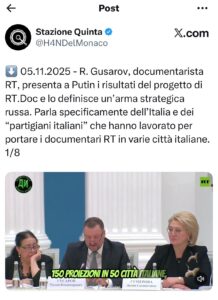
2) an excellent propaganda tool that Putin uses in Russia, showing Italian peace demonstrations on the state-run TV channel RT.
But above all, the key message isthat Ukraine ‘has already lost’ and Russia is winning – which is not the case – and that by moving closer to Putin we could gain peace of mind and economic benefits (e.g. the purchase of Russian gas, which is cheaper than American gas).
Below, amongst other points, you will find the threats made against Carlo Calenda in late June 2026, and an advert that appeared some time ago claiming that Russia was not our enemy: how can these two things be reconciled? Especially as two spies working for Russia have just been arrested in Rome.
And the fact that Carlo Messina, CEO of Banca Intesa, is ‘against the war’ does not seem to be a coincidence, given that he was decorated by Putin.
Expanding on my opening remarks, I would like to reiterate thatwhilst Italy is a member of NATO and supports Ukraine – with funds, weapons and diplomatic support – an organised network is operating within the country with Moscow’s direct backing, disseminating material produced by a broadcaster banned under European law, and finding a platform in the country’s main media outlets.
This is unacceptable because it is not a ‘different’ opinion but hostile propaganda, which undermines our sovereignty.
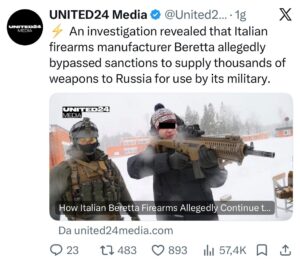
Then there are very serious issues, such as the possible circumvention of sanctions by the arms manufacturer Fratelli Beretta, which confirm that Italy is the ‘soft underbelly’ of this Europe: ..According to documents cited by The Insider, Pietro Gussalli Beretta, CEO of Beretta Holding, personally served on the board of directors of the Russian import company LLC Russkiy Orel during 2022. Even after the start of the Russian invasion of Ukraine, the company received more than 3,900 European-made firearms.
From March 2022 to February 2024, Russian importers registered at least 15,337 Western firearms, according to the investigation.
Almost 40 per cent of these – 6,064 firearms – were manufactured by companies within the Beretta Holding group, including Benelli Armi, Fabbrica D’Armi Pietro Beretta, Beretta Benelli Iberica, Sako Limited and Stoeger Silah Sanayi…
If it is any consolation, we are not the only country where this destabilisation is taking place:
– In the UK, Brexit continues to cause political instability
– In Germany, the AfD is on the verge of becoming the largest party
– In France, there is a possibility that the extremes – the RN and Melenchon – could reach the second round in the upcoming elections. The right is backed by Vincent Bolloré, a far-right businessman who owns a major media group: on 10 June 2026, JDNews – the Bolloré group’s weekly magazine – featured four pro-Russian French figures. “The call to action”, the newspaper, editorials and interviews sympathetic to Vladimir Putin, take centre stage. Behind the apparent promotion of “peace”, Henri Guaino, Philippe de Villiers, Nicolas Dupont-Aignan and Luc Ferry vaguely call for Ukraine – which has been at war since 2022 – to surrender. The cover has sparked outrage, but it could have been far more controversial. The former head of RT France, Xenia Fedorova, who features in Bolloré’s media outlets, was initially due to appear in one of the issues alongside the founder of Puy du Fou…
The only positive aspect is that Le Pen and Bardella – like Melenchon – no longer wish to leave the EU (the popular movement was called ‘Frexit’ a few years ago).
The major difference between the two countries is that the propagandist Xenia Fedorova will be expelled from France, whilst here, openly pro-Putin commentators continue to appear freely as pundits every evening, mainly on Urbano Cairo’s La7.


