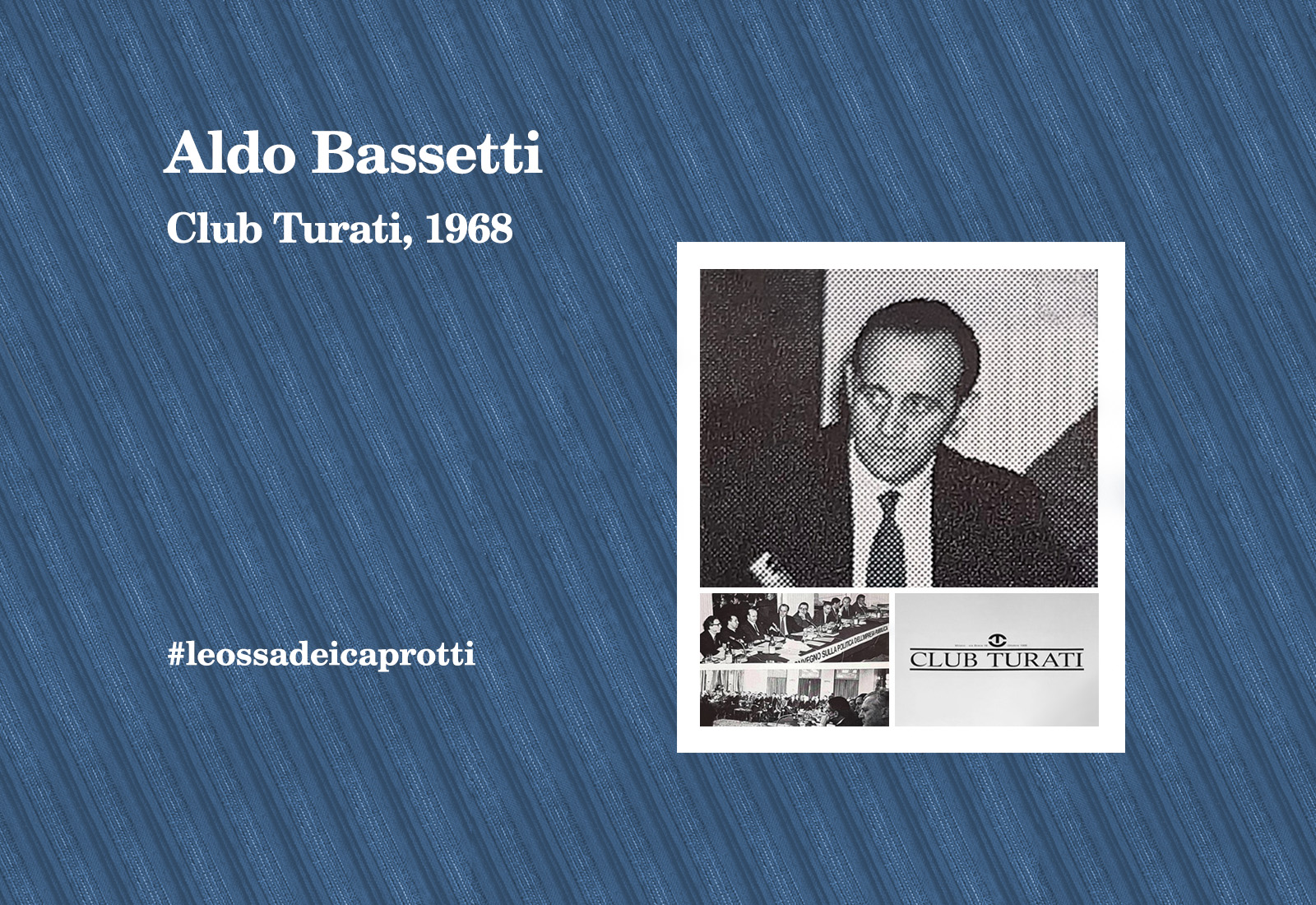
The Circolo culturale (later Club) Turati (Turati Cultural Club) was founded in 1961 through the merger of the Centro studi Filippo Turati (Filippo Turati Study Centre) with the CERES – Centro per le ricerche economiche e sociali (Centre for Economic and Social Research). Chaired by former minister Ezio Vigorelli, it had a board of directors that ‘attempted to reflect the various souls of the Milanese left’, made up of Aldo Bassetti, Alessandro Bodrero, Giangiacomo Feltrinelli, Paolo Grassi, Giovanni Mosca (…), Vittorio Olcese and Eugenio Scalfari (the latter, among other things, in those very years entered into partnership with Bassetti and others to save the weekly ‘L’Espresso’).
Bassetti explained his support for the Turati as follows: ‘We did the Turati because the Socialist Party had no cultural structures, to give documentation to its men in the Commune. But we did not want the Turati to be a dépendance of the PSI. We weren’t socialists, we were a lay group willing to take on a new policy‘. Bassetti and Feltrinelli took on the running costs of the club. (SCIROCCO, ‘Le fiaccole di Prometeo’, pp. 155-156).
One can see from this sentence a trait of Bassetti’s personality, of his total and enthusiastic commitment in every field of life in which he engaged, not least politics. Totally left-wing oriented, a convinced anticlerical, he was however a man of discussion, of sharing ideas and sentiments that went beyond labels. Wherever there was a ferment of culture, of debate, a ‘magic of doing’, one might say, he was there and spared no time or resources to make this magic become as real as possible.
Bassetti left the Club in the early 1970s, together with Olcese, ‘polemic towards the new direction given to the club by Carlo Ripa di Meana – secretary from 1967 to 1969 – and his successor Umberto Dragone’(Ibid., p. 169-170.).
A summary of Bassetti’s intense adventure in the Turati Club – and of what he and several other entrepreneurs of the second half of the 20th century were for the Italian economy, society and culture – is in the recollection written by Bruno Pellegrino, politician, journalist, sculptor and painter, and himself president of the Club:
Farewells. As we were. Aldo Bassetti. Yesterday afternoon the last of the ‘young lions’ of Milanese entrepreneurship in the 1950s/60s left us. A patrol of enterprising, progressive business leaders with a passion for the debate of ideas and its venues, the development of a new book and newspaper publishing industry, and a love of the arts and design. Aldo Bassetti, together with Vittorio Olcese, Roberto Olivetti, Carlo Carla, Piero Stucchi Prinetti and a number of intellectuals such as Paolo Grassi, Armando and Roberto Guiducci, Franco Momigliano and Alessandro Pizzorno, had set up the Circolo, later Club Turati . They wanted to feed the nascent centre-left governments with ideas and projects. They closed a world that for many was very distant, for me sentimentally very close. I owe to them the privilege of having been able to lead Club Turati, like Armanda Guiducci, Carlo Ripa di Meana and Umberto Dragone before me. Thank you Aldo, there will be no lack of occasions and thoughts to recall that season of life, of Milan, of culture, to which you contributed so much. Have a good rest.” (B. PELLEGRINO, The Farewells).
Bibliography:
Self-portrait of Bruno Pellegrino(https://www.brunopellegrino.it/autoritratto-di-bruno-pellegrino/ ).
B. PELLEGRINO, Gli addii, Ricordo di Aldo Bassetti, Facebook post, 10 December 2022 [sic](https://www.facebook.com/bruno.pellegrino.92 ).
G. SCIROCCO, Le fiaccole di Prometeo. Circoli politico-culturali e centro-sinistra a Milano (1957-1969), in Milano. The 1960s. Dagli esordi del centro-sinistra alla contestazione, edited by C.G. Lacaita and M. Punzo, Manduria, 2005, pp. 131-171.
G. CAPROTTI, Le Ossa dei Caprotti. Giorgina Venosta and Aldo Bassetti, from the 1960s to 2021. Cues from the book(https://www.giuseppecaprotti.it/libro/giorgina-venosta-e-aldo-bassetti-dagli-anni60-al-2021/ ).