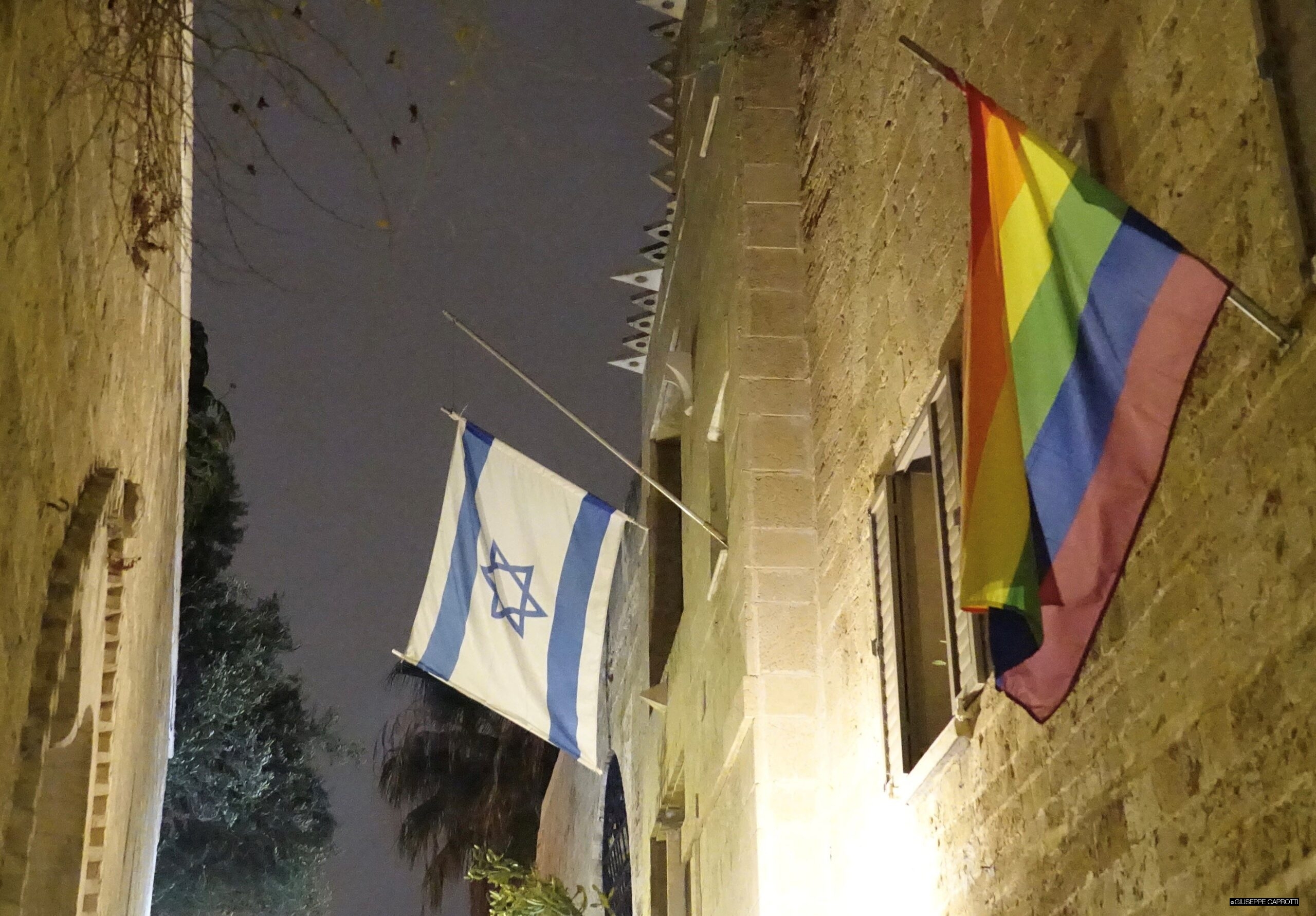
Written on 2 October 2024, updated on 20 May 2026
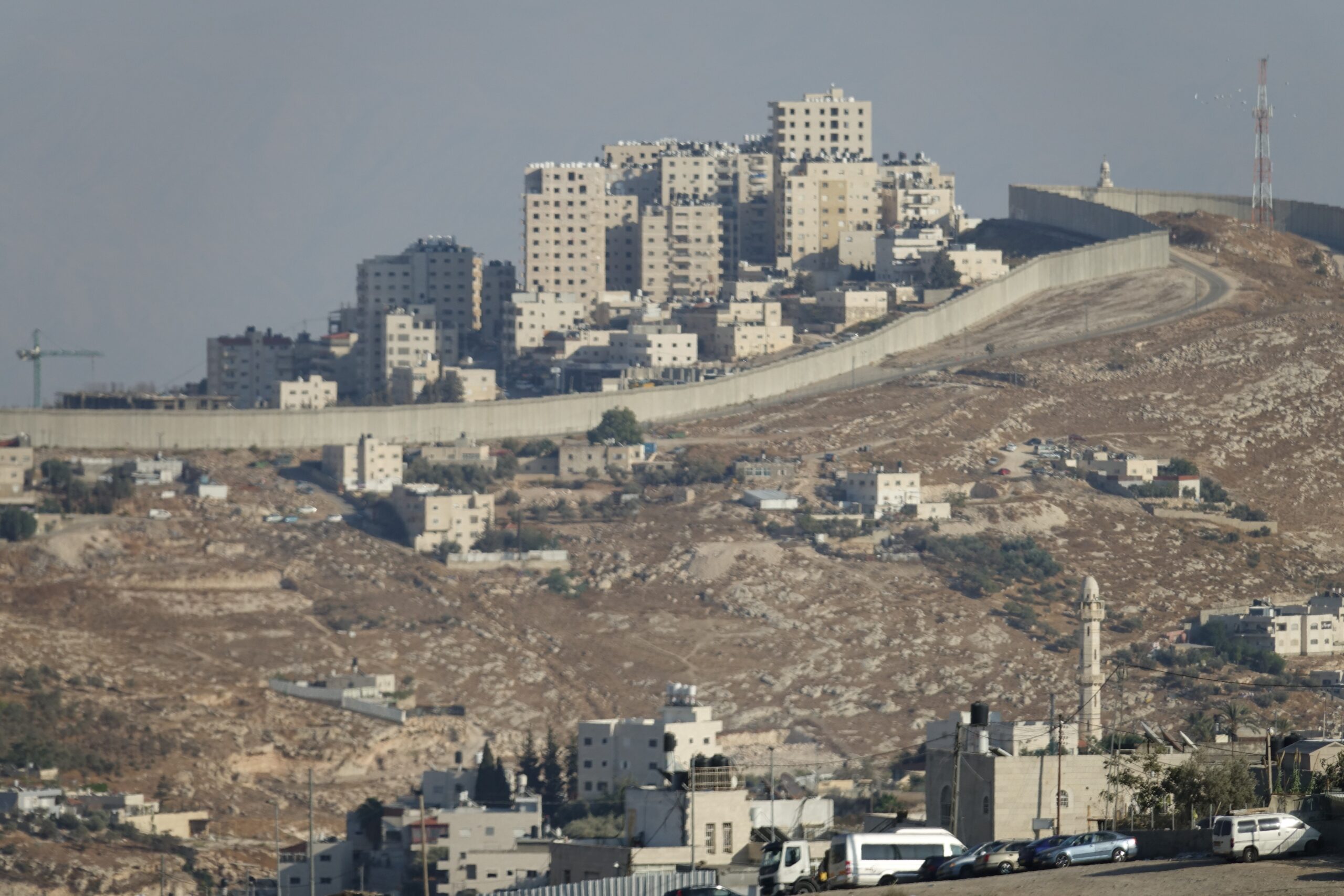
Beneath the wall in the West Bank, which I photographed in 2019: this is “a system of physical barriers built by Israel in the West Bank from spring 2002 onwards.
It stretches along a controversial 730 km route that has been redrawn several times due to international pressure and consists, along its entire length, of alternating sections of wall and barbed wire fencing with electronic gates”.
I first heard about it from Daniel Barenboim at the Teatro Franco Parenti in Milan, years ago.
Barenboim had set up a mixed orchestra of Israelis and Palestinians.
David Grossman is one of Israel’s greatest writers; he lost his 20-year-old son in Lebanon during the 2006 war against Hezbollah. He is the author of *More Than I Love My Life* and winner of the 2017 Man Booker International Prize and the 2018 Israel Prize. Article translated by Alessandra Sgarbi
Around 1,000 dead, more than 3,000 wounded, dozens of people taken hostage. Every survivor is a miraculous story of resourcefulness and courage. Countless miracles, countless acts of heroism and sacrifice by soldiers and civilians. I look at people’s faces and see the shock. Numbness. Our hearts are weighed down by a constant burden. Time and again we tell ourselves: it is a nightmare. A nightmare beyond compare. There are no words to describe it. There are no words to contain it.
I also see a deep sense of betrayal. The betrayal of citizens by their government, by the Prime Minister and his destructive coalition. A betrayal of everything we hold dear as citizens, and in particular as citizens of this State. A betrayal of its founding and binding principle. Of the most precious trust of all – the national home of the Jewish people – which was entrusted to its leaders for safekeeping, and which they were supposed to treat with reverence. Instead, what have we seen? What have we become accustomed to seeing, as if it were inevitable?
What we have seen is the total abandonment of the State in favour of petty, greedy agendas and a cynical, narrow-minded and delusional politics. What is happening now is the tangible price Israel is paying for having been seduced for years by a corrupt leadership that has led it from bad to worse; that has eroded its institutions of law and justice, its army and its education system; a leadership that was prepared to put the country in existential danger just to keep its prime minister out of prison. I also see a profound sense of betrayal. The betrayal of the citizens by their government, by the Prime Minister and his destructive coalition. Just think now of the man with whom we have collaborated for years. Think of all the energy, thought and money we have wasted watching Netanyahu and his family act out their Ceaușescu-style dramas. Think of the grotesque illusions they conjured up before our incredulous eyes.
Over the past nine months, millions of Israelis have taken to the streets every week to protest against the government and the man at its helm. It has been a movement of immense significance, an attempt to steer Israel back onto the right path, towards the noble ideal that underpins its very existence: to create a home for the Jewish people. And not just any home. Millions of Israelis wanted to build a liberal, democratic, peace-loving state that respected the faiths of all peoples. But instead of listening to what the protest movement had to offer, Netanyahu chose to discredit it, to portray it as treasonous, to incite against it, and to deepen the hatred amongst its supporters. Yet he seized every opportunity to declare just how powerful Israel was, how determined it was and, above all, how well prepared it was to face any threat. Tell that to the parents driven mad with grief, to the child thrown onto the roadside. Tell that to the hostages. Tell that to the people who voted for you. Tell that to the 80 breaches in the world’s most advanced border fence.
But do not be deceived, and do not be confused: for all the fury directed at Netanyahu, his people and his policies, the horror of these past few days was not caused by Israel. It was carried out by Hamas. The occupation is a crime, but shooting hundreds of civilians – children and parents, the elderly and the sick – in cold blood is a worse crime. Even in the hierarchy of evil, there is a ‘ranking’. There is a scale of severity that common sense and natural instincts can recognise. And when you see the killing fields at the music festival site, when you see Hamas terrorists on motorbikes chasing young revellers, some of whom are still dancing, unaware of what is happening….
I do not know whether Hamas operatives should be called ‘animals’, but they have undoubtedly lost their humanity.
We move through these nights and days like sleepwalkers. Trying to resist the temptation to watch the horrific clips and listen to the voices. Feeling the fear creeping in amongst those who, for the first time in 50 years – since the Yom Kippur War – are experiencing the terrifying prospect of defeat. Who will we be when we rise from the ashes and return to our lives? When we feel, deep in our bones, the pain of the words of the writer Haim Gouri, written during the 1948 Arab-Israeli War: ‘How many there are who are no longer with us’. Who will we be, and what sort of human beings will we become, after having seen what we have seen? Where shall we begin after the destruction and loss of so many things in which we believed and on which we relied? I pray that there are Palestinians in the West Bank who, despite their hatred for Israel – their occupier – will distance themselves from what their compatriots have done. If I may venture a hypothesis: post-war Israel will be far more right-wing, militant and racist. The war that has been imposed upon it will have cemented the most extreme and hateful stereotypes and prejudices that define – and will continue to define even more firmly – Israeli identity. And from now on, that identity will also embody the trauma of October 2023, as well as the polarisation and internal division. Is it possible that what was lost – or put on indefinite hold – on 7 October was the tiny possibility of genuine dialogue, of each nation truly accepting the other’s existence? And what do those who brandished the absurd notion of a ‘binational state’ have to say now? Israel and Palestine, two nations distorted and corrupted by endless wars, cannot even be cousins to one another – does anyone still believe they could be Siamese twins? Many years without war will have to pass before acceptance and healing can even be considered. In the meantime, we can only imagine the extent of the fear and hatred that will now rise to the surface. I hope, I pray, that there are Palestinians in the West Bank who, despite their hatred for Israel – their occupier – will set themselves apart, both in deed and in word, from what their compatriots have done. As an Israeli, I have no right to lecture them or tell them what to do. But as a human being, I have the right – and the duty – to demand that they behave in a humane and moral manner.
Towards the end of last month, the leaders of the United States, Israel and Saudi Arabia spoke enthusiastically about a peace agreement between Israel and the Saudis, which would be based on Israel’s normalisation agreements with Morocco and the United Arab Emirates. The Palestinians are barely mentioned in these agreements. Netanyahu, arrogant and self-assured, has succeeded – in his own words – in severing the link between the Palestinian issue and Israel’s relations with the Arab states. The Israeli-Saudi agreement is not unrelated to the events of ‘Black Saturday’ between Gaza and Israel. The peace it would have created is a peace for the rich. It is an attempt to sidestep the heart of the conflict.
These past few days have shown that it is impossible to begin resolving the Middle Eastern tragedy without offering a solution that alleviates the suffering of the Palestinians. Are we capable of shaking off the now-worn-out clichés and realising that what has happened here is too immense and too terrible to be viewed through stale paradigms? Even Israel’s conduct and its crimes in the territories it has occupied for 56 years cannot justify or soften what has been laid bare: the depth of hatred towards Israel, the painful realisation that we Israelis will always have to live here on high alert and in constant preparation for war. In a ceaseless effort to be both Athens and Sparta at the same time. And a fundamental doubt as to whether we will ever be able to lead a normal, free life, free from threats and anxieties. A stable and secure life. A life that feels like home.
Unfortunately, perhaps Israel was ‘home’ for Israelis, but somewhat less so for Palestinians, as demonstrated by the wall I saw with my own eyes in 2019.
Perhaps the only chance for lasting peace in the Middle East is, as Omer Mei Wellber writes in *La Repubblica* on 19 May 2024, “a future without Hamas and without Netanyahu”.
Read more on this: Israel’s tragic mistakes, for the sake of Israel, or Etgar Keret ’s perspective below.
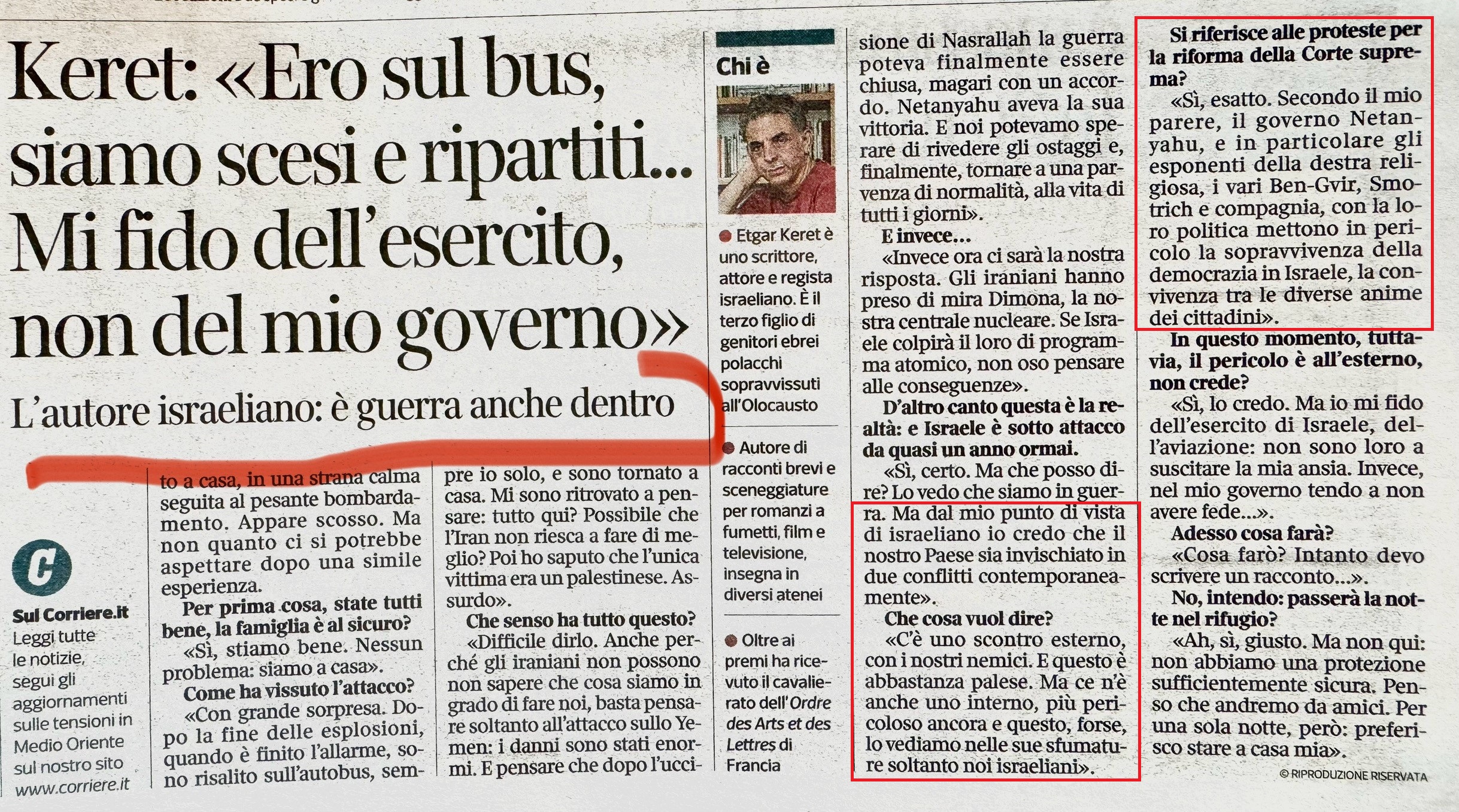
Professor Emeritus Daniel Bar-Tal of Tel Aviv University, in his extensive book*The Trap of Intractable Conflicts*(2024), explains Keret’s points even more clearly and states that: “the forces that led Israel to expand Jewish settlements in the West Bank, beyond the internationally recognised borders of the state. He explains how the psychology of occupation and the ideas underpinning it have corrupted Israeli Jewish society to the point of derailing its democratic development, with the rise of an authoritarian regime characterised by extremist nationalism and religious fanaticism, which were among the causes of the Gaza war…”.
Meanwhile: ‘After eighteen months, they are literally living in hell’: in Israel, the hostage issue is a slow-acting poison within society. In a wounded country, the stories of freed hostages rekindle the wounds and anger – even hatred – day after day, helping to explain why no genuine debate is emerging on the proportionality of Israel’s response in Gaza.
I obviously agree with Grossman when he says: “The children of Gaza need hope for the future. It is our duty to give it back to them”
I recall – as I mentioned at the beginning – that his son Uri, aged 20, a conscript in 2006, was killed by an anti-tank missile during an Israeli Defence Forces operation in southern Lebanon.
The reservists’ anti-Bibi revolt: ‘A personal war in Gaza’
The Prime Minister mocks them: pensioners
JERUSALEM
He calls them ‘pensioners’, yet they are among the few Israeli soldiers unable to wear their insignia in public, such is the clandestine and secret nature of Sayeret Matkal’s operations. They do not need to recognise one another when it comes to signing a letter in support of what they believe in, in defence of the state for which they have fought and which, they warn, Benjamin Netanyahu is trying to subvert.
At least 1,500 special forces veterans — including members of the Shaldag unit, comparable to the American SEALs — have signed a letter calling for an end to the war against Hamas in Gaza because — they argue — it no longer has the objective of bringing the hostages home: 59 are still being held by the terrorists, and only 22 are believed to still be alive. ‘The fighting continues for personal and political interests.’
Among those who have given their full names, and some who have provided only their initials for security reasons, the list stretches back through the generations to Ehud Barak, the most highly decorated soldier in Israeli history, who served as Bibi’s commander in the Sayeret Matkal before becoming his political opponent as a Labour leader and, during these months of protests, one of his most lucid critics. Many of the ‘retirees’ are in fact still on active duty, accounting for at least 16 per cent of the elite units. They thus explain that they are not encouraging desertion, and confirm that they respect the General Staff’s call to arms. However, they endorse the passages in the document published a week ago by the reserve fighter pilots: ‘The offensive no longer contributes to its stated objectives; it will lead to the deaths of the hostages, military personnel and innocent civilians’…
The far right is attempting to downplay the scale of the rebellion within the armed forces and the secret services (even former Mossad chiefs are joining the opposition), just as it had done when reserve officers took part in the January 2023 demonstrations against the government’s anti-democratic justice plan – protests that lasted ten months until the massacres of 7 October, when 1,200 Israelis were killed by Hamas paramilitaries…
On 10 June 2025, the Financial Times wrote: ‘In recent weeks, something has changed.’
The main Israeli media outlets are showing, albeit in short clips, the human toll in Gaza. Some politicians are questioning whether Israel is still fighting a just war. And on the fringes of the hostage protests, anti-war activists are holding vigils for the dead in Palestine. Their numbers have grown from a handful to hundreds, and on Saturday they marched with candles and pictures of dead children in a silent procession..
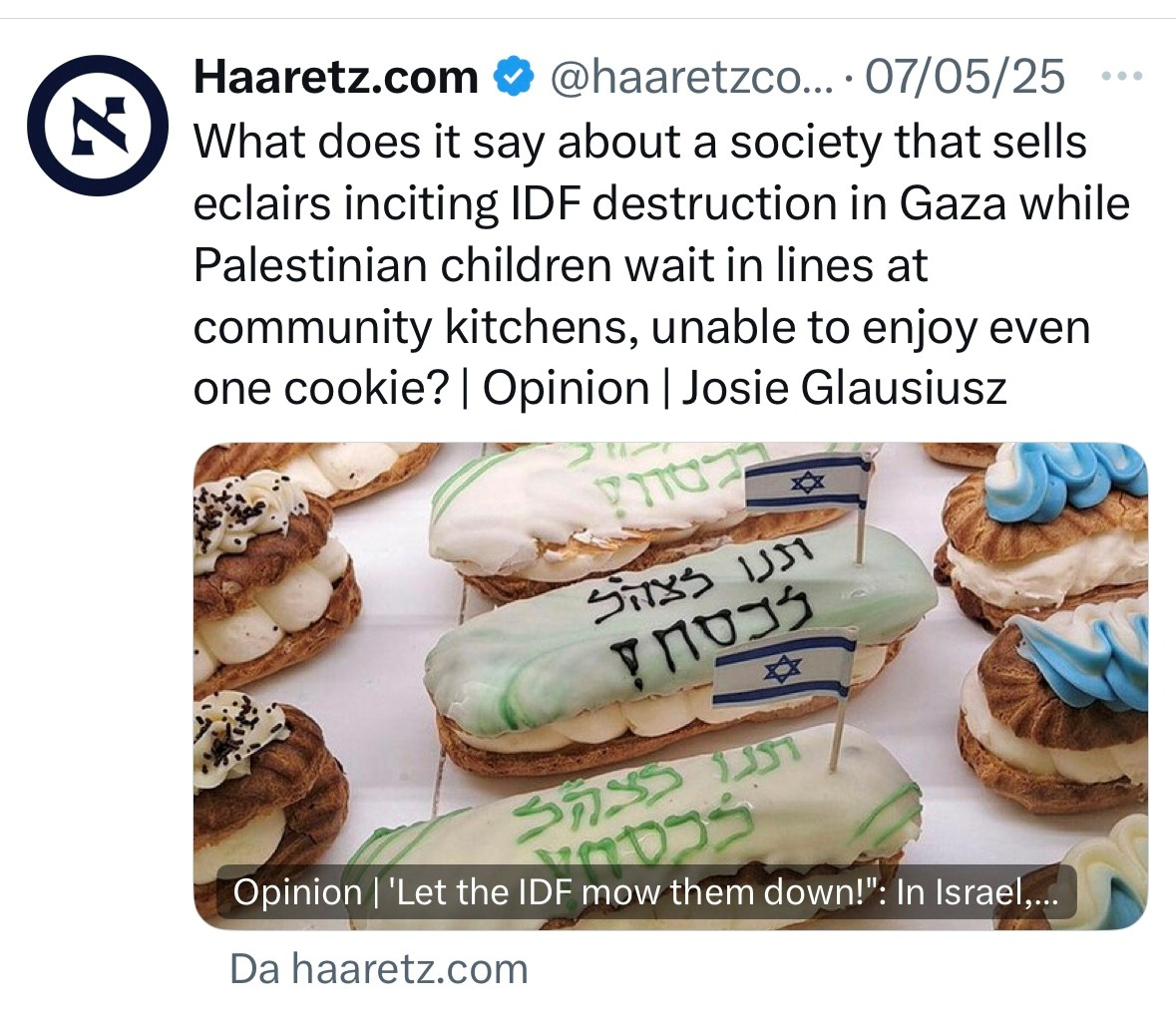
Below: a post by Haaretz against the war in Gaza which, in summary, asks, ‘How can you sell sweets that incite destruction in Gaza when Palestinian children don’t even have a biscuit?’
But on 22 July 2025, in the *Corriere della Sera*, the Israeli writer Etgar Keret denounced the‘moralabyss’ into which his country had fallen:
‘There are days when the sincere hope that the hostages will return soon sustains us, and others when it does not. There are days when soldiers die, and others when they do not. There are days when it seems the government is on the verge of collapsing, others when it seems it will continue to oppress us forever. But one thing remains constant: every day for the past four months, a two- or three-digit number of Palestinians have died in Gaza: on the days that were the happiest for us Israelis, on the days that were the saddest for us, whilst we were mourning a fallen soldier and whilst we were laughing at a TV programme, whilst we were setting off for Greece and whilst we were stranded at the airport unable to return home because of the war, when the conscription notice arrived and when we came down with the flu. On each of those days, less than two hours’ journey from home, children, men and women were dying, and their deaths are described as ‘collateral damage’.»
«Every night, as we close our eyes, not far away, people we didn’t know stop breathing. Entire families. (…) These deaths do not move mountains; they do not make the news in Israel; they are not acknowledged, are scarcely reported, yet they are constant, arbitrary, devastating and senseless. The ever-growing pile of Gazan corpses marks, like a metronome, the dwindling time for the hostages, the future announcements of fallen Israeli soldiers, but above all it stands there to remind us of the moral abyss into which we have fallen. An abyss in which the deaths of tens, hundreds of human beings have become routine’.
Read also: Siege syndrome. The Israeli right’s compressed-airhatred has reached us here too (30 April 2026).
Below: That icing on the cake, with Israel losing its soul day after day (3 May 2026)