

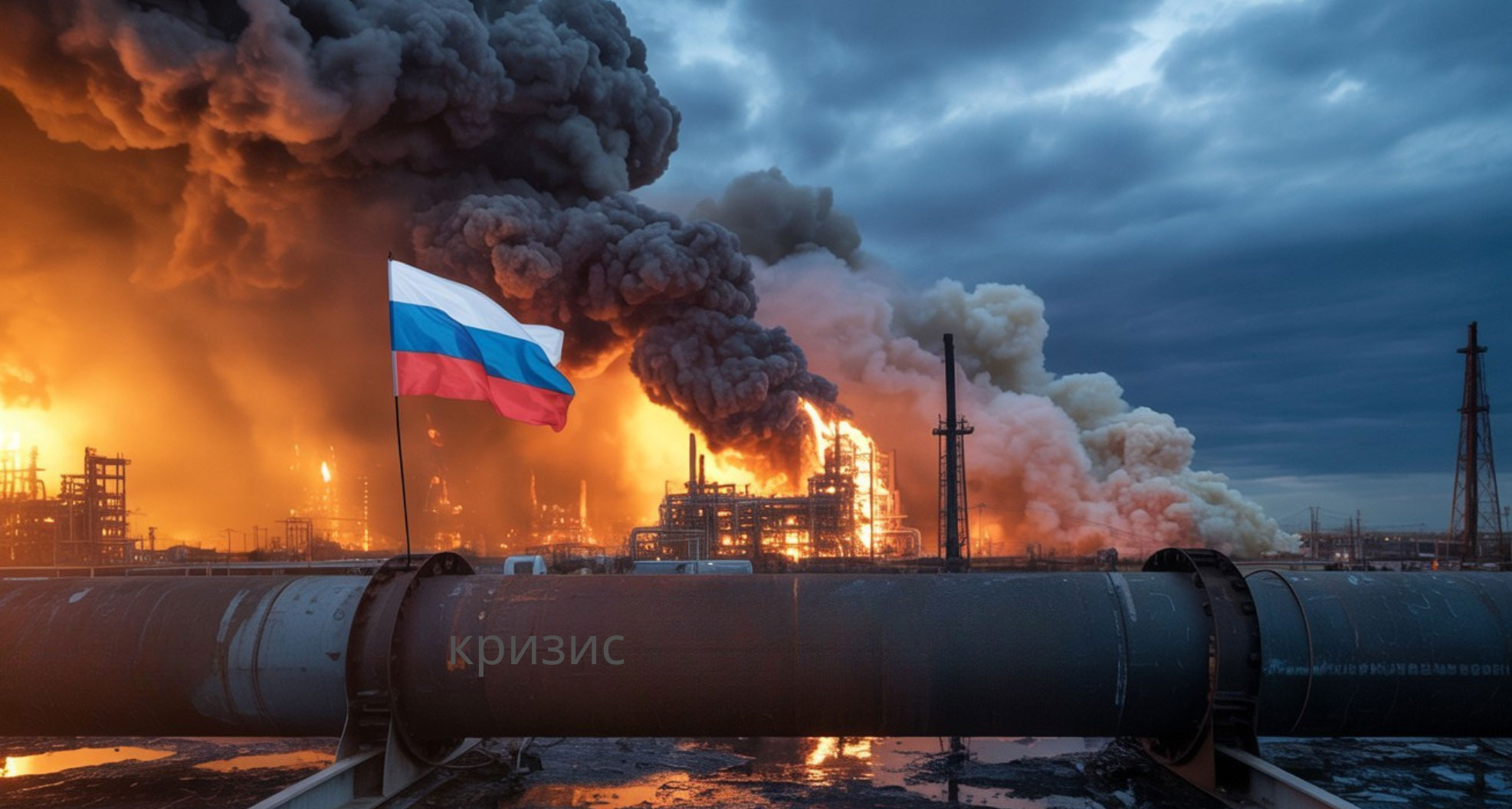
Compiled 2 September 2025, updated 17 April 2026
We start with these assumptions:
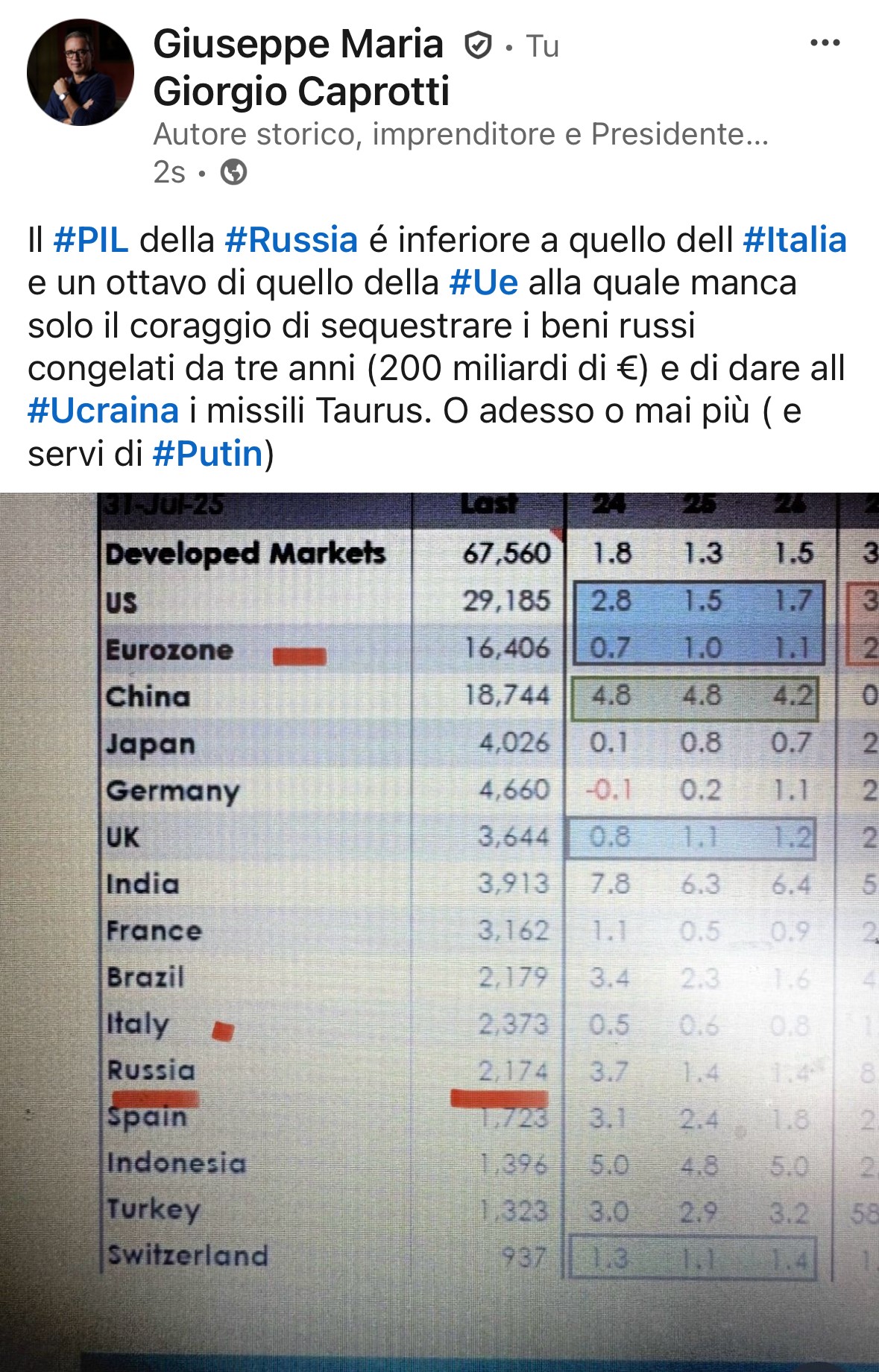
1) Italy’s GDP is higher than Russia’s.
And that of the Russian federation is eight times less than that of the European Union.
It is now a war economy, where some primary goods such as butter or potatoes may be in short supply.
2) Hit by falling oil revenues and Western sanctions, Russia’s growth is slowing down and its budget deficit has exploded.
Why the Russian economy is starting to fail
By Marie Jégo and Benjamin Quénelle
The war in Ukraine is starting to take its toll on the Russian economy, which is facing a severe slowdown due to falling oil revenues and Western sanctions. It is ‘on the verge of recession ‘, Economy Minister Maxim Rechetnikov acknowledged at the St. Petersburg forum, the ‘Russian Davos’, in June.
This remark was immediately refuted by Vladimir Putin, who was quick to praise Russia’s resilience in the face of sanctions. But the numbers do not lie. In July, the International Monetary Fund cut the country’s growth forecast from 1.5% to 0.9% for 2025. This is a far cry from the staggering 4% growth rates achieved in 2023 and 2024, when the state had devoted all its financial resources to the war.
Another worrying sign is the explosion of the budget deficit, which reached 4.9 trillion roubles (around EUR 56 billion) at the end of July, according to the Ministry of Finance, exceeding the government’s annual target by 30%. The economic slowdown, declining oil and gas revenues, and also the dwindling reserve funds, virtually exhausted by three years of war, are a new reality: there will be cuts. The Ministry of Finance will have a hard time cutting defence and security, which account for just over 40% of spending. The government will therefore have to reduce social security contributions, but also support for civil industries.
Exporting at bargain prices
While overall budgetary expenditure increases (20.8% in one year), revenue decreases. Thus, revenues from the sale of oil and gas, which account for about one third of federal revenues, fell by 18.5% in the first seven months of the year. The reason for this is the price of a barrel of oil, which tends to fall on the world market ($66.40 at the beginning of August, equivalent to about EUR 51.80), with the price of Russian crude oil tending to fall more sharply due to the $47.60 ceiling imposed as part of the 18th sanctions package recently adopted by the European Union. Faced with the West’s refusal to buy its oil, Russia has redirected its sales to China, India and Turkey, but it exports at rock-bottom prices and getting around the sanctions is costly for producers, who are forced to multiply the number of intermediaries.
For now, life in Moscow and other medium-sized cities of the Russian Federation remains attractive, with restaurants, theatres and luxury shops crowded, but a combination of factors – falling revenues, high interest rates and persistent inflation – indicates that the economy is in crisis. While the defence industry, fuelled by state contracts, ‘runs like a Swiss watch ‘, according to Sergei Aleksashenko, former vice-president of the Russian Central Bank (1995-1998), the civil sector is struggling.
In the first seven months of 2025, entire sectors of the civil economy – metallurgy, mining, construction and the automotive industry – saw their output decline. In the metallurgical sector, MMK, the Magnitogorsk Combine, one of the world’s largest steel producers and a leader in Russian ferrous metallurgy, reduced its output by 18% in the second quarter. In the January-June period, its net profit plummeted by 88.8% compared to the same period in 2024.
The coal industry is in dire straits: production is down, export earnings are down and debts are rising. Even the largest companies are in the red. The net loss for the entire industry in 2025 could reach between 300 and 350 billion roubles (over 3 billion euro), warned Dmitry Lopatkin, deputy director of the coal industry department of the Ministry of Energy. As a direct consequence of the war and sanctions, this sector is struggling to compensate for the loss of European markets, for which it was one of the main suppliers. Refocusing on the Asian market, where competition is fiercer, particularly from Australia, Indonesia and South Africa, is no easy task.
The use of ‘cannibalisation
Especially since China, Moscow’s largest trading partner, increased its imports by 14% in 2024, but reduced its supplies from Russia by 7%. Finally, sanctions have made it difficult for Russian companies to access equipment and components from Europe, the US and Japan, which they traditionally used. Since they have not overcome their dependence on Western equipment, they are forced to resort to ‘cannibalisation’, i.e. the dismantling of several units to assemble a single, functioning one.
The automotive industry is also particularly affected. In the first half of the year, car production fell by 28%, truck production by 40%, and several factories will switch to a four-day working week. This is the case with the truck manufacturer KamAZ, the car factories Avtovaz and GAZ, and the tractor plants in Chelyabinsk and St. Petersburg. This reduction in working hours will lead to a 20% drop in wages for the workers and employees of the factories concerned, contributing to a reduction in consumption (In 2026, a heavy signal comes from the ‘humble’ cucumbers, a familiar food on all Russian tables, which have seen their price double since December 2025).
For months, industrialists and bankers have been calling for a reduction in the Russian Central Bank‘s reference interest rate, which has been kept high to combat inflation, estimated at 10%. For businesses and households, this means being able to resort to consumer loans and borrowing again. On 25 July, the institution lowered the reference interest rate from 20% to 18%, which is insufficient to stimulate credit. With such high rates, companies can hardly borrow for investments. In July, Alexei Krapivin, CEO of construction giant Natsproektstroy, stated that many companies are unable to sustain their ongoing projects or honour their debts. More than 55% of the loans granted to companies are variable-rate and, with interest rates remaining high, many companies find themselves in a pre-default situation.
toxic mix
In addition, banks are concerned about the rapid growth of outstanding debts. From the beginning of 2022 to May 2025, corporate debt to banks almost doubled. At the end of June, Bloomberg, citing banking sources, sounded the alarm about the growing risks of a systemic banking crisis. Banks have been lending at low interest rates to support the Kremlin’s war effort and are now threatened by ‘bad loans ‘. Almost half, or 48, of Russia’s 100 largest banks saw their financial results deteriorate in the first half of the year compared to 2024. Fifteen of these were loss-making.
Having full access to the banking system’s data, I can confidently say that fears of a banking crisis are unfounded,” reassured Elvira Nabiullina, Russia’s central bank governor, on 3 July …
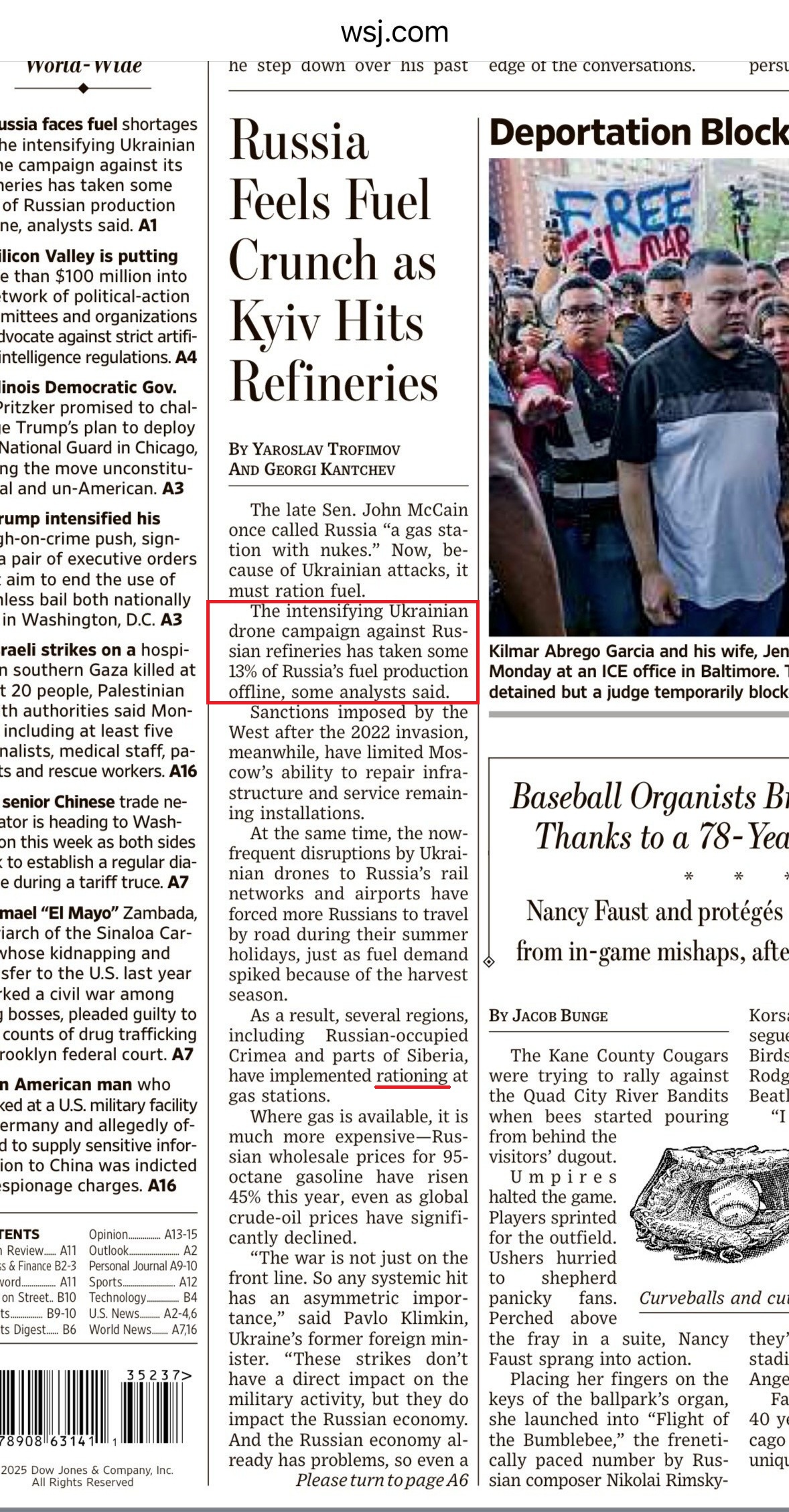
but this cue from Le Monde does not take into account the war and the Ukrainians’ latest move: the attacks on refineries, which according to The Wall Street Journal have severely reduced Russia’s production capacity leading to gasoline rationing.
The US newspaper speaks of 13% while The Courier speaks of 17%.
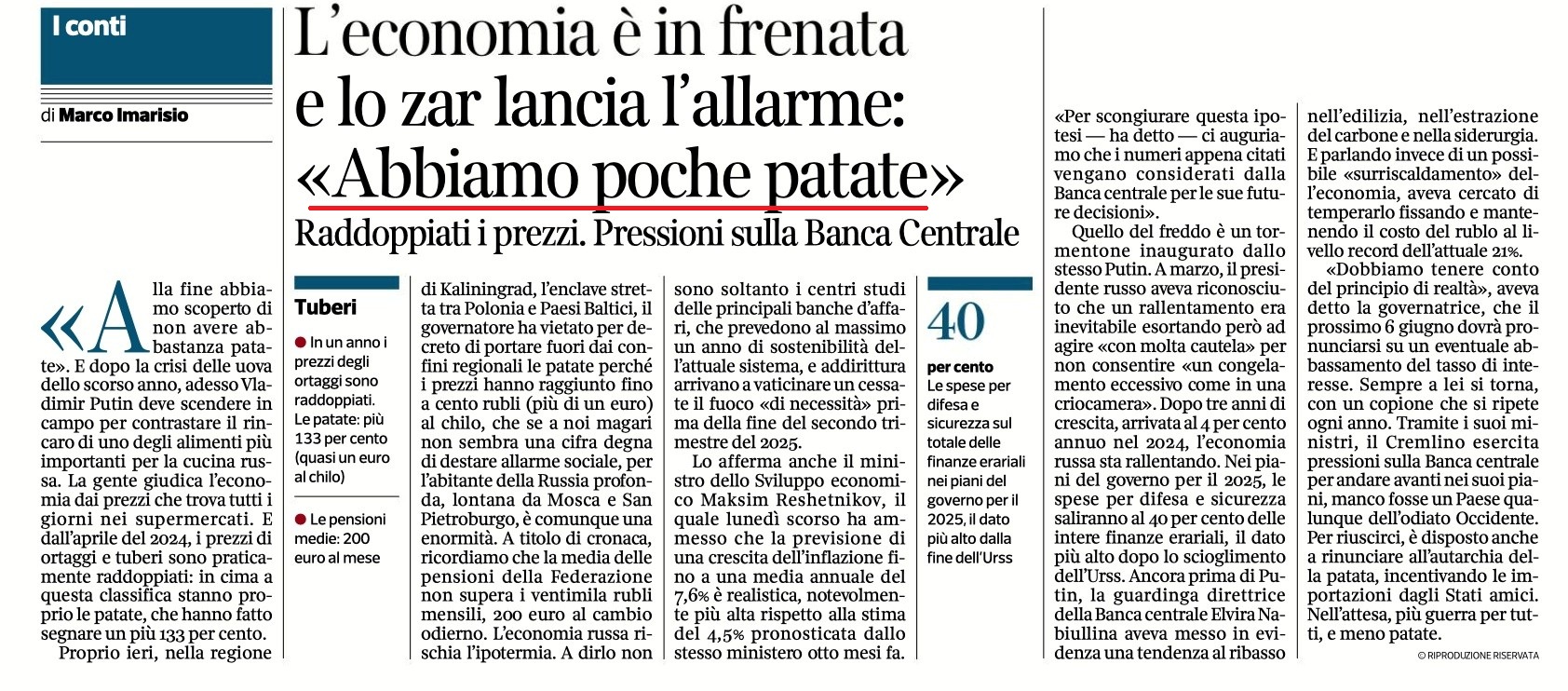
Below: potato shortage in May 2025, now there is talk of monstrous price increases for cucumbers. Both are staples of the Russians’ daily diet.
And Repubblica confirms the difficulties:
The price of fuel on the domestic market has reached all-time highs and several petrol stations have already run out of fuel, especially in Crimea and Siberia, where queues of motorists at the pumps and price increases of up to 50 per cent are reported. Analysts at Reuters estimate that the bombing has reduced the capacity to process crude oil into petrol and diesel by 17 per cent, at a time of very high demand: the last holiday period is prompting travel, adding to the needs of agricultural vehicles for grain harvesting and demand for winter heating.
The raids are proving more precise and devastating. Engineers in Kiev have perfected the guidance systems of the drones, which carry more explosives thanks to upgraded engines. Russian footage shows the unmanned aircraft hitting the most delicate structures and demolishing them after flights of seven hundred to a thousand kilometres. A year ago, seven to ten days were enough to get them up and running again after the raids: now it is estimated that the repairs will take at least a month, maybe two..
The Ukrainians are not only targeting refineries, they are also targeting the infrastructure that feeds crude oil and gas sales abroad: the resource that keeps the Russian war economy going..
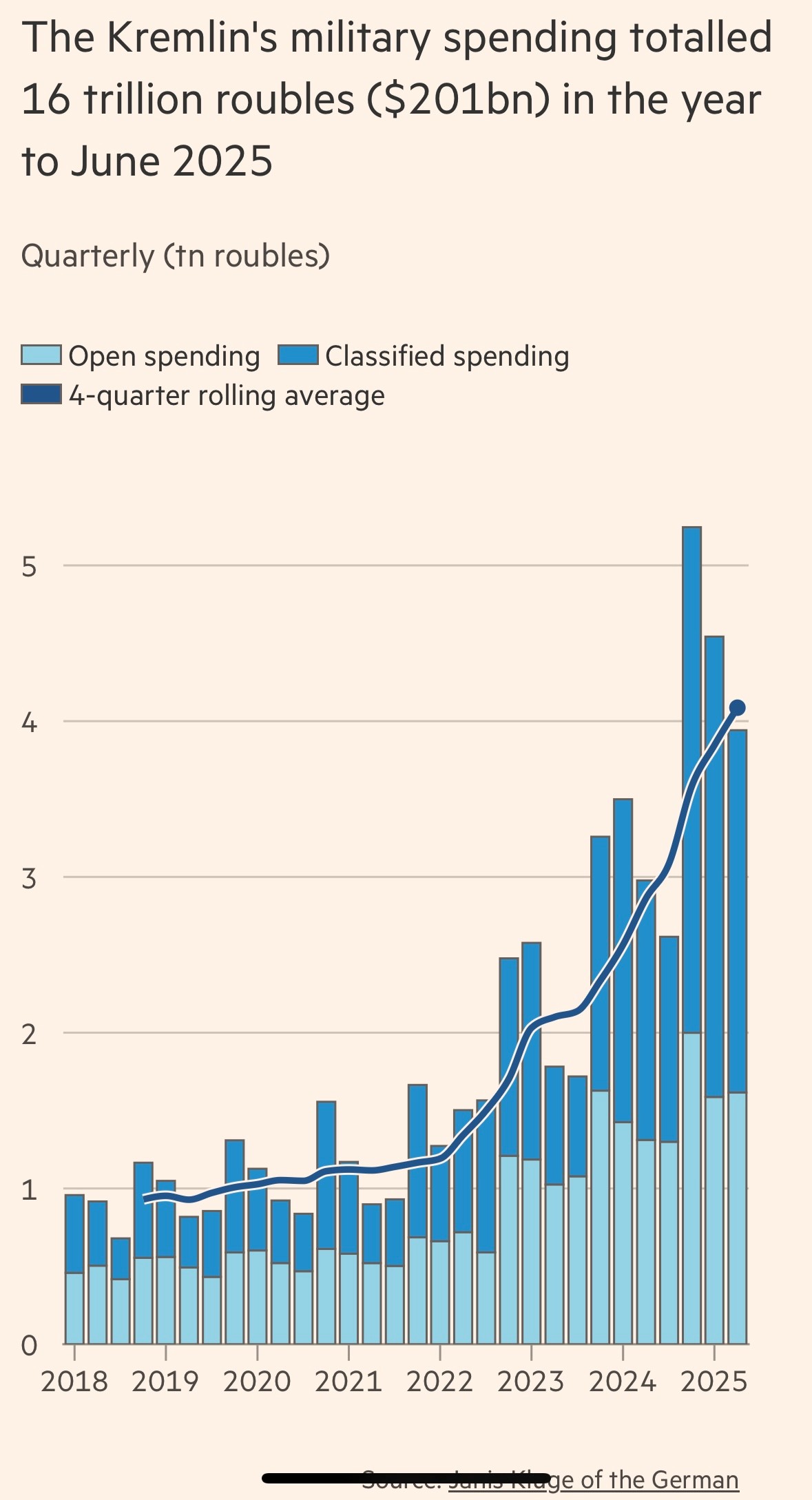
below : Russian military spending (FT September 2025) has exceeded $200 billion over the past 8 years.
The underlying problem is that Trump could have given the final push in the war on Vladimir Putin’s Russia and brought it down but instead decided to remain “Our Man in Washington”: Trump in the hands of the Russians.
P.S.: despite mounting pressure, the Russian authorities have stuck to Joseph Stalin’s Stalin-era ‘all for the front, all for victory’ approach, with wartime spending almost doubling in nominal terms since the start of the full-scale invasion
Thanks to Damiano Paternò
Below: AF’s 16 February 2026 and Le Monde’s April 2026 : Russian GDP at – 1.8% (January and February)


