Compiled on 1 July, updated on 29 September 2025.
“… Simion is proof that the sovereignist’s kit works in many countries of the old Iron Curtain. The script, in Hungary as in Slovakia, in Poland and now in Romania, is the same; victimhood and nostalgia for the good old days, hostility towards the elites, Euroscepticism, opposition to migrants, fierce nationalism, aversion against Ukraine that sometimes becomes manifest subalternity to Putin’s Russia…’.
All true.
But the manipulations of Russian disinformation, which can even go to extreme acts, are missing. Such as sabotage.
Incendiary, Killer, Saboteur, Spy
As Trump courts him, Putin is escalating Russia’s hybrid war against the West
At the end of January, just a week into Donald Trump’s second term as US president, a senior NATO official told members of the European Parliament that Russia’s intensive use of hybrid warfare poses a serious threat to the West. In the hearing, James Appathurai, NATO’s deputy secretary general for innovation, hybrid and cyber, described ‘incidents of sabotage taking place in NATO countries over a period of the last two years’, including train derailments, arson, attacks on infrastructure, and even assassination plots against leading industrialists.
Since Russian President Vladimir Putin launched his full-scale war in Ukraine in 2022, sabotage operations linked to Russian intelligence have been recorded in 15 countries. Speaking to the press after the January hearing, Appathurai said it was time for NATO to switch to a ‘war post’ to deal with these growing attacks…
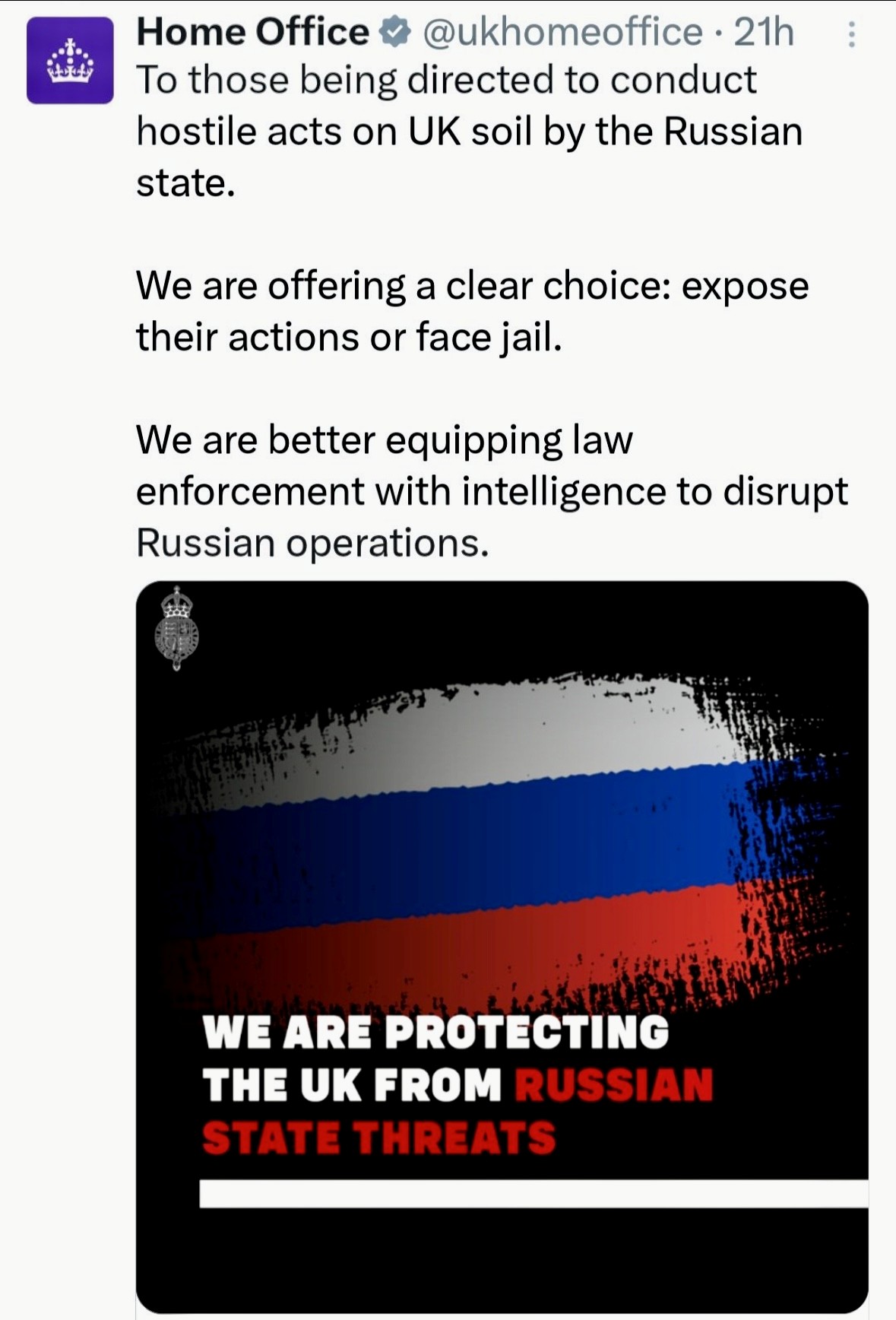
Below: a post by the Home Office, the equivalent of the Italian Ministry of the Interior, against Russia’s ‘hostile acts’ on British soil. Britain, unlike Italy feels at war.
…But any assumption that a Trump-Putin deal will cause the Kremlin’s spies and saboteurs to step back is dangerously wrong. For one thing, their political masters would not allow it. Very few in Moscow’s security establishment believe that lasting peace can be achieved with the US or the wider West. In February, Fyodor Lukyanov, head of research at the Valdai Club, a pro-Kremlin think tank, declared that there is no chance for a ‘second Yalta’ – a comprehensive agreement that would redefine borders and spheres of influence in Europe. And Dmitry Suslov, another prominent Kremlin foreign policy voice, said any thaw in US-Russia relations would be short-lived and unlikely to survive the US mid-term elections in 2026.
At the same time, in Russia’s security services, distrust in US intentions runs deep. For centuries, Russia has seen the West as intent on the subjugation or total destruction of Russia, and Soviet and Russian intelligence services have operated for decades on the assumption that the West is an implacable enemy. For Moscow’s spies, Trump’s courtship of Putin offered an opportunity to expand and strengthen their campaign of subversion in Europe. Given the Trump administration’s scepticism towards NATO and the defence of its transatlantic allies, a US-Russia agreement could increase Moscow’s willingness to launch unconventional attacks in Europe…
… So far, the most brazen operation was Russia’s assassination attempt in spring 2024 on Armin Papperger, the head of Rheinmetall, Germany’s largest arms manufacturer. The plot was thwarted by German and American intelligence services, as Appathurai, the NATO hybrid warfare officer, publicly confirmed in January. In his testimony, Appathurai noted that there were ‘other plots’ against European industry leaders. This threat seems unlikely to go away: in particular, along with other European defence companies, Rheinmetall is likely to play an even larger role in arming Ukraine in a post-agreement future, and its growth projections have increased since the Trump administration came to power…
… In his January testimony, Appathurai also confirmed that Russia recruited ‘criminal gangs or unwitting youths or migrants’ to conduct many of these operations. In March 2024, for example, two British men were arrested for torching a Ukrainian-linked parcel delivery warehouse in east London, an attack that was linked to the paramilitary company Wagner, traditionally a front for the Russian military intelligence agency. One reason for this is that local criminals could be recruited via social media for a one-off job without even knowing who they are working for, making it more difficult to infiltrate Russian citizens in these countries.
In addition to targeting European infrastructure and military logistics, Moscow’s spy agencies may also try to use sabotage operations to influence the political landscape in target countries. In the run-up to the German federal elections in February, for instance, there were a series of attacks on civilians in Germany by Afghans and other immigrants. According to a senior German intelligence official we spoke to shortly before the election, German agencies believed that Russian security agents may have instigated these attacks in order to swell support for the far-right, which opposes German support for Ukraine…
in view of incoming Chancellor Friedrich Merz’s pledge to drastically increase German defence spending and its role in Western security, the Kremlin may have an even greater incentive to try to destabilise the country.
Given the stalemate, the government’s inaction and the heavy reliance on international support, are you afraid that in the coming months we might see a Ukrainian-like scenario in Georgia as well?
No, actually I fear the opposite. What worries me is to see a ‘Georgian scenario’ in Ukraine.
Today Russia has realised that it is no longer necessary to win over countries with weapons: the military intervention in Georgia in 2008 did not work; in Ukraine, despite the enormous tragedy, it did not bring the desired results.
Now they are experimenting in Georgia with an alternative: how to conquer a sovereign country not with tanks, but by manipulating elections, spreading propaganda, using information technology and sophisticated tools of influence. The goal is to elect puppet governments throughthese manipulations, and through them, to take control of the country. This is the ongoing process: they have not yet won because we are resisting. But if it works, we might see the same strategy applied in Moldova soon. And it is a scenario that Putin also openly proposes for Ukraine, talking about the need for ‘democratic elections’ – but under external conditioning…
We strongly condemn the recent imprisonment and detention of Georgian opposition leaders, clearly politically motivated, a few months before local elections. Their detention, as well as the arbitrary arrests and increasing repression of other critics of the Georgian authorities, civil society representatives, peaceful protesters and independent journalists, contribute to the dismantling of democracy in Georgia and the rapid transformation towards an authoritarian system, in contradiction with European norms and values. Recent legislative changes aim to stifle independent civil society and legitimate protest…”
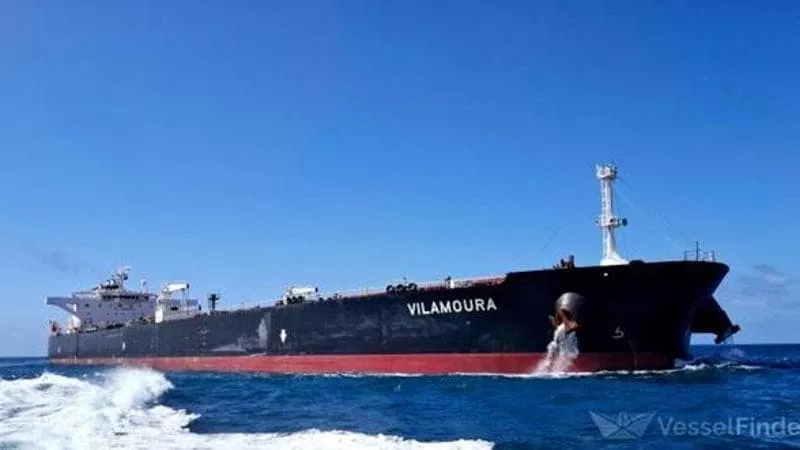
Obviously also Ukraine, in a relentless hybrid war, is moving to strike Russia : Another oil tanker explodes in the Mediterranean: it is the fifth mysterious case