[vc_column_textThe Russian-Finnish War or Winter War is studied in university courses in Contemporary History. It was relatively short but very bloody: there were at least 26,000 Finnish casualties and 126,000 Russian casualties.
The Finns – not surprisingly – were later allied with the Axis (Germany, Italy and Japan) against the Soviets when Operation Barbarossa began. You will find my conclusions at the end of the text.
Compiled on 14 April 2022 , updated on 28 September 2025
Winter War
Also known as the Finnish-Russian War, the war lasted 105 days and ended with the Moscow Peace Treaty under which Finland had to give up some territories but still managed to maintain its status as a free and independent state.
The great feat of ‘little’ Finland against the Russian giant.
Despite the fact that a non-aggression pact had been concluded between Finland and the Soviet Union as far back as 1932 (and then renewed in 1934 for another 10 years), the USSR never did anything to deny its expansionist aims towards the young and neighbouring Finnish nation. For its part, Finland was also doing all it could to cope with an eventual Russian attack, as Grand Marshal Mannerheim had fortifications built at various points along the long eastern line dividing the two nations.
In the late summer of 1939, Germany and the Soviet Union signed the Molotov-Ribbentrop non-aggression pact, according to which Finland fell within the Russian sphere of influence. Soon afterwards, Stalin began making demands for various territorial concessions to Finland, including the establishment of Soviet military bases on Finnish territory, justifying them as necessary requirements for the security of Leningrad and the protection of the northeastern border from possible attacks by sea from Germany and England.
Obviously, Finland refused to submit to the conditions set by the Soviet Union, which did not bode well. In fact, the same proposal was made at the same time to each of the Baltic Republics, which, unlike Finland, bowed to Stalin’s wishes. In the summer of the following year the Red Army occupied Estonia, Latvia and Lithuania, set up puppet governments and began repression and mass deportations. In fact, in order to avoid entering the conflict against a bigger and better equipped enemy, the Finnish government tried the counterproposal card, offering to cede a small part of territory to the Soviets, but the Soviets rejected it as insufficient.
In such a tense climate, war was now inevitable. Both sides prepared and mobilised for the imminent outbreak. The Russians were the first to attack, without even proclaiming a declaration of war and using as a casus belli the attack on Mainila where a Soviet guard post was blown up in mysterious circumstances, as later testimonies brought to light that the incident was engineered by the Russian secret services as a pretext for the start of hostilities.
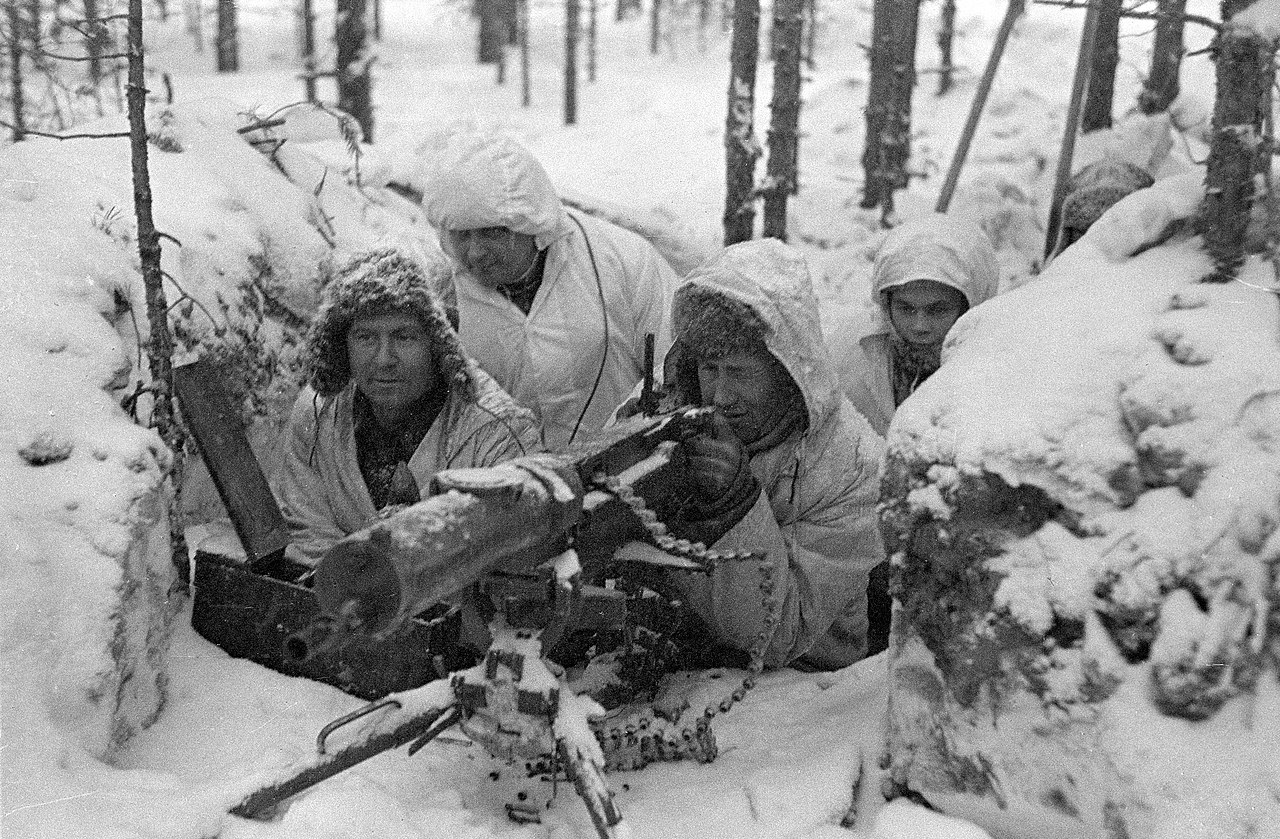
Below: Finnish soldiers defend themselves at -40° (from Wikipedia).
The invasion of Finland
On 30 November 1939, Soviet forces invaded Finland, but the Russian plan of a blitzkrieg-style war failed miserably in the face of the strenuous defence by Finnish forces. Although outnumbered and poorly equipped, the Finns showed exceptional courage and implemented the military strategy of guerrilla warfare to overcome the obvious disparity in strength between the two sides.
The winter of 1939-40 was very harsh, with temperatures reaching minus 40 degrees. The Finnish troops were exceptional in turning the cold, the long hours of darkness, the forest and the near-absence of passable routes to their advantage. Dressed completely in white and equipped with cross-country skis, the Finnish soldiers were able to move very nimbly and were also often in a position to counter-attack in parts of central Finland.
Realising some of the mistakes made earlier, the Soviet high command concentrated more soldiers in a smaller number of divisions to break through the Finnish resistance by exploiting their greater strength. At that point, Finland was in serious danger of suffering a Soviet invasion all over its territory. However, the Russians for their part were also exhausted by a war that proved to be longer and more costly than expected, as well as being worried on other fronts about developments in World War II.
The surrender of Karelia
On 6 March 1940 an armistice was signed and on 12 March the Moscow Peace Treaty was signed, which stipulated the loss by the Finns of parts of the northern territory (part of the Salla area and the Kalastajansaarento peninsula), some islands in the Gulf of Finland and , above all, Karelia. Viipuri, which was the second most populated city in Finland and a very important industrial and trade centre, was part of this region.
Below : Flag of the Karelian Soviet Socialist Republic of Finland from 1940 to 1953.

.Endnotes :
Read more about how I corresponded with Montanelli here.
In the text above I highlighted the analogy between this war and the current one in Ukraine: in both cases the Russians underestimated their adversary.
The difference is that the Ukraine, this time, was not left alone as Finland was, isolated also by the non-aggression pact between Germany and the USSR, signed between Molotov and Von Ribbentrop, which gave the Soviet Union a ‘free hand’ in Finland, the Baltic States and Bessarabia (which coincides with present-day Moldavia and Transnistria).
This war partly explains Finland’s desire to join NATO (Finland joined NATO, it is the 31st country to join the western military alliance: its entry came after months of opposition from Turkey).
Finland’s entry into NATO, propitiated by Putin’s war, is the logical consequence of this story. It was preceded by the Nordic countries‘ decision to organise a joint air defence from Russia.
But the story does not end there: Ukraine, Nato defies Russia: will send 10 ships to the Baltic Sea, the decision follows a wave of suspected sabotage on submarine cables in the Gulf of Finland.
… The decision to increase Nato’s presence in the Baltic Sea was taken on 30 December [2024] at the request of Finland and Estonia following several disruptions in recent months involving an electricity cable and four data cables between Finland and Estonia on Christmas Day.
Finland does not rule out the possibility of deliberate damage and is currently conducting acriminal investigation into the Eagle S, an oil tanker flying the Cook Islands flag but suspected of belonging to the ‘ghost fleet’ that Russia uses to export oil in violation of sanctions imposed after the large-scale invasion of Ukraine…
But back to Karelia, which belonged to Finland and was annexed by the USSR after the Russian-Finnish War.
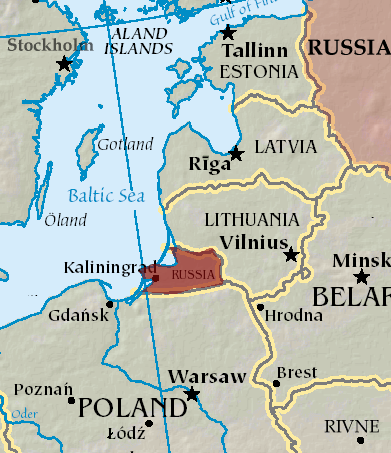
This was also the case from 1945 onwards with the German city of Königsberg, which was renamed Kaliningrad on 4 July 1946 in memory of Michail Ivanovič Kalinin, Bolshevik revolutionary and politician. The German population that survived the war was forcibly expelled between 1946 and 1949 and the city was repopulated with Soviet citizens. The German language was replaced with Russian.
The objectives ofRussian imperialism ,such as the control of the Black Sea, on which the grain supply of a large part of the world now depends, or of the states considered satellites (e.g. Belarus and Ukraine), and its methods – including starvation, deportations, labour camps, and Russification – are still the same.
These annexations have allowed the Russians to have important bases penetrating some western states such as Finland, Poland and Lithuania: perfect for the current hybrid war, desired by Putin .
Below: the Kaliningrad Oblast