23 Mar 2025, 18:13 | by Valerio Massimo Visintin
In February Boccondivino, a historic Milanese restaurant, closed after 50 years.
High rents, speculation and the underworld crush Milanese restaurants
Last February, in the pages of Corriere della sera, my colleague Elisabetta Andreis announced: ‘Milan, the Boccondivino restaurant closes. Closing on the threshold of half a century, Boccondivino is only the latest illustrious victim of an expanding virus. We have seen the demise of Rovello 18, Biagio, Il Cerchio, just to name three from memory. A few weeks ago, Andreis herself wrote: ‘High rents in Milan, rising rates hit the restaurant industry: from the Boeucc to the Pandenus, the places that are leaving‘. Adding: ‘The list is long. In Piazza Cavour, the Swiss corner, which has come to pay 330,000 euro for 300 square metres, is leaving‘.
Many historic restaurants are closing in Milan
This is not the natural extinction of businesses that have come to the end of their existential cycle. It is the metamorphosis of an entire sector, determined by financial logics that have nothing to do with gastronomic affairs. These are the side effects of the urban fundamentalism that is gnawing at the city. And if the sudden burial of historic signs becomes news, in the indifference of the media the prospects for the restaurant industry have been reduced to a few calendar pages. Half of all establishments will lower their shutters within five years. A quarter of new openings do not exceed fifteen months.
High rents, speculation and the underworld: out-of-control costs
But is it only unhappy rent growth that is squeezing restaurants? Perhaps. Actively participating in the pruning are the great manoeuvres of the real estate funds that are devouring the land. In these oases of fierce ‘urban regeneration’, small and medium-sized restaurant businesses are being wiped out. They no longer have a right to asylum. In their place, only the dining halls of the big chains, with their repertoire of standardised food, or the glossy cathedrals of cover chefs, built with the money of a few investors, take root. Who often remain in the shadows, because in this picture, of course, organised crime and a certain type of business with dirty hands also play their part.
Milan is just the outpost of the crisis
In a recent interview with colleague Alessandra Dal Monte (for Corriere’s Cook), chef Felice Lo Basso, announcing his strategic retreat to Switzerland, said: ‘In Milan, things are not going as well as they are told. People no longer have money because the city is too expensive and salaries are too low. I pay 10,000 euro rent a month for 200 square metres‘. It is likely that Lo Basso is downplaying his responsibilities. However, it is hard to blame him.
So? The most cynical of non-Milanese readers might shrug: ‘Your loss. What do we care?”
Make no mistake. Milan is Italy’s sentinel. The social and financial dynamics unfolding in Lombardy’s capital city today are coming soon to your screens. Enjoy.
Regarding the situation of food quality in Italy read also : Poaching on the Po and the quality of fish in some ‘restaurants’.
Concerning the situation of restaurants, whose turnover is declining, in France we add – as a cause of decline – remote work : More and more restaurants are closing due to a lack of customers and sufficient margins. Insolvencies in this sector have reached a historically high level. Customers are declining, particularly due to rising à la carte prices…
…While the number of companies entering insolvency proceedings in France reached its highest level in 15 years in 2024, the hotel and restaurant sector is even more affected than other sectors, according to statistics from the Banque de France, published on 20 February. In January, the number of insolvencies was 17% higher than the average between 2010 and 2019 in this sector. According to the latest edition of the Observatory of the Banque Populaire Caisse d’Epargne, published in January, 2% of jobs – around 25,000 – are at risk. On average, each restaurant experienced a 1% to 2% drop in turnover in 2024, according to Food Service Vision’s analysis, with large variations from restaurant to restaurant. Above all, margin rates have melted …
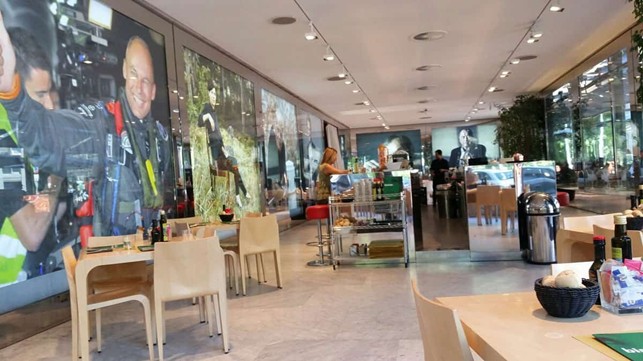
Below the Swiss Corner in Milan’s Piazza Cavour: it paid 330,000 euro/year for 300 square metres.