

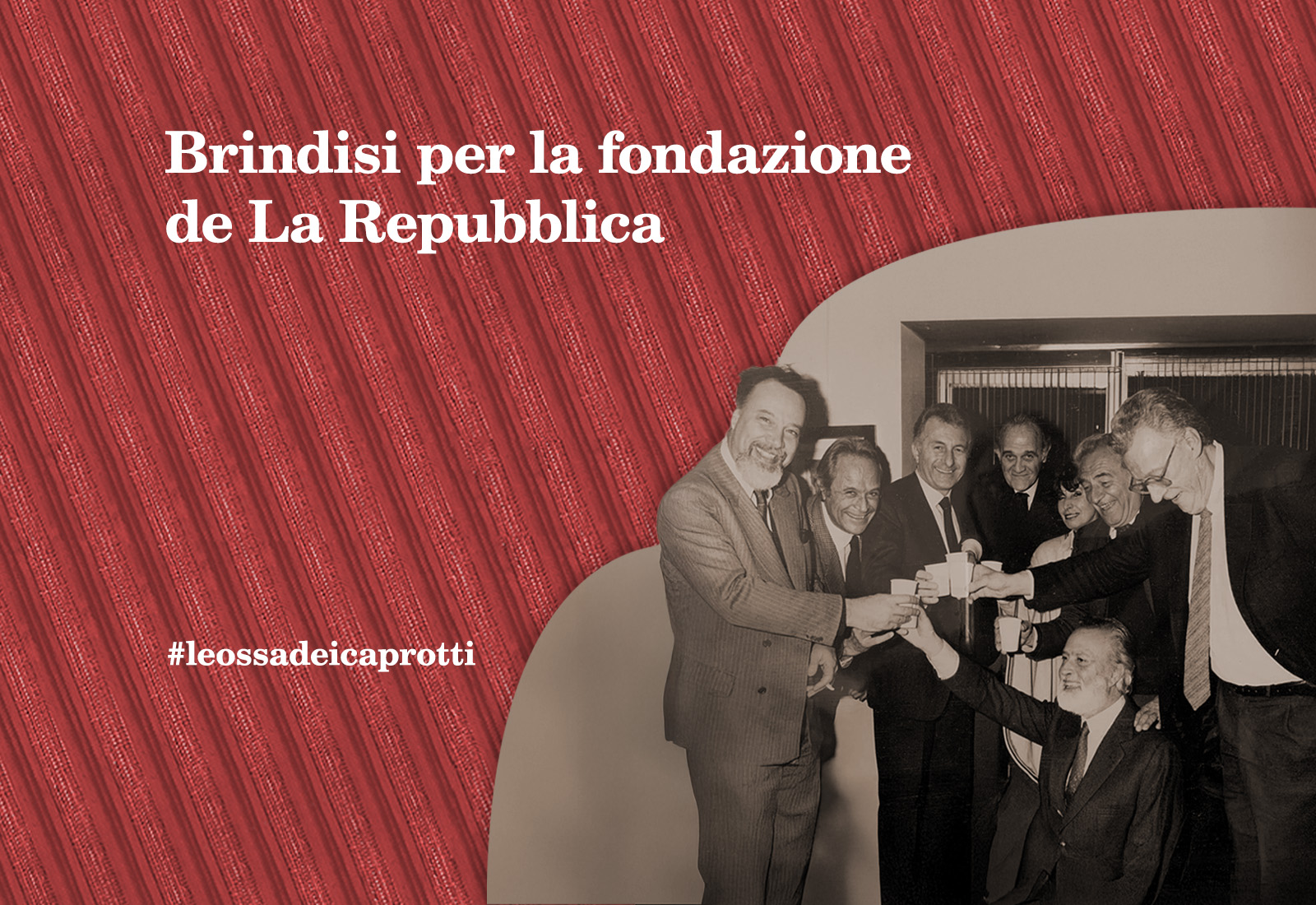
Cover photo: from left to right: Carla Rognoni, then editor-in-chief of ‘Panorama’; Mario Formenton, president of Mondadori; Emilio Fossati, general manager of Mondadori; Aldo Bassetti; Simonetta De Benedetti, then wife of Eugenio Scalfari; Gianni Rocca; Gianpaolo Pansa and Eugenio Scalfari at a toast for the founding of Repubblica in 1975 [Thanks to Guido Barendson for his contribution].
Aldo Bassetti, a member of one of the great Lombard, Italian and international textile dynasties, a successful entrepreneur (and second husband of Giuseppe Caprotti’s mother, Giorgina Venosta), played a crucial role in the founding of ‘La Repubblica’, launched in 1976. Bassetti, together with other partners including Carlo Carlo Carla Caracciolo and Eugenio Scalfari (with whom, a decade earlier, he had already helped save the weekly ‘L’Espresso’ and turned it into one of the country’s leading opinion newspapers), had in fact recognised the need for a new daily newspaper that could respond to a growing demand for free and pluralist information in an Italy that was undergoing profound changes.
‘La Repubblica’, in fact, was born in a historical context marked by the end of the economic boom period and the onset of strong political and social tensions characterised by political violence and terrorism (the so-called ‘Years of Lead’). The newspaper immediately distinguished itself for its innovative approach, offering in-depth articles, investigations and a critical view of the facts. Under Scalfari’s editorship, it positioned itself as the voice of reference for the Italian progressive left.
Bassetti, as an entrepreneur and financier, contributed not only to the initial capital but also to the creation of a solid editorial structure. His entrepreneurial vision was fundamental in ensuring the economic sustainability of the project, facing the challenges of competition with other established newspapers such as ‘Corriere della Sera’ or ‘La Stampa’. The success of ‘La Repubblica’ can also be attributed to the choice of clear and direct language, which made the news accessible to a wide audience. The newspaper then succeeded in attracting young and intellectual readers, quickly becoming one of the most read newspapers in Italy: in the early 1980s, it established itself as one of the leading national newspapers, reaching circulation peaks of over 500,000 copies. This success was also due to the innovative marketing and communication strategy implemented by Bassetti and his team, which contributed to the modernisation of the Italian news landscape and inspired other newspapers to pursue high standards of journalism.
Finally, the impact of ‘La Repubblica’ was not only limited to publishing: its contribution to Italian political life was significant, influencing public debates and helping to form a critical conscience among citizens. Aldo Bassetti played a crucial role in this: he was particularly committed to the promotion of values such as editorial independence and the social responsibility of the media, helping to create a newspaper that not only informed, but also shaped public opinion on relevant issues such as civil rights, social justice and democracy. Bassetti was also profoundly influenced by his own personal history (during World War II, one of his aunts was killed during a Nazi round-up), and focused on a strong commitment to anti-fascism, freedom of the press and a narrative that reflected the different facets of Italian society.
Bibliography:
G. CAPROTTI, Eugenio Scalfari, great friend of Aldo Bassetti and Giorgina Venosta, 27/08/2024(https://www.giuseppecaprotti.it/eugenio-scalfari-grande-amico-di-aldo-bassetti-e-giorgina-venosta/ )
Repubblica, la, entry in Treccani, Online Encyclopaedia(https://www.treccani.it/enciclopedia/la-repubblica/ ).


