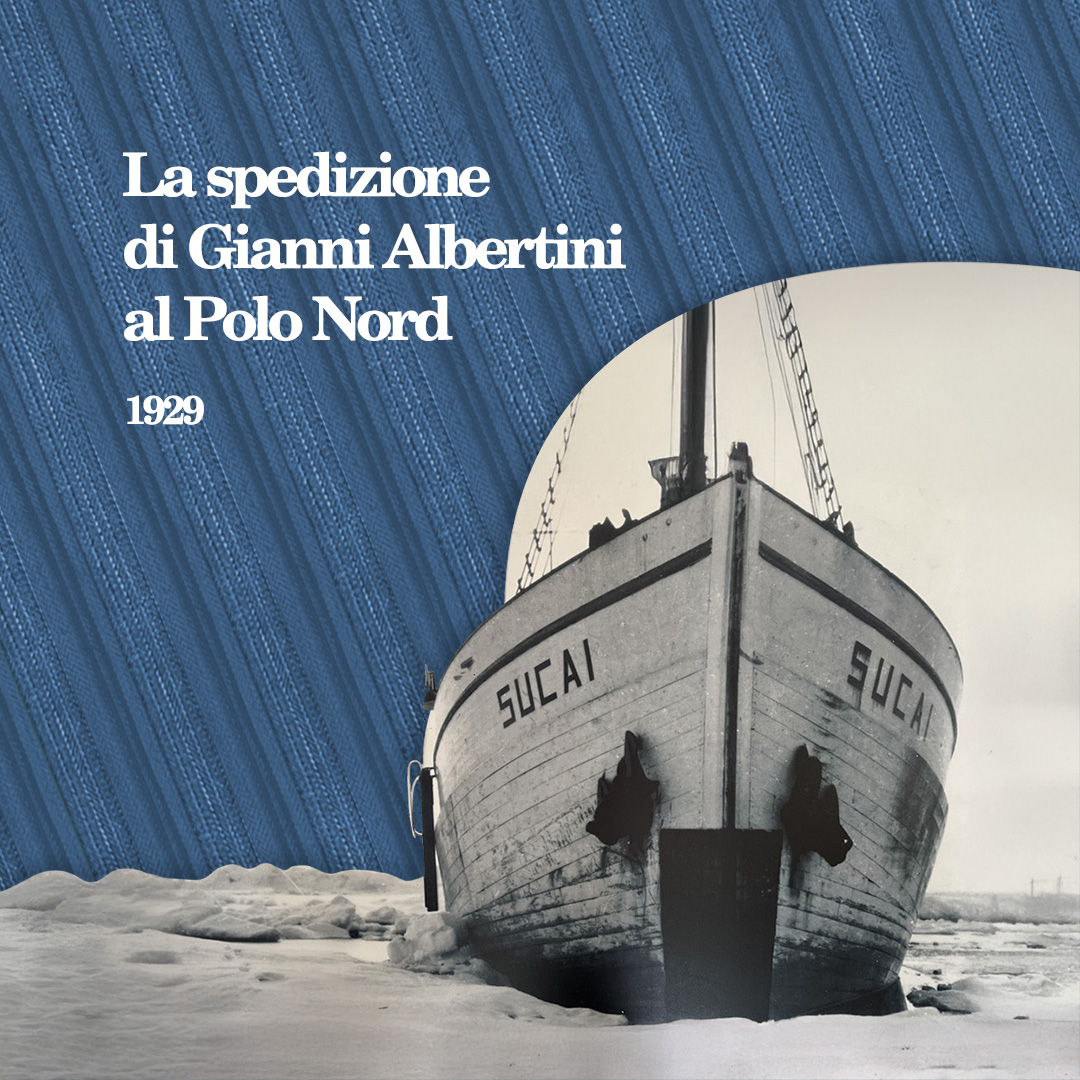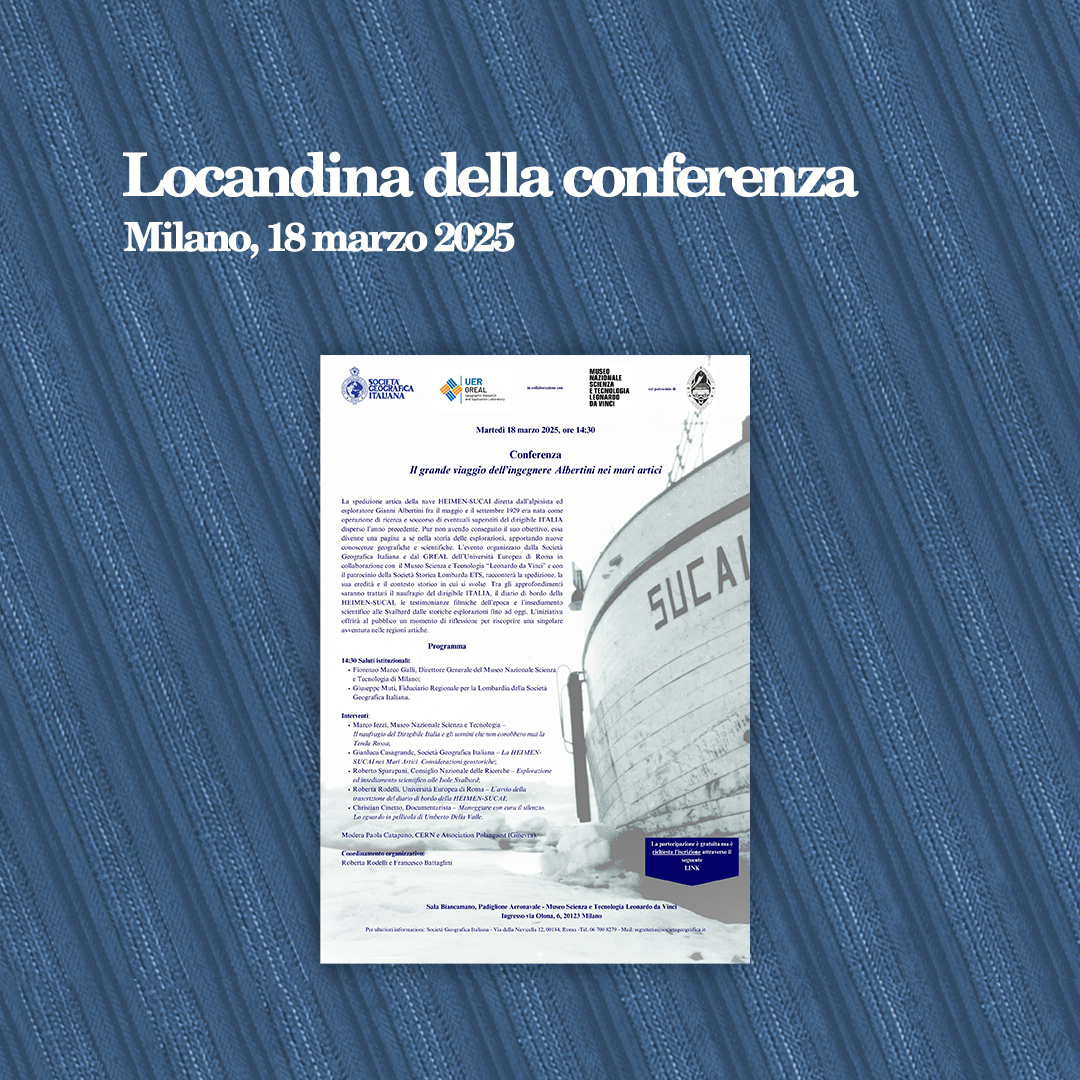
On 18 March 2025, the Leonardo da Vinci National Museum of Science and Technology in Milan hosted an event dedicated to Gianni Albertini and his 1929 HEIMEN-SUCAI Arctic expedition.
During the afternoon, documents and objects used during the expedition were presented, both on display in the hall and in the various speeches. These were made available by Albertini’s descendants, who have carefully and lovingly preserved them: period photographs, family testimonies, archive documents (such as the ship’s logbook of the Heimen-Sucai ship, the transcription of which was begun, presented by Roberta Rodelli), and unpublished films that documentarist Christian Cinetto digitised and presented as a documentary entitled ‘The Mystery of the Arctic’. This is a completely new and, for me, surprising part, and it is worth reporting a summary of Dr. Cinetto’s talk, which illustrated both the technique and the emotion.
While organising the expedition with which, in the spring of 1929, he intended to go in search of the Missing of the Dirigibile Italia, which had crashed into the Arctic pack the previous year, in order to supplement his financial means Gianni Albertini entered into a contract with the Ente Nazionale di Cinematografia to document the venture. The Ente then sends a cameraman, Umberto della Valle, who at 40 years of age is the oldest person on board.
The film made by Della Valle lasts a total of 91 minutes, a unicum in prehistoric Italian production, and has three main reasons for its value:
Historical value: there are very few Italian non-propaganda films of the time that are able to tell the story of reality as closely as a feature film. It is not a narrative documentary, but rather a sequence of evocative, emotional images that tell us about the important sides of the characters we get to know: scenes of daily life on board, moments of study, and above all Albertini’s deep bond with his sled dogs.
Technical value: shooting on a boat in the Arctic frost, with the film directly exposed to the light reflected by the snow, required extreme technical mastery: Della Valle had to foresee the exposure, provide for the preservation of the film and trust in the final rendering without being able to control it on the spot, not to mention the management of the expedition members in front of the camera.
Stylistic value: Della Valle does not merely observe, but suggests, orchestrates and elaborates.
These images do not just tell the story of events, but convey the emotion and personality of the protagonists. Precisely for this reason, Della Valle’s film retains, as mentioned, an extraordinary historical and technical value: it is the work of a pioneer who was able to transform discovery into visual storytelling, helping to define the documentary as we know it today.
Bibliography:
E. GAZZARRINI, A Century of Exploration in Picture Dialogue. Albertini and the legacy of the Arctic, a journey between past and present, 18 March ’25.
C. CINETTO, Handle silence with care. Lo sguardo in pellicola di Umberto Della Valle, speech at the conference Il grande viaggio dell’ingegnere Albertini nei mari arctic, Milan, 18 March 2025, Museo Scienza e Tecnologia Leonardo da Vinci.
R. RODELLI, The start of the transcription of the HEIMEN-SUCAI logbook, Ibid.