

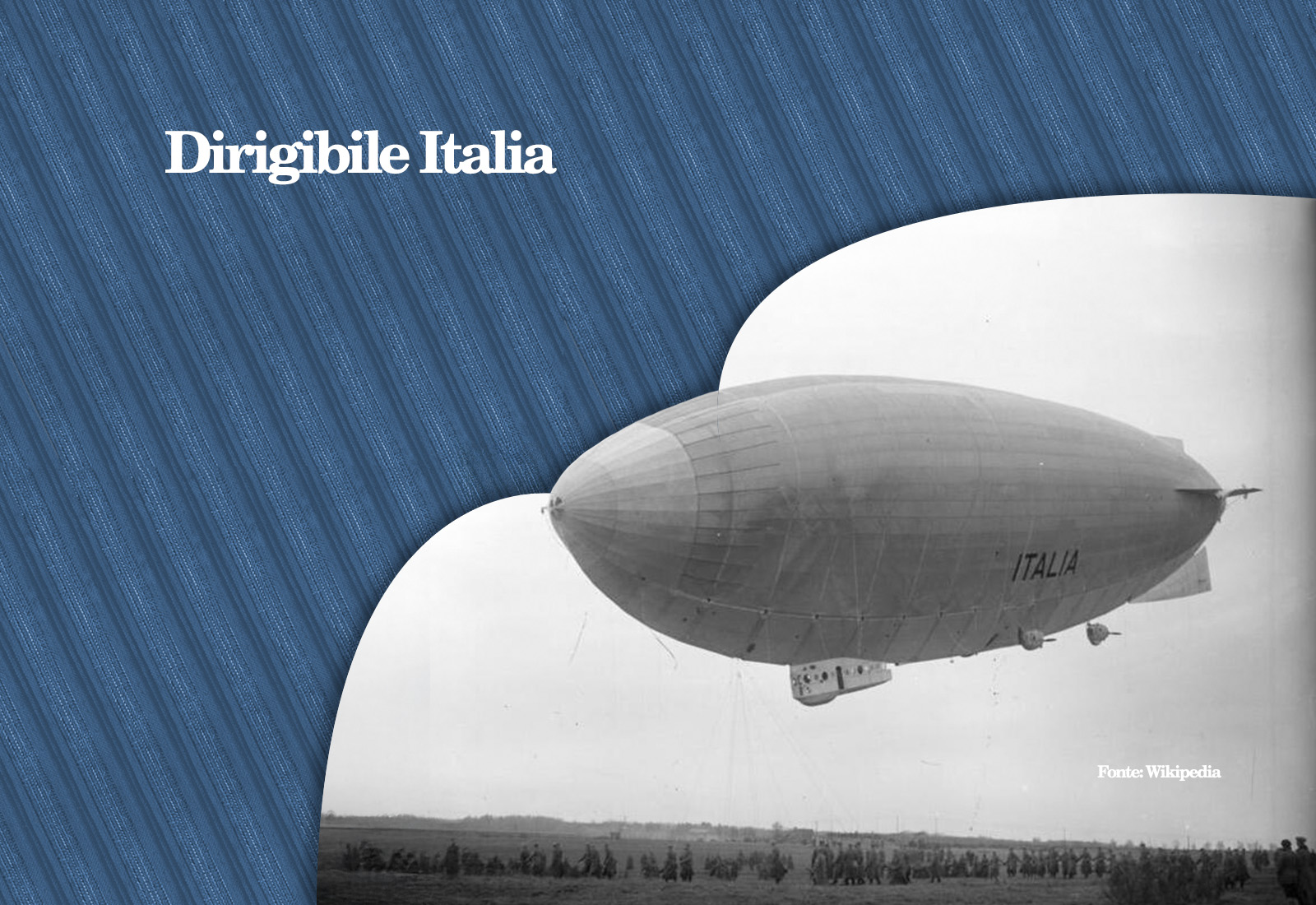
In the spring of 1928, the airship ‘Italia’ expedition set off under the command of Air Force Colonel Umberto Nobile. The aim was to fly over the North Pole for the first time with a precise programme of geographical exploration and scientific research. Unfortunately, the venture ends with a dramatic shipwreck on the Arctic pack on 25 May; in the impact, ten men, including commander Nobile, fall onto the ice floe, fortunately together with food and equipment; six others remain on the airship’s envelope with no controls, which rises and disappears with them in the fog. In the weeks that followed, the epic of the ‘Red Tent’ (after the colour of the field tent prepared for the descent to the Pole, which the castaways dyed with aniline to make it visible) unfolded, in which as many as six nations took part in a race against time, and which occupied the front pages of newspapers all over the world. The men of the ‘Red Tent’ were almost all rescued; of those who disappeared with the balloon, nothing more was ever heard, although the most credited version is that they drifted as far as the Barents Sea, where they sank.
Gianni Albertini, a young engineer from Milan, expert skier and mountain guide, was involved in the Nobile expedition thanks to the president of the University Section of the Italian Alpine Club (SUCAI), the association of university students linked to CAI, who suggested his name and that of his friend Sergio Matteoda because, already accustomed to the hardships of cold and ice, they would have been able to operate efficiently even in extreme conditions such as the Arctic. Assigned to logistics, they embarked on the support ship “Città di Milano”; having arrived at King’s Bay, one of the fjords of the Norwegian Svalbard islands, “they will have to facilitate the airship’s test flights by sweeping the snow from the runway and blasting the ice with dynamite if necessary. They will have to help with mooring manoeuvres between the walls of the open-air hangar, pull the heavy sledges with the hydrogen cylinders needed to inflate the envelope. And, in order not to let the accumulation of snow weigh you down, climb into it without shoes, with your feet covered in straw wrapped in cloth, and remove it with extreme care, using tools wrapped in cloth. (…)’ (SANFELICE, ‘The man who went in search of ‘Italy ”).
Albertini did not board the airship when it left for the expedition, as he had hoped from the start; he stayed with the others to hear the whole story of the flight over the Arctic on the radio until the dramatic messages and silence that announced an alarming series of events.
Rescue operations begin. Two whaleboats take part in the search, the Hobby (sent from Norway) and the Braganza (chartered from Italy), which also has Albertini and Matteoda on board, among others, who disembark and go in search of the Mariano group by sledge (after five days, the first officer, Adalberto Mariano, the navigating officer Filippo Zappi and the Norwegian meteorologist Finn Malmgren have in fact decided to leave to try and reach safety, La Tenda Rossa, p. 53). ‘From 23 June to 6 July the four men [the two “sucaini”, the sledge driver and the guide, ed.] scoured the vast territory almost as far as Cape Leigh Smith, in the north-eastern part of the Northeastern Land. No trace of the Mariano group or the Italy envelope was found along the more than 500 kilometres explored. It was confirmation that no man from the airship Italia had so far succeeded in reaching the vicinity of the mainland.”(Ibid., p. 59). It was the Soviet icebreaker Krassin that reached and embarked everyone, both the men of the Red Tent, Mariano and Zappi (Malmgren died on the march), and the crew of the three-engine Junkers that took off from the Krassin, broke down and was joined by a new expedition of Albertini and Matteoda.
For two more months, the Braganza and the Krassin searched for the wreck of the Italia and the men she had taken with her, but, as they did not obtain any results, they called off the search.
Only Gianni Albertini could not get their fate out of his mind, and the human and moral imperative to find them gave rise to his ‘Heimen-Sucai’ expedition, which set off the following year, 1929.
Bibliography:
The Red Tent. 70° anniversario della spedizione del Dirigibile Italia, 1928-1998, exhibition catalogue at the Museo nazionale della scienza e della tecnica “Leonardo da Vinci” a c. di C. BARBIERI et al., Milano, 1999.
A. Sanfelice Visconti, “La Lampadina Racconti – L’uomo che andò in cerca dei dispersersi dell’ ‘Italia'”, in “La Lampadina. Periodic Illuminations’, 7 February 2020.


