Compiled 7 April, updated 17 April 2025
While Russia is negotiating the future of its military presence in Syria with HTC, the murderers of Bashar al-Assad, long protected by Moscow, the military regimes of the Sahel are questioning the strength of their alliance.
By Benjamin Roger, Emmanuel Grynszpan, Frédéric Bobin and Cellule Enquête vidéo
Read my commentary on this Le Monde article at the end.
Since the fall of Bashar al-Assad’s regime on 8 December, Russia has worked to preserve the essentials in Syria. Two sites are at stake in negotiations with Damascus’ new masters, the former Islamic rebels of Hayat Tahrir Al-Sham (HTC): the Tartus maritime base and the Hmeimim airport. Deployed in Syria since 2015, the Russian military has used these two bases, 60 kilometres apart, as logistical support points for its operations in the Sahel, while its old wide-body aircraft do not have sufficient range to fly non-stop from Russia to Libya.
Anchorage point in the Mediterranean
At the Tartus naval base, the only anchorage point for the Russian fleet in the Mediterranean with maintenance capabilities, satellite images taken by Maxar between 15 and 17 December show around 100 military trucks just parked in the terminal usually occupied by the Russian fleet. The six ships and the submarine remain invisible and are said to be anchored offshore as a security measure. About the same number of military trucks and armoured vehicles also appear in satellite photos, parked on the runway of the Hmeimim airport. As if they were ready to be loaded onto wide-body aircraft that have remained stationary since the fall of Bashar al-Assad. Experts estimate that several hundred rotations will be needed to evacuate all the equipment, especially if Russian planes are banned from flying over Turkey and Iraq, as is currently the case for flights loaded with weapons. The few planes leaving Hmeimim for Russia fly over Saudi Arabia and Iran, tripling the length of the trip.
Anton Mardasov, research associate at the Middle East Institute, a Washington-based think tank, said that Russia’s military presence ‘lost all meaning after the fall of Bashar al-Assad’. This specialist in Moscow’s Middle East policy is counting on a retreat to Russia or Africa, but not necessarily in the immediate future.
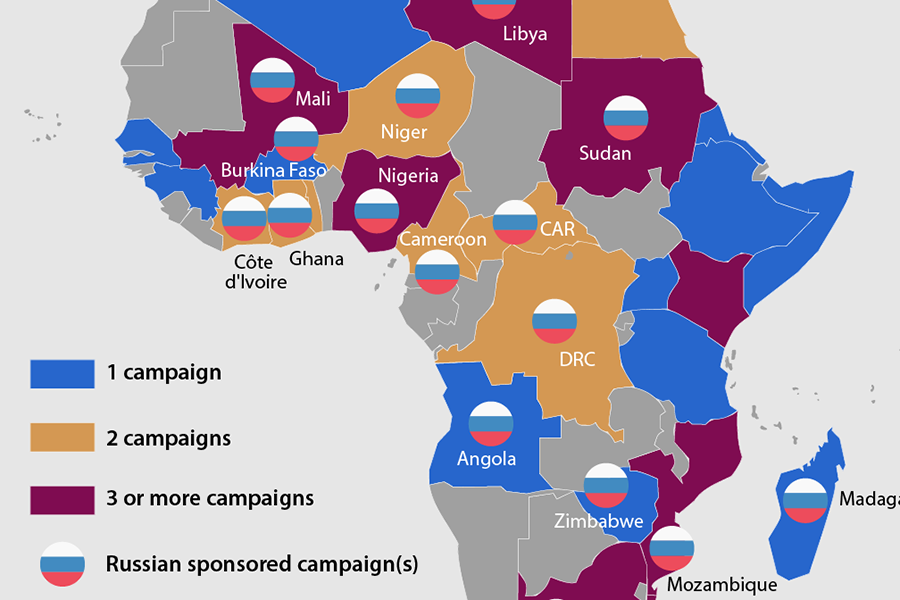
In this context, Libya’s strategic interest could be strengthened. Russia already has a foothold in Cyrenaica (east) and Fezzan (south) under Field Marshal Khalifa Haftar, who has established a power in Benghazi parallel to that in Tripoli. Several flights between Hmeimim and Benghazi were identified at the time of the fall of Bashar al-Assad. Rotations have always been regular between the two countries, especially since Libya has been used by Moscow as a transit and projection platform towards its partners in sub-Saharan Africa (Central African Republic, Mali, Burkina Faso, Niger, etc.). Yes because Russia is increasing its presence in Libya, much to the dismay of the West.
According to a Western source, the plane belonging to the Cham Wings company, owned by a close associate of the Al-Assad clan, which landed on 8 December at Benina airport, on the outskirts of Benghazi, was carrying a very special areopagus: a group of senior Syrian army officers. There was also a rumour that Maher Al-Assad, the deposed dictator’s brother, was among the passengers.
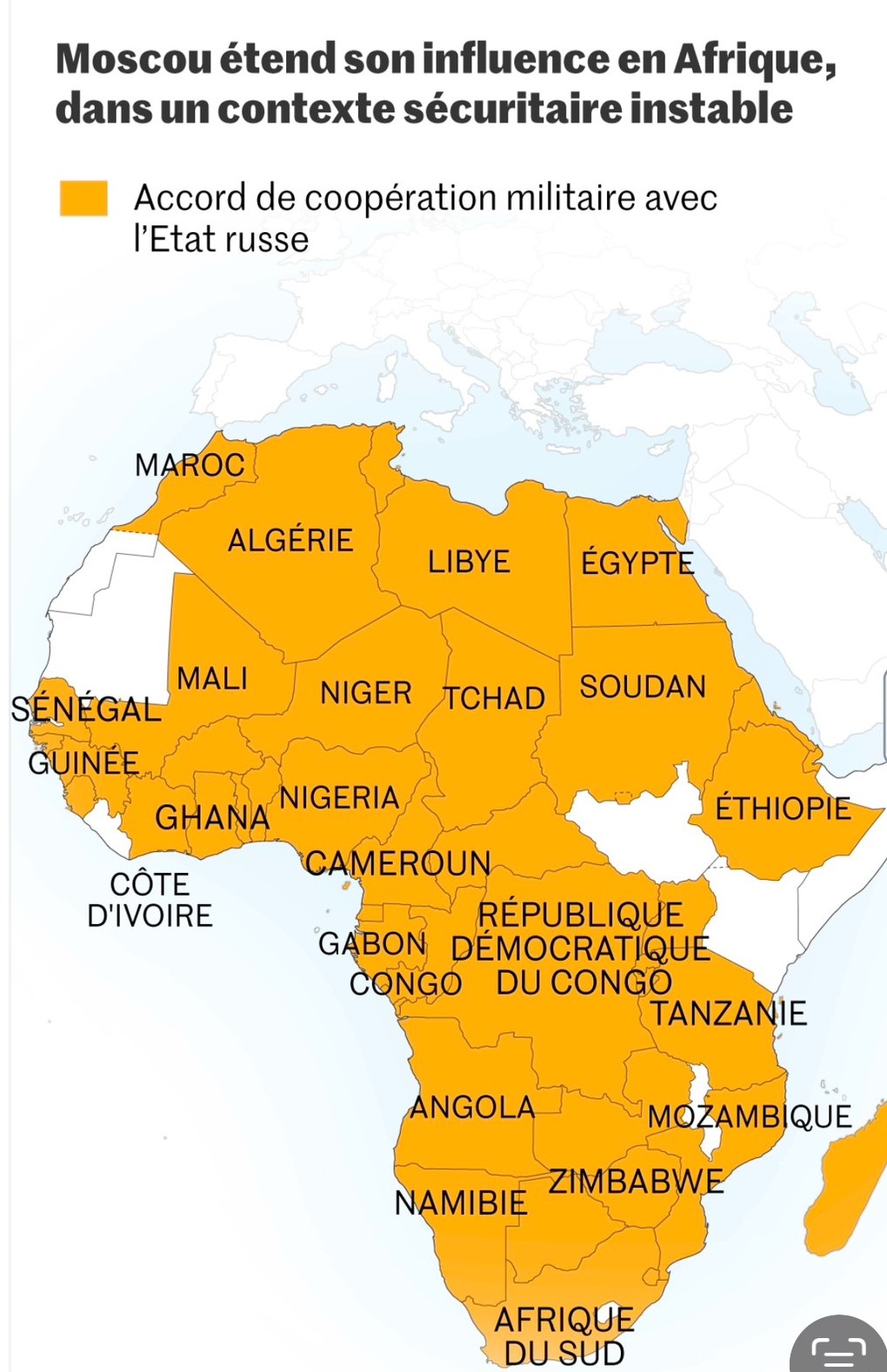
With a few rare exceptions, as of August 2024, almost all African states had a contract to supply Russian weapons.
Stalemate situation in Libya
More Russian Ilyushin transport planes were spotted coming from Russia, landing at the UAE-built Al-Khadim airbase not far from Benghazi. “There is every reason to believe that the Russians are transferring military assets to Libya, including some from Syria. The question is whether these are temporary or permanent measures,’ notes a UN source.
The Americans have intensified pressure on Haftar in recent months to dissuade him from giving in to the sirens of Moscow, which is trying to get him to sign an agreement on the installation of a Russian naval base on the Libyan coast. The strongman of Cyrenaica has not yet made up his mind, but tensions run through his clan – divided over the sale of a base. The new Syrian situation will make the tug-of-war even more intense at a time when Russia absolutely needs to save, and even strengthen, this North African logistical hub that allows it to project itself into sub-Saharan Africa, where its paramilitaries of the Wagner Group or the Africa Corps operate (under the leadership of Prigozhin’s son, Wagner continues to play its part in the Central African Republic and Mali).
For the past year or so, the Russians have taken the initiative by helping to build a new ‘military town’ (naval and air bases) in Qaminis, south of Benghazi, a training base 25 kilometres south of Sirte and an airstrip near Ash Shwayrif, 300 kilometres south of Misrata, not to mention the development and expansion of the port of Tobruk. not far from the border with Egypt. If no agreement has been signed, they can use it as they see fit, as Khalifa Haftar depends on their protection for the security of his sanctuaries to the east and south.
The big question now concerns the attitude of the Turks, who militarily control rival Tripolitania (West), should the precarious balance in place since the October 2020 ceasefire be broken by an increase of Russian power in Libya.
‘It is a total failure for the Russians’
But beyond the logistical issues in Libya and the southern Sahara, the challenge is also political for Russia. From Bamako to Niamey via Ouagadougou, Moscow-backed military coup-makers have closely followed the Russian reaction to the rebel blitz offensive on Damascus. And all have made the same observation: Moscow has not been able to save Bashar al-Assad – or even abandon him, according to some. This raises the question: if Vladimir Putin did not protect his Syrian ally, who is strategic in his game in the Middle East, would he do it for them?
Among these African partners, particularly the Malians, the fall of the former Syrian dictator has rekindled questions about the solidity of their protector. Doubts had already emerged in June 2023, after the aborted rebellion of Yevgeny Prigozhin and his Wagner Group mercenaries. The oligarch then shook the power of Vladimir Putin – before dying in a plane crash in Russia three months later – to the disbelief of many observers, in Africa as elsewhere.
‘Everyone is asking questions again after the events in Syria,’ confides a Malian official. This is a total failure for the Russians, questioning their reliability and weakening their position in Mali and the Sahel. This is not very reassuring. Added to this are the unknowns related to the slow reorganisation of the Russian civil-military system in Africa. Since the death of Yevgeny Prigozhin, the Ministry of Defence has sought to take over Wagner ‘s African activities and merge them into a new civil-military system, theAfrica Corps. However, this wish was not fully realised, as the ‘Wagnerians’ continued their business and operations in the Central African Republic and Mali, where they remained in favour of the leaders.
At the end of November, Yunusbek Yevkurov, the Russian Deputy Defence Minister, visited Bamako again to negotiate a change in the framework of cooperation with the Malian junta. After tense discussions, he noted that the entireAfrica Corps contingent will not be deployed in Mali on1 January 2025, the date originally set, after the arrival of a first group of 200 men in mid-December. Financial problems are said to be at the heart of the dispute with Malian officials, who have therefore extended their contract with Wagner until at least March.
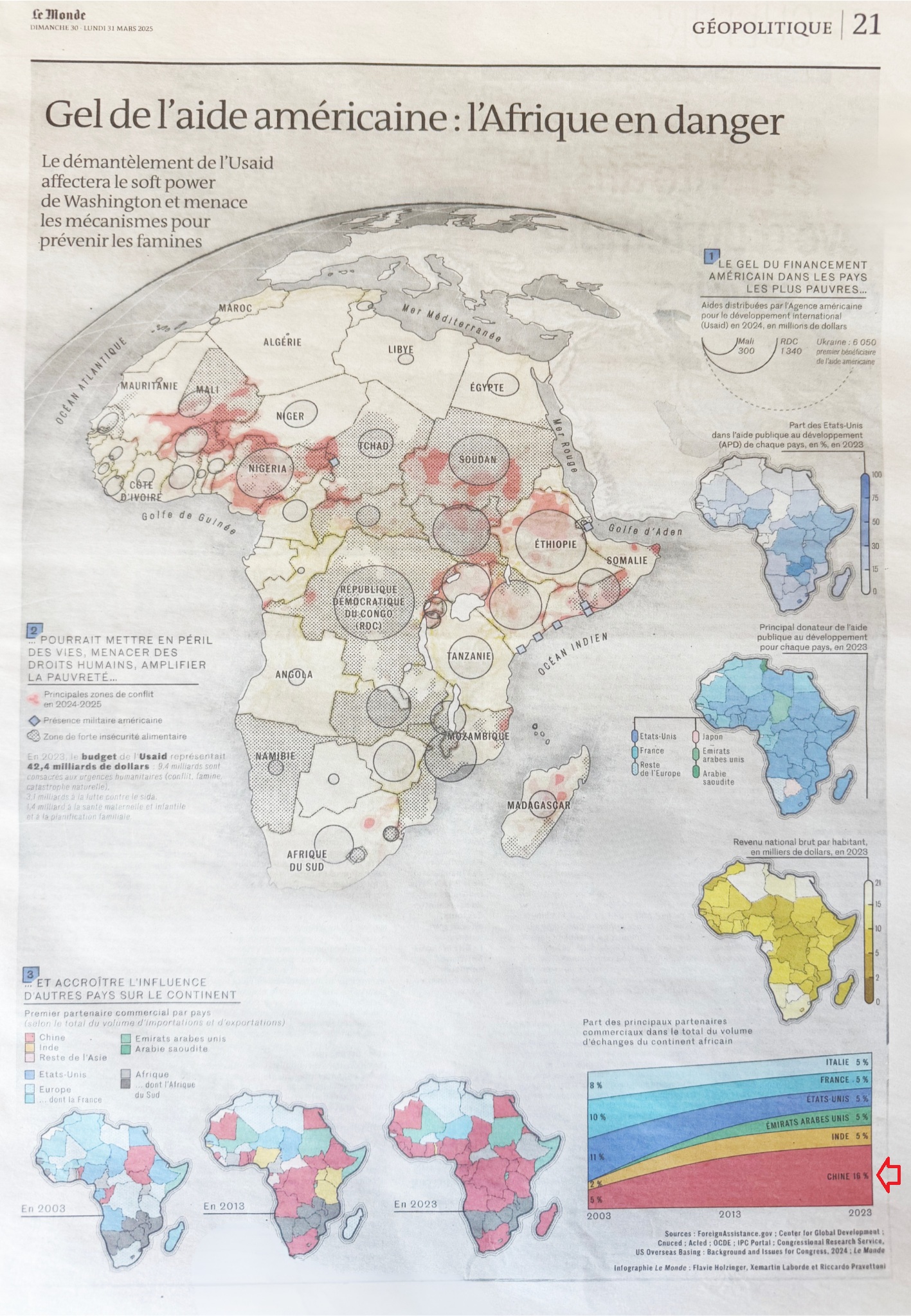
Below: The biggest beneficiaries of the Usaid aid cut . About the funds to Ukraine, Gaza and Israel I speak here.
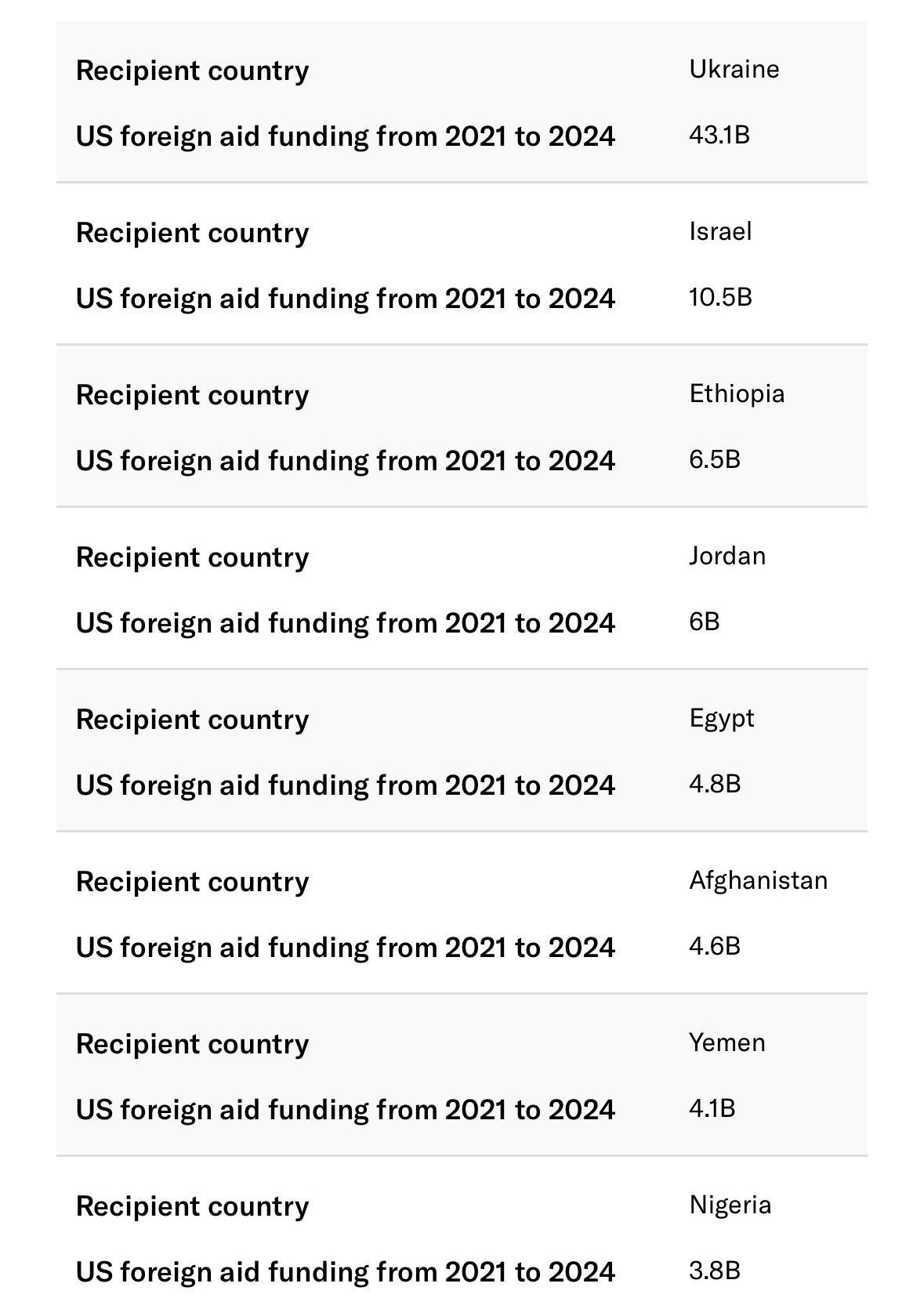
Obviously Russia is looking for alternatives to Syria, now lost: on one side is Libya, on the other Sudan.
Remember the twin towers?
P.S.: in Africa besides the Russians there are also the Saudis, the Emiratines, the Turks, the Chinese but also the Indians.
All happy about the US president’s moves without any strategic vision.
In 2023, China was Africa’s largest partner with 16% of the African continent’s trade (India, the Arab Emirates, the US, France and Italy weigh 5%).
And Russia?
Some cannot be detected and some is arms (but also gold, diamonds, oil, etc.).