Drafted 8 December 2024, updated 11 August 2025
The Middle East and Africa are intimately linked to Europe due to numerous factors.
One of the main ones is the flow of migrants from the global South.
Let us start from this cue:
Syria: Facing Bashar al-Assad, thirteen years of hesitation on the part of the great powers
By Gilles Paris
The refusal of then US President Barack Obama in August 2013 to take action against the Syrian dictator left the way open for Russia and Iran.
On 15 March 2011, several dozen protesters stormed the Hamidiyeh souk in Damascus, chanting slogans hostile to the incumbent regime. In these alleyways, over which the portraits of the Assadian trinity have long hovered – Hafez, the father, who died in 2000, Bassel, the son promised to succeed him, who died in 1994 in a car accident on the road to the Syrian capital’s airport, and Bashar, his brother who became president – a revolution has just begun. It ended thirteen years later when he took the same road for the last time, on the night of Saturday 7 to Sunday 8 December, to escape the lightning rebel advance that had begun less than ten days earlier in the north of the country.
In 2011, this nascent revolution took by surprise the powers that be, who believed that the incumbent dynasty in Syria had more resources to resist the ‘Arab Spring’ wave of potentates it had already swept away: Tunisia’s Zine El-Abidine Ben Ali, in January, and Egypt’s Hosni Mubarak, the following month.
After all, Bashar al-Assad has ‘only’ been president for a decade. At only 45 years old, he is still considered capable of taking the measure of the anger that is being expressed in an entire region. Against the ‘securitocracies’ that have made themselves at home there, according to the formula of Syrian political scientist Bassma Kodmani (who died in March 2023). Against the capture for their exclusive benefit of the national resources embodied, in Damascus, by the disturbing opulence of the president’s cousin, Rami Makhlouf.
A month earlier, in February 2011, Vogue magazine dedicated the cover of its English edition to the ‘desert rose’, Asma Al-Assad, the wife of the master of Damascus. ‘Two lovers in Paris’, Paris Match headlined in December 2010, on the occasion of a visit to the French capital by the dictator and his wife. In 2008, at the invitation of Nicolas Sarkozy, Bashar al-Assad had the honour of attending the 14 July parade in the presidential gallery, on the sidelines of a summit for the Mediterranean.
It was a spectacular rehabilitation, only three years after Damascus’ complicity in the assassination of Lebanese Prime Minister Rafik Hariri in Beirut in February 2005 was questioned, also by France. This assassination was the prelude to the merciful departure of Syrian troops from the cedar country, which has been under control since the end of the Lebanese civil war in 1990.
Like its Tunisian and Egyptian predecessors, the Syrian revolution is seeking a dignity that has been trampled underfoot for decades. In 2011, it is not content with gathering more and more marches in the country’s major cities. It also took hold on social networks and showed determined but peaceful crowds, a generation speaking the language that had become universal on Facebook and YouTube. Destabilised, the Syrian regime responds with the only lexicon it masters: that of violence. This violence constitutes the identity of the Syrian ‘state of barbarism’, according to sociologist and Arabist Michel Seurat, a French hostage captured in Lebanon and who died in captivity in 1986.
Militarisation of the revolution
On 18 August 2011, US President Barack Obama drew the consequences. “Syria’s future must be determined by its people, but President Bashar al-Assad stands in his way,” he said in a statement. His calls for dialogue and reform ring hollow as he imprisons, tortures and massacres his own people. We have always said that President Assad must lead a democratic transition or resign. He did not. In the interest of the Syrian people, the time has come for him to step aside. The next day, the European Union (EU) followed suit, as did the leaders of Germany, France and the UK.
Three months later, on 12 November, the Arab League decided to temporarily exclude Syria, demanding the withdrawal of Arab ambassadors in Damascus until the Syrian regime implemented a plan for an end to hostilities and a genuine dialogue with the wide range of opposition forces. Sanctions are also imposed.
Bashar al-Assad, it is true, is in a bad position. TheFree Syrian Army, made up of officers and soldiers who had defected, withstood the onslaught of his regime’s troops, which would soon be reinforced by militiamen of unparalleled brutality, the Shabbiha. The militarisation of the revolution is leading to a civil war in which the opposition is therefore doing more than resisting in Syria’s main cities. After Daraa in the south, Homs and Hama in the west, the rebels gained a foothold in 2012 in the eastern districts of Aleppo, the large metropolis in the north of the country, as well as in Ghouta, the former oasis that has become a suburb of the Syrian capital.
On 20 August of the same year, Barack Obama first warned a cornered regime against theuse of chemical weapons. “At this stage, I have not ordered a military engagement,” he said during a press conference. “We’ve been very clear with the Assad regime, but also with the other actors on the ground: the red line for us is to see a lot of chemical weapons in circulation or used. It would change my calculus. It would change my equation,” the US president said.
Barack Obama, who built his national career by denouncing the US invasion of Iraq in 2003, had done himself violence two years earlier by actively participating in the international intervention in Libya in March 2011, conducted under a UN mandate. The objective was to stop a military column on its way to the rebel city of Benghazi, the first theatre of the Libyan ‘spring’, where the son of Tripoli’s ruler, Seif Al-Islam Gaddafi, had promised to spill ‘rivers of blood’.
This Franco-British operation, militarily supported by the United States and made possible by Russian abstention, gradually turned into support for the regime change that became effective with the assassination of Muammar Gaddafi on 20 October of the same year. Since then, chaos has followed the dictatorship, as evidenced by the assault by jihadists on the US diplomatic representation in Benghazi on 11 September 2012, a few weeks after Barack Obama’s warning. The US ambassador to Libya, Christopher Stevens, was killed there, just two months before the US presidential elections scheduled for November.
Violation of the American ‘red line
To reconcile the Middle East with the US, which was permanently scarred by their devastating adventurism in Iraq, Barack Obama gave a major speech in Cairo in June 2009 in which he unwittingly anticipated the slogans of the ‘Arab Spring’. “I firmly believe that all people aspire to certain things: the ability to speak their minds and have a say in how they are governed; confidence in the rule of law and equality before the law; a transparent government that does not steal from the people; the freedom to live as one wishes. These are not just American ideas, they are human rights, and that is why we will support them everywhere,’ he said.
Taken at his word in Egypt, he abandoned his old ally Hosni Mubarak under pressure, much to the chagrin of the monarchs of the Arabian Peninsula. But two years later, in light of the Libyan precedent, his hand trembles in Syria. Even after the violation of his ‘red line’ when Bashar al-Assad’s soldiers bombed Ghouta with sarin gas in August 2013. Barack Obama then invoked a consultation of the US Congress to hide his denial of his own principles. In Paris, the President of the Republic, François Hollande, who was ready to militarily support American attacks that would undoubtedly hasten the dictator’s demise, resigned himself to impotence.
For the Syrian revolutionaries, the tide has barely turned. They will soon be swept away by a perfect complement for the Western countries: the jihadist groups that the Iraqi chaos fuelled and whose members held in Syria were released from their prisons with amnesties by Bashar al-Assad’s regime in the first months of the uprising.
The calculus of the master of Damascus is clear: it is either him or chaos; awakening the threat of jihadism can only slow down the countries that want it to fall. Hillary Clinton, then US Secretary of State, bitterly regretted the US president’s retreat in 2014. “The failure to help create a credible fighting force composed of the people behind the anti-Assad protests has left a big vacuum, which the jihadists have now filled,” she told The Atlantic.
François Hollande said the same thing to Le Monde in 2015. ‘On Syria it was a frustration,’ he confided. ‘I don’t know what the result would have been if we had hit, maybe we would have met again and you would have said to me, “You hit, but there is Daesh [the Arabic acronym for the Islamic State organisation] there, it’s your fault”. What I can say is that we didn’t hit – and there is Daesh. Underestimated by Barack Obama in his early days, the latter took advantage of the civil war to establish itself in the east of the country, in connection with the territory conquered in Iraq where it had established its capital, in Mosul. Its eradication is becoming the priority of Western countries. The Syrian regime will refrain from making life difficult for him, preferring to focus on the repression of revolutionaries.
The democratic president will never say he regrets the 2013 decision that will prolong the suffering of Syrians for eleven interminable years. The slow shift in the balance of power between rebels and jihadists in favour of the latter is not the only cause. American passivity acts as a powerful enabler for two countries historically linked to the Syrian regime: Russia and Iran. For Tehran, having an ally in Damascus is crucial to supply its epigone in Lebanon, Hezbollah, with weapons. The latter is actively fighting the Syrian rebels, under the supervision of the cadres of Iran’s elite Revolutionary Guards Corps.
Massive support from Russia
For Russia, which is engaged in an ambitious policy of restoring its greatness and has had a base for its navy in the Syrian port of Tartus since 1971, the Syrian civil war is an opportune opportunity. After the intervention in Georgia in 2008 and the unilateral annexation of Crimea in 2014, the massive military support given to Bashar al-Assad from 2015 onwards has provoked the hyperactivity of Russia’s Black Sea fleet, which foreign observers call the ‘Syria Express’. This reinforcement illustrates the renewed will to power of the Kremlin’s master, Vladimir Putin.
The latter makes the Syrian rebel areas the testing ground for Russian rearmament and future deregulation of the use of weapons, including the systematic bombing of hospitals…
On the eve of his departure from the White House in 2016, Barack Obama rewrote history to justify his choice of non-intervention. “When you have a professional army that is well-equipped and sponsored by two big states – Iran and Russia – that have huge interests here, and they’re fighting farmers, carpenters, engineers who started protesting and suddenly found themselves in the middle of a civil war, the idea that we could have, cleanly and without committing American military forces, change the equation on the ground was never true,” he said at the time.
The splintering of the Syrian opposition, in which political scientist Bassma Kodmani has taken her place among other intellectuals, and its incessant bickering, it is true, support this version of events. It was only when Donald Trump, who was as un-interventionist as the Democrats, came to power that 59 Tomahawk missiles were fired at a regime base near Homs on 7 April 2017, following the chemical weapons bombing of a rebel-held village, Khan Sheikhoun. The US president would later amuse himself by recounting how he informed his Chinese counterpart, Xi Jinping, received at his residence in Mar-a-Lago, Florida, as the latter was attacking the slice of chocolate cake that concluded their dinner.
This attack was followed by a second one, in 2018, carried out jointly by the United States, the United Kingdom and France. It targeted chemical weapons production sites that Syria was supposed to dismantle in 2013 under Russian supervision at the price of Barack Obama’s waiver. However, these interventions are too timely to question the regime’s gradual reconquest of useful Syria that had eluded it, more specifically the North-South axis linking the city of Aleppo, recaptured in 2016, to Damascus in the west of the country. Soon the rebels were left with only the redoubt of Idlib, which borders Turkey.
Syria remains a land of military clashes, but now between great powers. In November 2015, a Turkish army F-16 shot down a Russian Sukhoi SU-24 after violating Turkish airspace.
Three years later, in February 2018, some 200 Russian mercenaries died in the bombing of their positions by US special forces deployed in eastern Syria as part of the fight against the Islamic State organisation. Against the advice of the Pentagon, Donald Trump regularly threatens to remove them.
Endless international negotiations
The same period saw a shift in favour of the Syrian regime, with endless international discussions aimed at ending the civil war…
The Syrian regime became all the more intransigent because its Russian sponsor initiated a competing process in the aftermath of the recapture of eastern Aleppo. The Kremlin announced a ceasefire for 30 December, under its patronage and that of Iran on the side of the regime, and Turkey on the side of the rebellion, then the organisation in January 2017 in Astana, Kazakhstan, of negotiations between Damascus and the armed groups under the leadership of Moscow, Tehran and Ankara. No Arab countries were invited and no postcards were sent to Western countries.
The United Arab Emirates… in 2014, are the first to learn the lessons of this new balance of power by spectacularly reopening their embassy in Damascus in 2018…
Abu Dhabi, where he will travel in 2022, is the first step on the path that will bring Bashar Al-Assad back to the Arab concert. A year later, this was done with an invitation to attend the annual Arab League meeting in May sent by his host, Saudi Crown Prince and de facto ruler of Riyadh, Mohammed bin Salman. The hundreds of thousands of dead, the barbarity of the repression, the millions of refugees and the accusations of war crimes were suspended.
The temptation of normalisation
The disruptive power of the Damascus master has finally paid off. By reintegrating Syria after a twelve-year ban, Arab leaders hope that the narco-state-turned-regime will reduce the traffic of a synthetic drug, captagon, with which it floods the region. They also count on a pacification that would allow the return of refugees scattered around Syria.
The temptation to normalise is also spreading in Europe. In July 2024, on the initiative of Austria and Italy, eight EU member states (Cyprus, Croatia, Greece, Czech Republic, Slovenia, Slovakia) asked Josep Borrell, head of EU diplomacy, for a review of European policy towards Damascus. “Bashar al-Assad remains firmly in the saddle. With the support of Russia and Iran, the Syrian regime has managed to consolidate its power, regaining control of 70 per cent of the country. Our Arab partners in the region have recognised this unfortunate reality,’ their leaders said in an official letter.
These countries call for ‘a more realistic, proactive and effective Syrian policy to increase [the EU’s] political influence, strengthen the effectiveness of [its] humanitarian aid and create the conditions for the safe, voluntary and dignified return’ of those who fled the horrors of the civil war. It is indeed a matter of being able to reject Syrian asylum seekers and refugees from the Schengen area.
These visionaries have failed to see that the support that has allowed Bashar al-Assad to remain in power, whatever the cost to his subjects, has dissolved. Besides the gradual disinvestment of Russia, which has been focusing on its war of aggression against Ukraine since February 2022, Iran and Lebanese Hezbollah have been weakened in recent months under the blows of the Israeli army. The slow implosion of Syria, exposed by a series of articles published in Le Monde in September, continued at the same time.
The channel of political discussion opened by Russia was no more fruitful than the UN initiative. Bashar al-Assad, unable to change anything about the balance of terror that constitutes his only course of action, has been unable to achieve peace.
The master of Damascus and his clan were wiped out in ten days. His flight in shame marked the end of a dynasty that had lasted more than half a century. It reopened for Syria the uncertainty from which so many countries that had taken an interest in Syria during a long decade of suffering had hoped to escape.
The Syrian president has found refuge in Moscow. In 2015, Kremlin support had enabled him to regain control of much of the country. This time, the Russian army, which is concentrating its resources on the Ukrainian front, has barely intervened against the Islamist rebels.
..Obama explained his decision shortly afterwards to a small group of Europeans, according to one of them: ‘I am faced with a dilemma. To make a difference in Syria, I would have to bring the full weight of America to bear. And then we will have Syria in our hands for decades. But I was not elected for this’. The legacy of Afghanistan and Iraq is too heavy…
Paradoxically, it was Putin who ‘rescued’ Obama from this predicament. At the G20 in St Petersburg, the two presidents jointly discussed a possible way out: the voluntary disarmament by Syria of its chemical arsenal. A few days later, John Kerry, the US Secretary of State, raised this possibility to the press in London. It was lucky: Sergei Lavrov, his Russian counterpart, was hosting Syrian representatives in Moscow. The Russian called the American and the deal was done. On 14 September, Moscow and Washington announced a plan to eliminate Syrian chemical weapons, which would be approved by the UN…
The lesson for Europe is not only humiliating, it is bitter. The Russian-American agreement legitimised Bashar al-Assad, considered a valid interlocutor, instead of weakening him. The refusal to punish him has created difficulties for the moderate Syrian opposition, with which the Europeans were cooperating. “It is a real rupture,” analyses Jean-Yves Le Drian. ” From there, radical groups have emerged, we have seen a haemorrhaging of opposition activists towards Daesh [Arabic acronym for the Islamic State organisation] . The red lines no longer exist and Vladimir Putin is taking over”….
In Bosnia, US intervention, hard-won by Bill Clinton from President Jacques Chirac in 1995, and the energy deployed by US special envoy Richard Holbrooke were decisive. ‘But with Syria, Obama’s renunciation marked a turning point in US policy: from now on, the US will no longer intervene unless its security interests are directly at stake’.
Europe is alone, but does not yet know it.
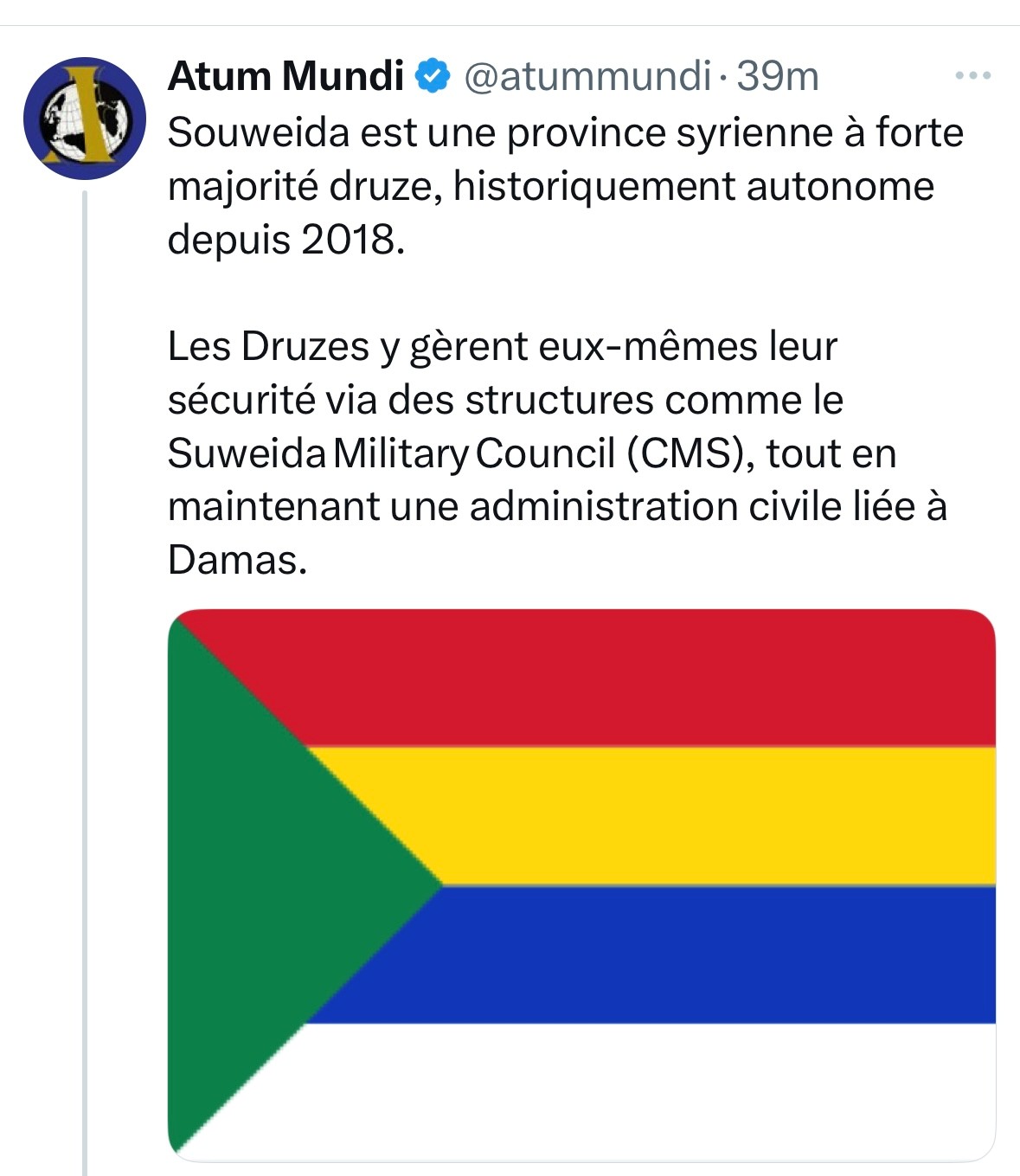
While Syria is struggling to regain national unity, as the recent clashes with the Druze population have shown (like Iraq it is an ‘artificial state’, created ad hoc after the First World War).