Drafted 30 April, updated 28 May 2025
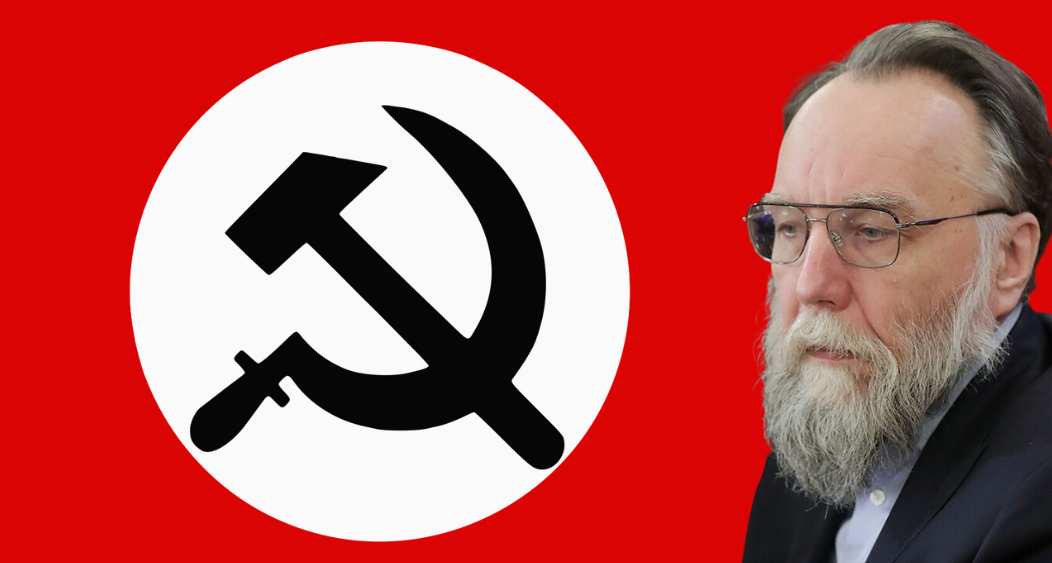
he was also the founder and member of the National Bolshevik Party (*), the National Bolshevik Front and the Eurasia Party. Emblematic is the slogan he coined: ‘Russia is everything, the rest is nothing! “..
The term ‘Eurasia’ sounds familiar, because it is found in Orwell’s ‘1984’.
And here it becomes more disturbing because of the suggestion it evokes. Eurasia, in fact, according to the Orwellian account in the novel 1984, is one of the three continental superpowers born after the hypothetical atomic war of the 1950s invented by George Orwell. The form of government hypothesised by the great British writer is neo-Bolshevism, born from the ashes of the Communist Party of the Soviet Union.
For Dugin, therefore, this dystopian novel is not a warning: it is a model to aspire to. As an old Soviet philosopher, Dugin is anti-capitalist, anti-liberal, anti-democracy, pro-dictatorship. For Dugin it is Stalin rather than Lenin, the great ideological hero.
Like Putin, Dugin also believes that the dissolution of the Soviet Union was a disaster.Dugin in his writings proposes the re-establishment of the Soviet-era empire by force.
In 2008, when Putin invaded Georgia in the same manner as he invaded Ukraine, Dugin urged him to attack Ukraine…
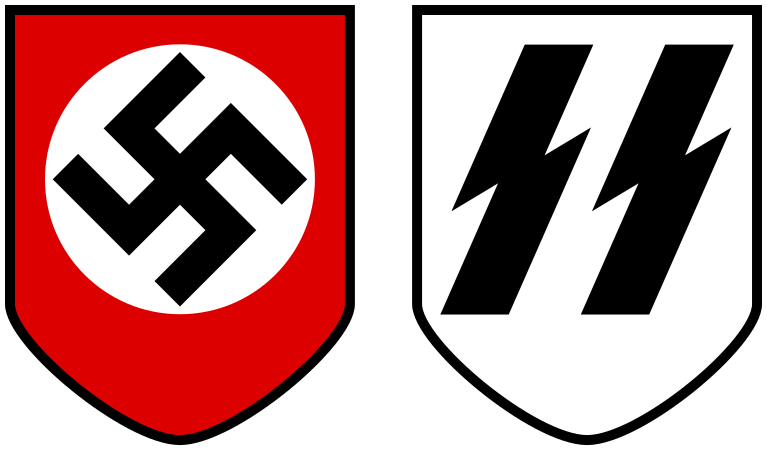
(*) whose flag combined with Dugin’s face, on the cover, has the colours of the Third Reich emblems that you will find below with the SS emblem.
Recall that prior to World War II, The Treaty of Non-Aggression between the German Reich and theUnion of Soviet Socialist Republics, commonly referred to as the Molotov-Ribbentrop Pact or Hitler-Stalin Pact, was a ten-year non-aggression pact signed in Moscow on 23 August 1939 between Nazi Germany and the Soviet Union and signed by Soviet Foreign Minister Vjačeslav Molotov and German Foreign Minister Joachim von Ribbentrop respectively.
The contracting parties undertook not to attack each other, not to support third powers in offensive actions and not to enter into coalitions against one another.
The agreement also defined, on the basis of a ‘Secret Protocol’, the respective territorial acquisitions corresponding to their expansion goals: in this way, the USSR secured the annexation of eastern Poland, the Baltic States and Bessarabia in order to re-establish the old borders of thetsarist empire, while Germany had its claims to the western part of Poland recognised.
Four days earlier, Nazi Germany and the USSR had also signed a first trade agreement, which would be followed by two more, in 1940 and 1941 .
This alliance, among other things, led to the Katyn massacre – massacre of 22,000 Polish officers, politicians, professors, industrialists (essentially the country’s intelligentsia) – which Vladimir Putin has long been trying to remove from Russia’s history textbooks.
The Russian project for the United States
She studied classical literature, spent four years in the USSR from 1973 to 1978, graduated in Russian and taught history of the USSR and international relations at the Sorbonne in Paris.
29 March 2025
Russian intelligence services have reportedly been working for decades on a plan to destroy America from within. The policies of the Trump administration seem to confirm this thesis: in just a few weeks, Trump, ruling by decree, has managed to sow chaos in the US and alienate the entire world, starting with his most loyal allies, while serving Russian interests. The Kremlin’s goal, together with that of the high-tech oligarchs, is to create an irreversible situation in the US, making it ungovernable.
“Today we are accomplishing what we have been trying to do unsuccessfully for 500 years! And we are changing the West!”
“Today we have completely avenged ourselves, erasing the defeat we suffered at the end of the Cold War.”
Alexander Dugin, interviewed by CNN on 18 March // CNN (the photo below is a screenshot).
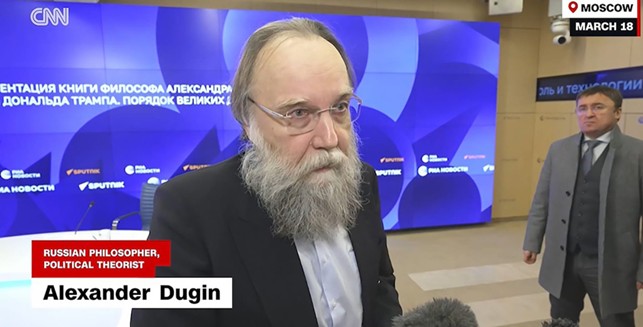
In an article published on 11 February 2019, Vladislav Surkov, one of the architects of Putin’s system, noted that the Russian regime had ‘considerable export potential’ because it was the power of force that spoke its name. The victory of Trumpism seems to prove him right. There is no modest triumph in Moscow. The Russian regime’s chief guru, Alexander Dugin, told CNN on 19 March: ‘Putin and Trump agree that the world order should be based on great powers and not on liberal globalism.
In 2017, Dugin himself was more explicit about his actions, stating in an interview with CNN: ‘I noticed in Donald Trump many similarities with my own thinking and I could have written his inaugural address […]. 8 November 2016 was a significant victory for Russia and for Putin himself […]. Putin taught Trump how to challenge the status quo , the received ideas, the totalitarian principles of globalism. “
The Pope’s mule
It was in the early 1950s that Stalin called upon his services to implement a policy aimed at destroying the US from within. The collapse of the USSR, far from putting an end to this enterprise, would give it more precise contours. In fact, within a small group of men linked to the GRU and the KGB who dream of revenge, the victory of the western camp in the Cold War is attributed to a plot hatched in Washington. These men are trying to inflict on the United States the same fate that befell the USSR under Gorbachev and Yeltsin: to deprive the country of its allies, throw it into chaos, disarm it unilaterally and cause its disintegration.
Their first task is to convince the decision-makers. For this they will find a talented popularizer, Alexander Dugin. This will mobilise geopolitics to show that the antagonism between Russia and the Anglo-Saxon world persists and that Russia must adapt its policy to this reality. In his book The Great Continental War, published in 1992, Dugin describes the ‘geopolitical conspiracy’ that led to the collapse of the Soviet Union and the establishment of Ukrainian independence. In 1997, Dugin developed his theses in his programmatic work Fundamentals of Geopolitics, which served as a textbook for the Russian Academy of General Staff. According to him, at the heart of geopolitics is ‘the affirmation of a fundamental historical dualism between the Earth, the tellurocracy, Eurasia, the heart of the Earth, with its ideocratic civilisation, on the one hand, and the Sea, the thalassocracy, the maritime power, the Atlantic, the Anglo-Saxon world, the mercantile civilisation.1… “The West, represented by America, is Russia’s absolute geopolitical adversary, the pole of a diametrically opposed trend to Eurasia. The war of geopolitical position with America has been and continues to be the essence of all Eurasian geopolitics since the mid-20th century, when the role of the United States became evident.2. Land powers are based on the primacy of politics over economics, authoritarianism, conservatism and collectivism. Maritime powers are characterised by liberalism and individualism. Between the two, conflict is inevitable.
As early as 1997, Dugin outlined the main lines of the policy of subversion of the American adversary, which would be systematically implemented by the Russian secret services: ” It is particularly important to create geopolitical disorder in American domestic life by encouraging all kinds of separatism, various ethnic, social and racial conflicts, by actively supporting all dissident movements, extremist, racist and sectarian groups that destabilise the internal political processes in the United States.At the same time, there will be support for isolationist tendencies in American politics, the theses of those circles (often right-wing Republicans) who believe that the United States should confine itself to its internal problems. These tendencies are extremely beneficial for Russia, even if ‘isolationism’ is implemented within the framework of the original version of the Monroe Doctrine, i.e. if the US limits its influence to the two Americas. This does not mean that Eurasia should at the same time refuse to destabilise the Latin American world by trying to take certain regions out of American control. All levels of geopolitical pressure on the United States must be activated simultaneously3. “
Dugin’s theses quickly gained ground in the Russian establishment, even infiltrating President Putin’s speeches, to the point where Dugin observed with his characteristic modesty:” Putin is becoming more and more like Dugin, or at least he is implementing the programme I have been building all my life.
Like his mentor, Putin has come to consider that the question of the war against Ukraine is “the victory or defeat of Russia in the battle against the existential enemy (Atlanticism, the global financial oligarchy, the West).”
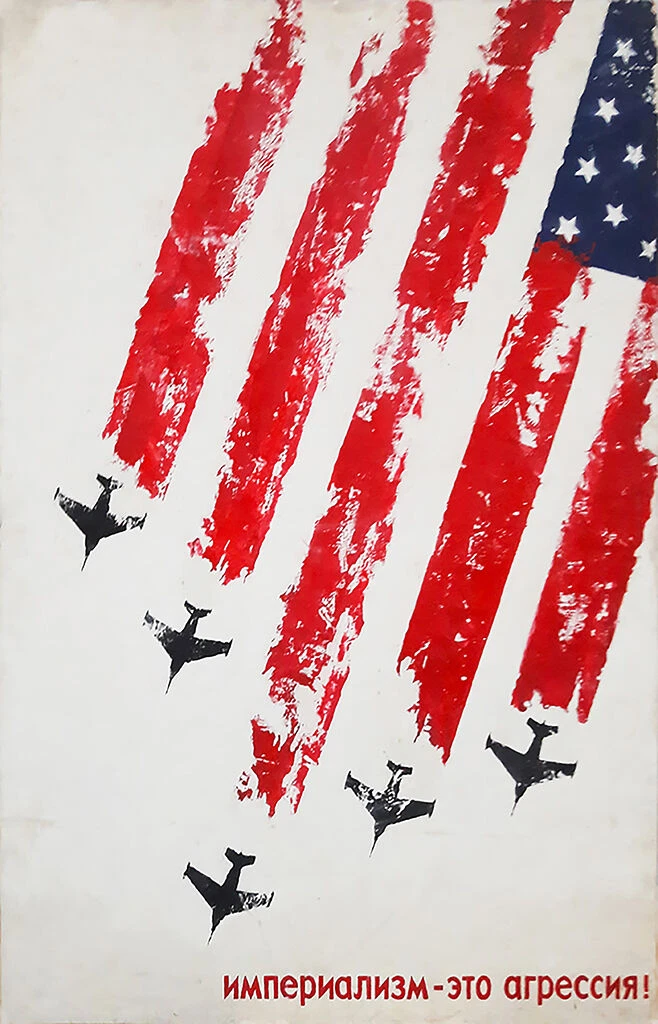
It seems there is literally nothing Donald Trump can refuse his friend Putin.
As soon as he appointed General Keith Kellogg as his representative for Ukraine and Russia, the Russian president let it be known that he did not want him. No matter, Kellogg will be in charge of Ukraine, and for Russia Trump will choose Steve Witkoff, an emissary totally unaware of this country, capable of swallowing Putin’s biggest lies, as his interview with Tucker Carlson shows: in short, the Kremlin’s ideal interlocutor.
The US withdrew from the International Investigative Group investigating the responsibility of Russian leaders in the war crimes committed in Ukraine. Trump ordered the closure of Radio Liberty.
On 19 March, US intelligence agencies ended coordinated action with the Europeans to counter sabotage, disinformation, and cyber attacks from Russia. Even better, it appears that the Trump administration is considering unilaterally recognising the annexation of Crimea.
We also want to emphasise the osmosis between Kremlin propaganda and the statements of Trump and his close associates: Zelensky has no legitimacy, he is corrupt, he has hijacked Western aid. Trump thus supports one of Putin’s main objectives, namely to bring down Zelensky, the soul of the Ukrainian resistance, by demanding immediate elections in Ukraine, which are impossible to hold in wartime. In Trumpian discourse, as in that of the Kremlin, ‘peace’ means capitulation, while the Ukrainians who resist and the Europeans who support them become ‘warmongers’: remember that after the German-Soviet pact, from September 1939, the British and French were treated as ‘warmongers’ by Stalinist propaganda because of their support for Poland.
It is noteworthy that the two points Putin allegedly admitted about the ceasefire represent the two areas in which Ukraine is dealing significant blows to Russia: the attack on energy infrastructure and the Russian Black Sea fleet being forced into hiding in Georgia because of Ukrainian drones and missiles.
The crescendo of the Kremlin’s demands is literally staggering: the Russians are now demanding as a condition for the ceasefire that observers be sent to Odessa to ensure that arms supplies to Ukraine are stopped, both from the US and Europe.
But that is not all. The Trump administration is initiating a last-minute economic bailout for a beleaguered Russia, destroying several levers the West had at its disposal to force Putin to relinquish his grip.
UShedge funds are preparing to invest in Russian securities. Since last December, the rouble has strengthened by 40%.
According to rumours, Putin and Trump conducted secret talks to restart the Nord Stream 2 gas pipeline. Trump’s change of heart towards this project, which Putin cares about more than anything else, seeing it as a way to bring Germany (and thus Europe) into the Russian orbit, is the measure of the US president’s evolution from his first term, when he opposed the pipeline. All in all, Russia will have, thanks to American financial and technological assistance, the means to calmly prepare for war against Europe, unless Gazprom’s resumption of vassalage is sufficient to install Moscow-subservient oligarchs in power throughout Europe.
Russia’s immediate objectives after Trump’s second victory
For the observer of the American political scene since the advent of Trump, one thing is striking: the contrast between the chaos reigned by the moody President Trump and the extreme consistency of the measures taken to implement unilateral US disarmament against Russia and to serve Russian interests. In this area, the Trump administration has demonstrated a consistency absent in other areas of its initiatives. This contrast is, in our view, the best indication that the Kremlin is taking control of aspects of US policy that are important to it.
Let us quickly review the measures that directly affect Moscow. All agencies responsible for protecting the US from foreign interference have been neutralised. Trump unilaterally ended cyber operations against Russia, leaving the US vulnerable to Russian hackers. The US voted together with Russia at the UN for the resolution on Ukraine: an essential step in the eyes of the Kremlin because it blatantly affects the Atlantic Alliance. They blocked statements condemning Russia within the G7. In particular, Trump scuttled a G7 proposal that recommended the creation of a special force to combat the Russian ghost fleet, which allows Moscow to export its oil by circumventing sanctions.
Much to the Kremlin’s satisfaction, the US administration has kept the Europeans out of peace negotiations with Moscow. Today it admits that the Europeans will have their role to play: lift the sanctions in accordance with Putin’s demands! Trump is pressurising Ukraine to agree to Russian demands: surrender of occupied territories, neutral status, and no guarantees, which in fact amount to the isolation of Ukraine in case of the next Russian offensive. Trump has helped Putin achieve his overriding goal of retaking the Kursk region by depriving the Ukrainians of US intelligence resources and disabling F-16s supplied to Ukraine by Europe.
Trump is dismantling US military logistics in Poland.
Nearly 84,000 active US service members are spread across at least 38 European bases, some dating back to the end of World War II. Poland has four bases on its teritory, but as the US is ‘rumoured’ to want to withdraw 20,000 troops its President Tusk is not at all quiet on the subject: Poland spends 5% of its GDP on armaments.
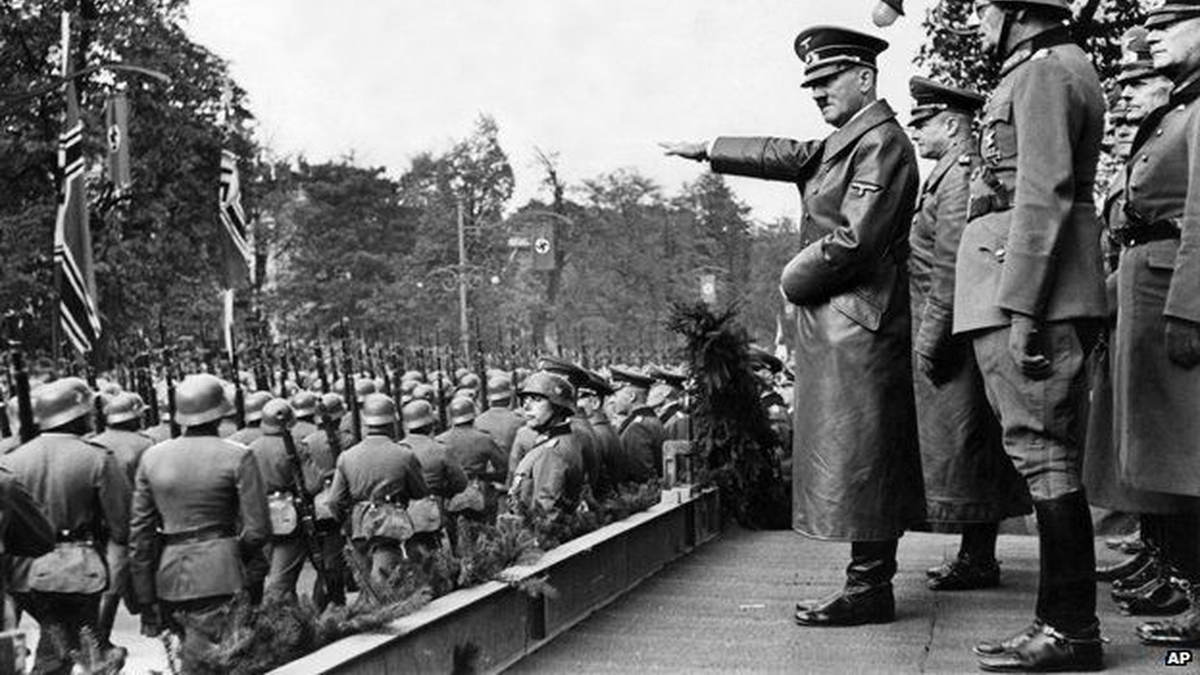
Below : German troops enter Poland in 1939, under the watchful and blessing eye of Adolf Hitler.
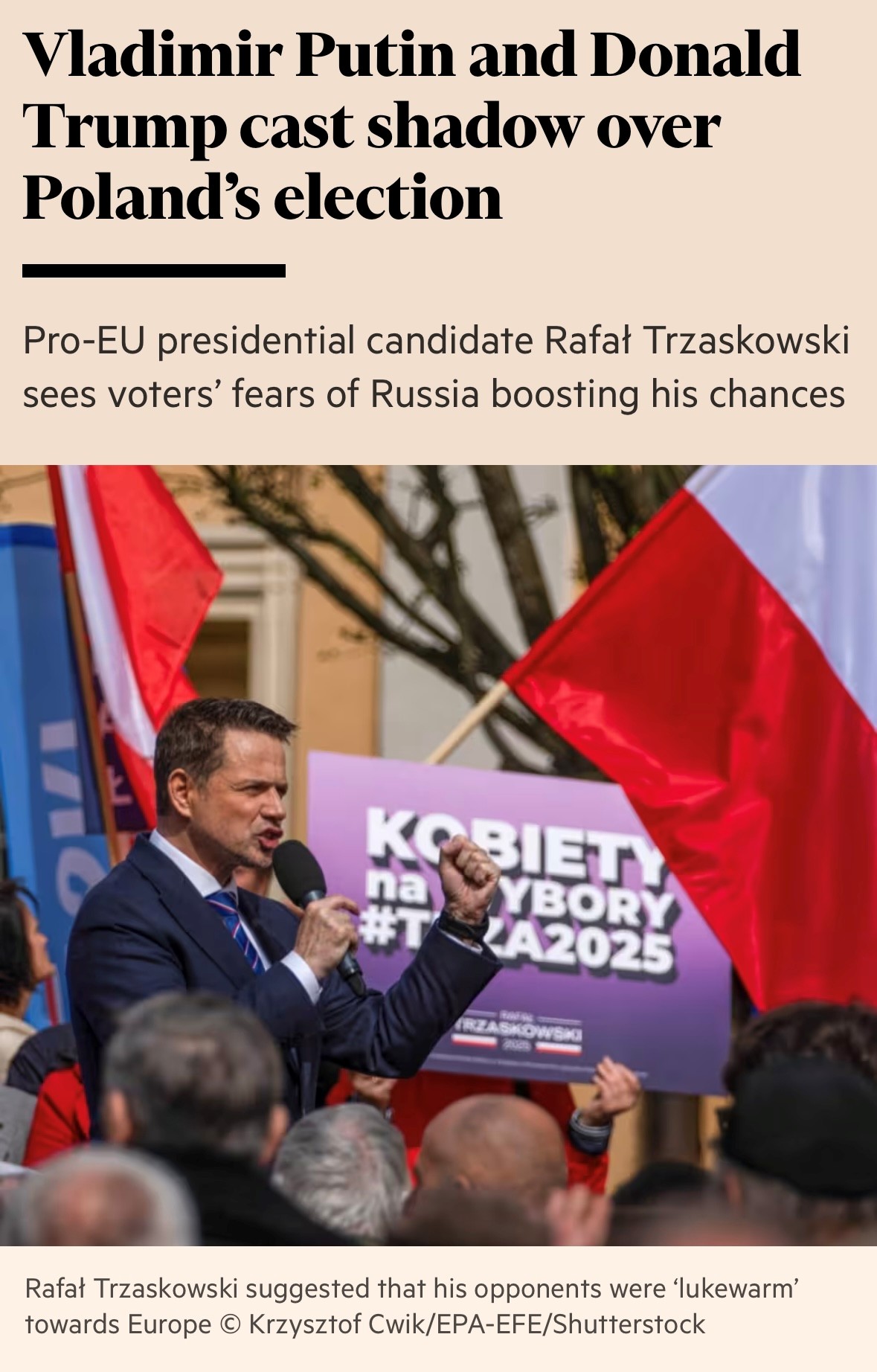
Rafal Trzaskowski, a pro-EU candidate, said he was more worried about Russian disinformation influencing voters than a disputed election result. “The Russians are everywhere and are trying to influence all elections, but I hope they will not be as effective here as they were in Romania.”
Poles do not forget their past!
And indeed :. .. poland is not only modernising but significantly strengthening its army, which could soon become the first in Europe (Russia aside), ahead of the German, French and – in the near future – also the British. And at the same time Warsaw – for years in close and growing harmony with Washington – could claim an increasingly important role within NATO, which it joined already in 1999 along with the Czech Republic and Hungary…
…Polish military spending.Already in 2021 – before the war – it exceeded the threshold of 2% of GDP that the Atlantic Alliance countries had agreed in 2006 but only five members had reached three years ago. Last year – the last for which data from SIPRI in Stockholm are available – Poland had leapt to first place with 3.83% of GDP devoted to the military, more than the United States (3.36%), although in absolute terms Washington obviously commands the ranking and reserves alone, under this heading, more than all the allies combined.
This year [2024] Warsaw will exceed 4 per cent, in 2025 it could reach 5 per cent. The surge is unparalleled throughout the Old Continent: from 2018 to 2023, in dollars (at current value, so inflation is also taken into account), investments in this area grew from 12 to 31 billion annually. These are also figures compiled by SIPRI.
The change of government in 2023 – from the conservative government of Jaroslaw Kaczynski to the liberal and pro-European government of Donald Tusk – did not affect this development, which materialises the National Security Strategy approved in 2020 and the Homeland Defence Act of 2022.
From around 120,000 men a couple of years ago, the army’s numbers should be increased to 300,000 men in 2035, including the newly created Territorial Defence. The issue of reinstating compulsory conscription was also put back on the table…
Conclusion: the Russian project for the United States directly concerns Europe as well, since NATO is, albeit informally, in a silence desired by Trump and Putin, disbanding.
Only a portion of Italians seem not to realise this. Or perhaps they simply do not feel like it.
[*] the second round will be held on 1 June.