Drafted 20 November 2022, updated 26 May 2025
Superstores: Esselunga loses share weakened by blows from new retail leaders
The players in the superstore format in Italy are Esselunga, the undisputed leader, with a share of over 40% of the total, then Selex, Coop, Conad, VèGè and Aspiag. This article describes in detail the evolution of these brands over the last six years by comparing average turnovers, turnover growth and relative market shares. A very interesting picture emerges
Esselunga is the ultimate expression of the superstore format in Italy, it is historically so, it has made it its hallmark, and it has met the challenge of time, which has finally proved it right. The average turnover of its shops is very high, although all market players who try their hand at this sales format find an excellent combination of attractive revenues and operating costs.
Who are Esselunga’s main competitors in this format today? What are the differences between the leader (Esselunga) and its competitors? Which of them is growing the most and with what values and market share? The loss of Coop’s leadership and the growth of Selex and Conad have coincided with a strong domination of these on these sales formats, but also on lower ones, as we have highlighted in another article. Isn’t there a risk of cannibalisation of turnovers? What are the differences between the different formats, in numerical terms? This article answers all these questions, going into the performance of the market players.
Let us start with Esselunga: the Pioltello-based company was the first not to chase the market and to bet much of its future, instead, on this sales format. As we have already written about twenty-five years ago, while all the others were concentrating their efforts on the large hypermarkets, the Lombard company opened superstores. Thanks to this gamble (which was obviously won) Esselunga achieved an exceptional performance that has allowed it to enjoy, over time, the credit that everyone gives it.
….
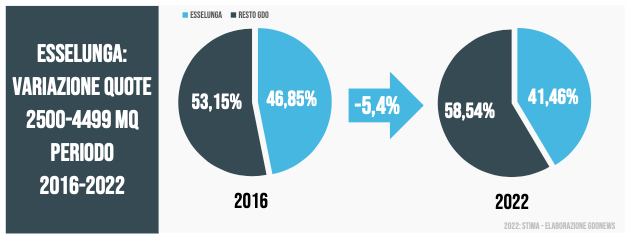
Let’s look at some numbers: the average turnover of a superstore, nationwide, is around 25/26 million euros. It must be borne in mind, however, that averages should always be interpreted. The Italian figure is in fact greatly influenced by Esselunga ‘s average turnover because this retailer, with less than two hundred shops, achieves a decidedly significant (superstore) market share of 41.5%. It is true that the weight of the Lombardy-based company has dropped a lot over time (only six years ago it held 47% of the market) but there is no doubt that its share remains preponderant today.
To understand the extent of the influence Esselunga exerts on the overall scenario, it is enough to know that one of its superstores invoices an average of 55 million euros, practically double the national reference figure.
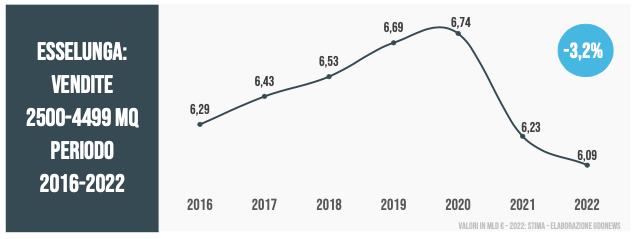
We would point out, however, that Esselunga’s turnover in the sector has been declining since the post-Covid period. This is not a major decrease but a slight decline of -3.2%.
Esselunga has a total turnover of EUR 8 billion thanks to the superstores, which account for about 75% of its turnover, but, as we have seen, it is losing share. This is because on these measures it has lost turnover (-3.2%) while the market, over the last 6 years, has grown significantly to be worth about 14.7 billion euros.
Second place goes to Selex, although it is far behind Esselunga. The group’s share is just under 14% while the turnover developed is around EUR 2 billion. It is interesting to note the increase in Selex’s turnover over the last six years in the segment. This growth was undoubtedly determined by the strong focus that the large groups linked to Selex have on super stores, but also by the incorporation of SUN.
The main players in SUN, in fact, such as Gabrielli and Gros, are companies that operate widely using the super store format. We can, therefore, attribute Selex’s exceptional increase of 64% to the two factors described above.
As we said, the average turnover per shop at national level is around 25/26 million, slightly down in the last two years. The average turnover of Selex, however, is lower and stands at just over EUR 15 million.
Between Esselunga, in first place, and Selex, in second, we therefore see two substantial differences, one relating to the share held and the other to the average turnover figure. Needless to say, the difference in revenue per shop stems from the greater number of Selex outlets which, unlike Esselunga, cover the entire country and are run by different operators with distinct commercial approaches.
After Selex, in third place, we find Coop. The two retailers are very close in terms of market share. However, the average turnover per shop of Coop is higher than that of Selex and is around 23 million Euro. The total turnover in the segment, on the other hand, is around 2 billion, slightly lower than that of the runner-up. For Coop, compared to 2016, we see an increase of 9.2%, given by an initial growth followed by a decrease after the Covid period.
Over the 6 years analysed, Coop’s market share has remained essentially constant. Unlike Selex, the cooperative giant practically took its foot off the growth accelerator and avoided massive development. In the past, Coop gained market share through the hypermarkets it used to become a leader. Only when it realised that the hyper segment was venturing into dangerous waters (losing sales), did it begin to react, trying to optimise its structure.
This is a reaction whose effects cannot be seen from one day to the next, but let’s say that, after a few years, Coop is coming back into balance, especially with its largest cooperative, Alleanza 3.0. In our opinion, despite the fact that other Coop Italia cooperatives operate with superstores, a good share of the 2 billion invoiced by Coop in the sector is to be attributed to Unicoop Firenze, which we think also contributes to significantly raising the average group turnover figure.
The superstores, for Coop, certainly represent a useful tool to compensate the (probable, in our opinion) losses from the hypermarkets. One can go to extremes by saying that such shops are essential in order to avert complex scenarios. In fact, as we have seen, the cooperative concentrates mainly on hypermarkets where it is the leader and only to a lesser extent on small and large proximity. The superstore, in this case, is practically the only segment capable of sustaining overall profitability.
Let us now turn to Conad, a player for which the same considerations made for Selex apply somewhat. We are witnessing an extraordinary growth of 66%, to which the acquisition of Auchan certainly contributed (just as the acquisition of SUN impacted on Selex). This is true because, in many cases, Conad has reduced the square footage of the former Auchan stores, effectively downgrading them from hyper to super stores.
In the mini-hyper segment a Conad shop invoices on average more than a Selex store but less than a Coop store. Conad’s market share increased, although not particularly, to 8.42%, which is still significant. Conad generates a turnover of 1,250 billion lire in the sector compared to 2 billion plus for Selex and almost 2 billion for Coop.
Behind Conad, we find VéGé, a player that has made the diverse multitude a strong point. Within this multitude, the presence of superstores (and hypermarkets) is important. The average turnover per shop is certainly interesting, close to that of Selex. It is a figure that, if we look back over the years, has fallen sharply. Given the fact, however, that the overall turnover in the sector, as expressed by VéGé, has seen a growth of 200% in six years (we are talking, however, about total values under one billion), we can say that the average turnover at the time of the aforementioned drop was certainly less indicative because it related to a period when group sales were about one third of today’s.
VéGé’s share is built from the aggregation of more heterogeneous groups than Selex and is almost 6%. Come to think of it, it is not that far from that of Conad and has, in any case, grown a lot, from 2.2% to 5.95%.
The last player we deal with is Aspiag. Unlike all the others, with the exception of Esselunga, Aspiag is a distribution centre that has always believed in the super store model and has focused strongly on it, although certainly not exclusively. Its turnover grew by 33% in the sector and its share is 4%.
In conclusion, let us say that the superstore is an area in which the best in the market are competing and represents the best part of those who suffer in the market (e.g. Coop). It is a world to be carefully monitored. In another article we have explained what threats characterise it, but it is important to bear in mind that it is one of those few sales formats that can still be counted on.
I have not reported all the graphs for various reasons. What has struck me, however, is that while all players except Coop (and Esselunga, of course) see their market share in the segment go up, their average turnover per point of sale goes down. And this, combined with the fact that the turnover of the entire sector is decreasing, is not a good sign at all.
To complete the picture read: Aldi takes over from Bennet in Viale Monza in Milan: what does it mean? (with insights from my book “Le Ossa dei Caprotti” ) and Food producers (big brands and not): what future?. In these two articles there are all the big market dynamics (discountabilisation and market saturation).
p.s.: the situation has improved in 2024 but the fact remains that Esselunga, for example, grows much less than Lidl and in fact, in 2025, the GDO Area 1 confirmation arrives punctually : discounters and supermarkets win, hyper and superstores badly.