

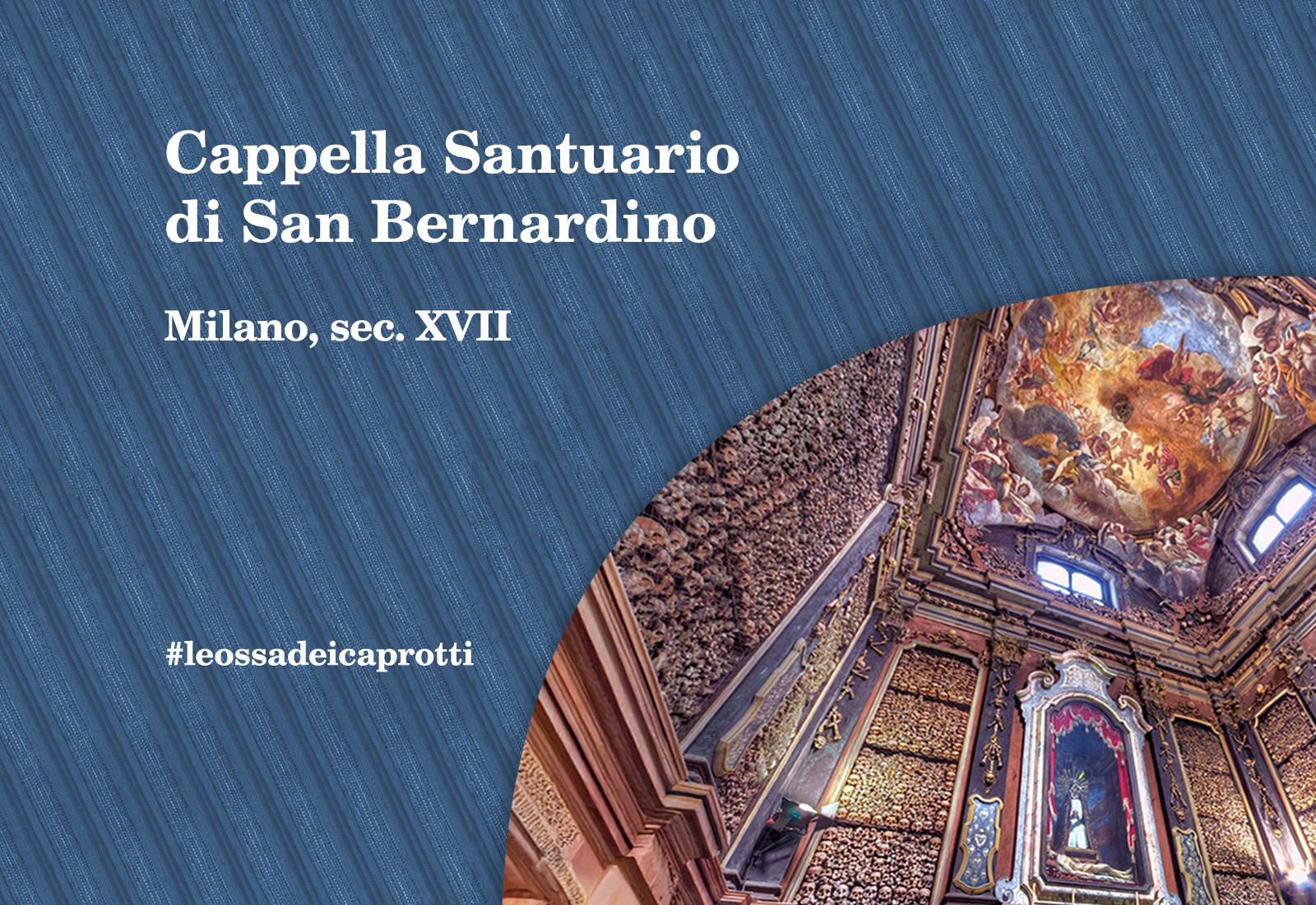
The photograph is taken from the official website of San Bernardo alle Ossa, https://www.sanbernardinoalleossa.it
“At home there are also many good times. (…) When he gives us some time, we take a trip together. On some occasions we go to Morimondo, where he goes hunting. Our father, however, has a fondness for the church of San Bernardo alle Ossa, in Piazza Santo Stefano in Milan, where he often takes us on Sundays. The shrine has the peculiarity of being decorated with hundreds of bones and skulls, accumulated since the 18th century when coffins were dug up from the nearby cemetery. And this detail, which to the eyes and imagination of us children is rather macabre, impresses us greatly. We will see that bones and cemeteries will almost be a kind of obsession in Bernardo’s life. (pp. 92-93).’.
HISTORICAL NOTE
In 1145, in the immense green space outside the Roman walls that stretched in the area from Via Larga onwards, a hospital was built by the munificence of a Milanese citizen, Goffredo da Bussero, not far from the basilica of S. Stefano near what is now Via del Brolo. A cemetery was built in front of the basilica to bury those who died in the hospital, but after a few years the available space proved insufficient. In 1210, at the end of the cemetery near the alley flanking the basilica (which still exists today), a chamber was erected to gather the bones exhumed from the cemetery. In 1268, the Prior and Brothers who ran the hospital had a small church dedicated to the Passion of the Virgin Mary, St. Sebastian and St. Ambrose built near the Ossuary. In 1340, a lay confraternity of Disciples obtained permission to build an Oratory above the small church to perform the functions prescribed by the pious Sodality and to guard the Ossuary and the small church below, to which the new patron St. Bernardo of Siena was added, after he was raised to the honours of the altars in 1450.
The small oratory is a 17th-century masterpiece, rebuilt from the foundations after the bell tower of the nearby church of St. Stephen collapsed and swept it away in 1642. Frescoed by Sebastiano Ricci, it houses a statue of Our Lady Dolorosa de Soledad, dressed in a white smock, covered by a black mantle embroidered in gold, similar to the Madonnas on display in churches in Seville, Toledo and other cities in Spain. The chapel-obsuary presents another motif of no small interest. The interior walls of the square building are almost completely covered with skulls and bones that were in the old Ossuary together with those that were exhumed from the suppressed cemeteries after the hospital was closed in 1652 by order of the administration of the Ospedale Maggiore, to which it had been attached some two centuries earlier. All the bones were arranged in the niches, on the cornice, adorning the pillars, decorating the doors. In this decorative motif, the macabre sense so typically Spanish blends singularly with Rococo graces. Tradition has it that many of the bones on display here were of Christians killed by Arian heretics at the time when St. Ambrose was bishop of the Church. Ambrose was bishop of the Milanese Church, a tradition that justified a cult that had reached the limits of orthodoxy, but in reality these are the remains of poor infirm people who died on the straw mattresses of the old Brolo hospital, Priors and Brothers who ran it condemned to be beheaded, prisoners who died in the prisons after their own cemetery proved insufficient in 1622, members of the highest Milanese nobility who rested in the sepulchres of the nearby churches, which were also now overflowing, canons of the nearby basilica of S. Stefano. But for the common people, that was the ossuary “of the Innocents” and they surrounded it with great veneration.
On the complex of San Bernardo, https://www.sanbernardinoalleossa.it
The cover photograph is taken from the official website of San Bernardo alle Ossa


