Drafted 13 May , updated 17 July 2025
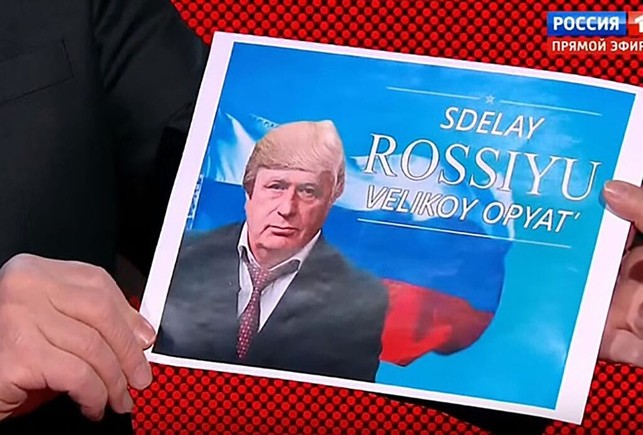
Vladimir Zhirinovsky, host of Vladimir Solovyov’s programme, shows a picture of himself as Donald Trump. 2016 // Rossiya 1, screen
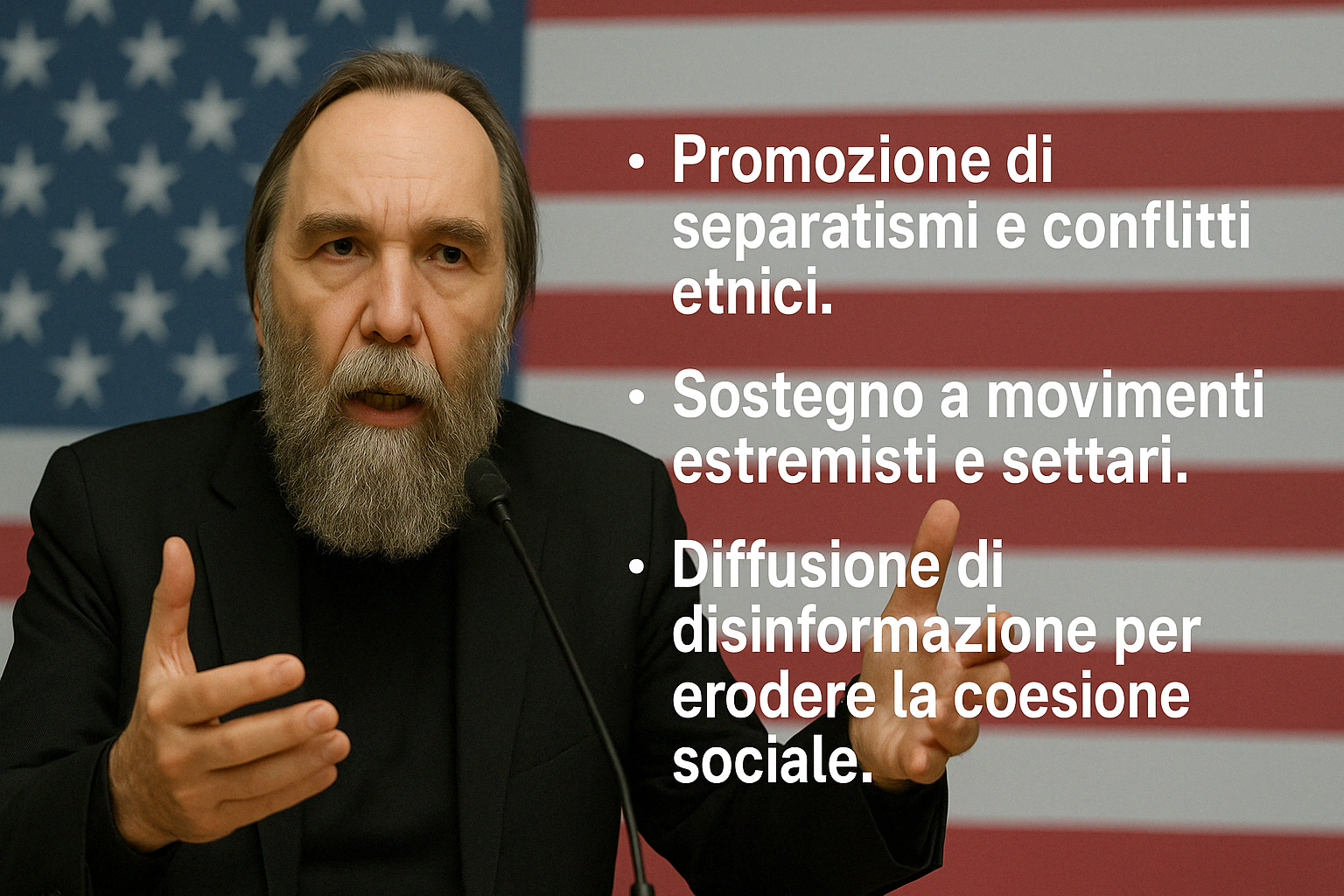
We reproduce the premise of the first excerpt of the Russian project for the United States : Putin’s inspirational source is called Aleksander Dugin, nicknamed ‘Putin’s Rasputin’, is an advisor to the Duma and the president of Russia.
he was also the founder and member of the National Bolshevik Party (*), the National Bolshevik Front and the Eurasia Party. Emblematic is the slogan he coined : ‘Russia is everything, the rest is nothing! “..
The term ‘Eurasia’ sounds familiar, because it is found in Orwell’s ‘1984’.
And here it becomes more disturbing because of the suggestion it evokes. Eurasia, in fact, according to the Orwellian account in the novel 1984, is one of the three continental superpowers born after the hypothetical atomic war of the 1950s invented by George Orwell. The form of government hypothesised by the great British writer is neo-Bolshevism, born from the ashes of the Communist Party of the Soviet Union.
For Dugin, therefore, this dystopian novel is not a warning: it is a model to aspire to. As an old Soviet philosopher, Dugin is anti-capitalist, anti-liberal, anti-democracy, pro-dictatorship. For Dugin it is Stalin rather than Lenin, the great ideological hero.
Like Putin, Dugin also believes that the dissolution of the Soviet Union was a disaster.Dugin in his writings proposes the re-establishment of the Soviet-era empire by force.
In 2008, when Putin invaded Georgia in the same manner as he invaded Ukraine, Dugin urged him to attack Ukraine…
This is the third excerpt from : The Russian project for the United States
By Françoise Thom, who studied classical literature, spent four years in the USSR from 1973 to 1978, graduated in Russian and taught history of the USSR and international relations at the Sorbonne in Paris.
Chaos in all directions
If paralysing the opposition and brainwashing Americans through propaganda is a copy of Putin’s methods, the Kremlin’s goal is clearly not to create a strong state across the Atlantic. As historian Ian Garner has said, Trump is a ‘directionless wrecker’, sawing off the branches he is sitting on. In addition to the very specific objectives pursued by Moscow mentioned above, which aim, on the one hand, to neutralise the US state’s immune system and, on the other hand, to put American resources at the service of Russian power ambitions, the Kremlin’s goal is to create an irreversible situation in the United States, making it ungovernable. The Russians favoured the election of Trump not because he was perceived as a strongman with whom they could get along, but because they saw in him ‘a wrecking ball’ [those used to knock down real estate] that would cause irreparable damage to the US.
Ever since the beginning of Trump’s blitzkrieg against the US establishment and traditional US allies, people have clung to rational explanations for his behaviour: Trump is attacking NATO countries to make them pay more for their defence; Trump is flirting with Russia to distract it from its alliance with China, since his administration’s priority is Sino-US confrontation. In reality, as David Frum, a columnist for The Atlantic newspaper, recently demonstrated , these rationalisations do not stand up to scrutiny: for example, Trumpians support the AfD in Germany, despite that party being hostile to increased military spending; and in Asia, everyone understands that the abandonment of Ukraine prefigures that of Taiwan. Trump’s policy is not isolationist; it is predatory and not at all hostile to ‘ regime change ‘, as Vance’s speech in Munich demonstrated. The same applies to the economy. Many American observers believe that Trump is deliberately sabotaging everything. But even here we invent rationalisations. Thus, Saikat Chakrabarti, a progressive Democrat, accuses Trump of ‘creating a recession’ on purpose to enrich his favourites: ‘This seems logical if you know that his goal is to create a Russian-like economy, run by a handful of oligarchs loyal to him. […] Creating such a state is difficult in a large, dynamic and powerful economy where too many actors can oppose it. Therefore, it accelerates the concentration of money and power in the hands of his followers, crushing the rest’.
The truth is that, outside the areas that directly affect it, the Kremlin favours maximum chaos in America and one would think that it gives free rein to the devastating impulses of its protégé. Moreover, thanks to his infallible talent for destruction, he has found fanatical supporters among Silicon Valley billionaires. It was thanks to them that the Republican Party turned into the Russian Party, a change that became evident in July 2024, during the Republican National Convention, which marked the triumph of the isolationist line. David Sacks, a technology oligarch, accuses President Biden of being responsible for the Russian invasion of Ukraine: “He provoked – yes, provoked – the Russians to invade Ukraine by talking about NATO expansion. Subsequently, he rejected any possibility of peace in Ukraine, including an agreement to end the war just two months after it began.”, while Marjorie Tailor Greene, Putin’s staunch supporter, lashed out at the ‘globalists’.
On 4 January 2025, Dugin boasted: ‘I have many good friends in the United States’ . And he congratulated himself on ‘the revolution of the brothers and the shift to the right’.
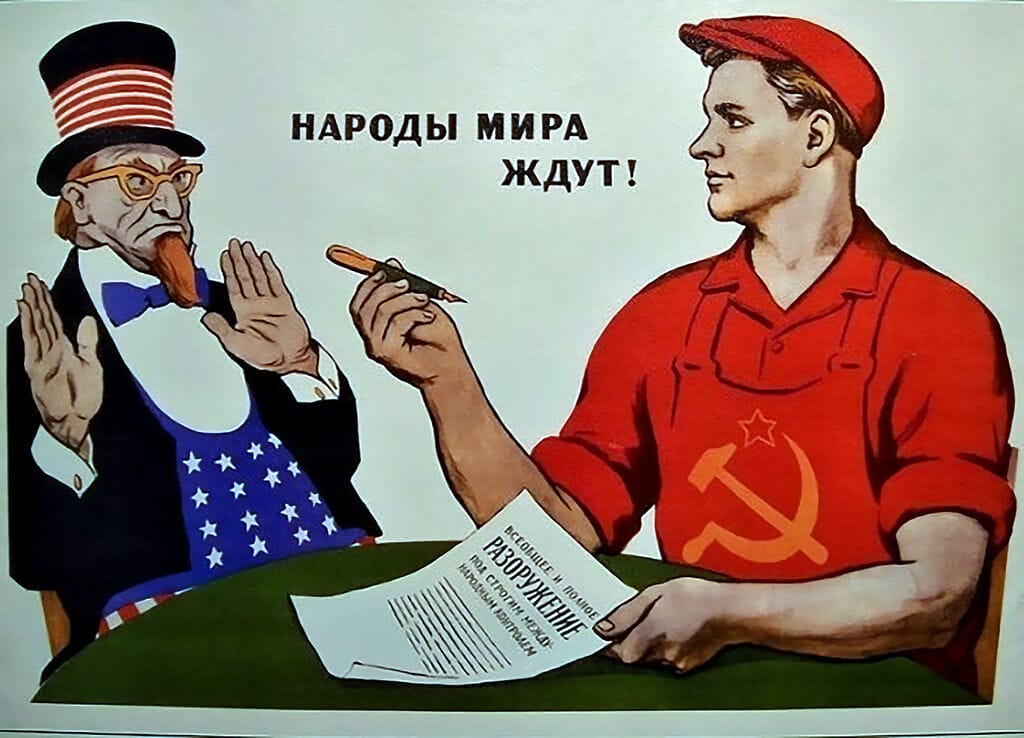
Leonid Rakov. Imperialism is aggression. 1966 Soviet Manifesto // Public domain
Allies of the Kremlin: Silicon Valley’s ideological project
Of course, the Kremlin-led US state-demolition initiative cannot be seen in its true nature as the kidnapping of a state by a hostile power. Carrying out the cover-up are the ideologues of Silicon Valley, whose goal is the same as Moscow’s: to destroy the American state. Let us see how the dogmas propagated by the so-called Tech Bros converge with the Kremlin’s plan for America, while masking it at the same time.
Let us start with their guru, the sulphurous Curtis Yarvin, author of a plan called RAGE (retire all civil servants). This former technology entrepreneur is one of the most influential thinkers of the pro-Trump far-right. Yarvin is the founder of an anti-egalitarian movement called ‘ neo-reaction ‘, which emerged on the Internet in the late 2000s and combines a classically anti-modern and anti-democratic worldview with a battle cry for technological capitalism as a means of human governance. In 2008, the young Yarvin proposed a rational solution to the problem of ‘unproductive’ waste: ‘Convert it into biodiesel, which can help fuel public transport’. But, he adds , “the problem with the biodiesel solution is that no one would want to live in a city whose public transport was fuelled, even in part, by the distilled remains of its former working classes. However, it allows us to address the problem we are trying to solve. In a word, our goal is a humane alternative to genocide. ‘ Yarvin claims to have found the answer: it is to ‘virtualise’ these people by imprisoning them in ‘permanent isolation’ where, to prevent them from going mad, they would be connected to an ‘immersive virtual reality interface’ so that they can ‘live rich and fulfilling lives in a completely imaginary world’. In 2012, Yarvin wrote: ‘If Americans want to change their government, they will have to overcome their phobia of dictators’. His ideology, called ‘Dark Enlightenment’, advocates the end of democracy: ‘I do not believe in the right to vote’ or ‘ Democracy is weak and obsolete’. In Yarvin’s worldview, it is not elections that make democracy work, but the illusions projected by a series of institutions, including the press and universities, in cahoots with the federal bureaucracy, into a nebula he calls the Cathedral. This invisible Cathedral is all-powerful because it is present everywhere and nowhere, woven into our way of life, our ways of communicating and thinking. “For all revolutionary purposes,” Yarvin wrote in May 2020, “the deep state is as decentralised as Bitcoin and as invulnerable to ballots as it is to bullets. “
On the other hand, Yarvin admires the way the Chinese state resorts to violence. He believes that China’s ‘zero Covid’ total surveillance policy in the face of the pandemic involves ‘fewer Covid-related restrictions than those imposed on citizens of the most republican state in the United States’. For Yarvin, even if libertarianism is right about the best way to organise society, its weakness is that it fails to take power seriously. What is needed is an all-powerful state, a sovereign Leviathan, capable of imposing order by force, with such absolute authority that it can then disappear from everyday life. The state ‘should be run like a business with a CEO at the head who has the same powers as an absolute monarch’, i.e. someone who is not accountable to his people or the law . States are to be dissolved and replaced by smaller territories, a kind of high-tech phalansteries or even floating islands, competing with each other and ruled by technology billionaires: one is reminded of the exotic fiefdoms ruled by the villains we see in James Bond films. We will then have network states or patchwork states. Curtis Yarvin writes: “The basic idea of Patchwork is that as the failed governments we have inherited from history are dismantled, they must be replaced by a global web of tens, perhaps hundreds of thousands of sovereign, independent mini-countries, each governed by its own corporation, regardless of the opinions of its inhabitants.”
Tech millionaires believe they will be in control in a world ruled by artificial intelligence. Musk aims to control the global financial system through X. Approaching power, the Silicon Valley billionaire sect is taking an increasingly millenarian approach. The tech bros are convinced that states will collapse and that we are heading for the apocalypse. This is particularly the case for Peter Thiel, a close friend of Curtis Yarvin. For him, democracies are obsolete. “I no longer believe that freedom and democracy are compatible “ thiel wrote in 2009. “The great task of libertarians is to find a way out of politics in all its forms, from totalitarian and fundamentalist catastrophes to the unreflective demos that drives so-called ‘social democracy'”. He dreams of reshaping nature, challenging “the ideology of the inevitability of death for every individual “. He plans to live to be 120 years old. Obsessed with the apocalypse (he wrote an essay on the subject), Peter Thiel had a bunker built in New Zealand in which to take refuge at the end of time (he spent the Covid pandemic there). Like Dugin, Thiel seems to believe in a global conspiracy that Trump’s rise to power will unveil. This is what he said in early January, in an article published by the Financial Times, hailing ‘Trump’s return to the White House’ that ‘presages the apocalypse of the old regime’s secrets. The apocalypse is the most peaceful way to resolve the old regime’s war against the Internet – a war that the Internet has won…” And singing the verse about the “state-funded media organisations, bureaucracies, universities and NGOs that traditionally demarcated public debate “.
Although many of these billionaire ideologues are educated people, their writings reveal the personalities of backward adolescents, unaware of the consequences of their actions and words, perhaps because they are used to evolving in a virtual universe of science fiction or video games, where everything is reversible. These computer geniuses have reptilian brains, alien to ethics and empathy, indifferent to truth and allergic to law. Their dominant passion seems to be transgression. They resemble our 68-year-olds, admirers of the Maoist cultural revolution. For them, the latest chic trend is to flaunt an iconoclastic attitude, to impress the bourgeoisie, especially if they know nothing about what they are talking about. Musk then explained in great detail that ‘Stalin, Mao and Hitler did not murder millions of people. It was their civil servants who did it’ in short, another coup d’état by the Deep State!
All this makes this environment very receptive to the teachings of Russian propagandists, rich in their unique experience in manipulating crowds. Starting with the alt-right movement, combining neo-Nazis, nationalists and monarchists, of which Richard Spencer is the founder. His former Russian wife, Nina Kouprianova, Dugin’s translator, allowed him direct contact with Vladimir Putin’s entourage. Dugin and Vladislav Surkov, the architect of Putin’s regime, are believed to have exerted a strong influence on the alt-right movement. For Surkov, the goal of propaganda is not simply to spread lies, but to completely destroy the ability to process information. Steve Bannon, the creator of MAGA propaganda, noted: ‘It’s not about persuasion: it’s about disorientation. ” ‘Darkness is good…. It only helps us when people make mistakes. When they don’t see who we are or what we do.” “ The main target is not the opposition,” Bannon explains. “The Democrats don’t matter, ” he told writer Michael Lewis in 2021. “The real opposition is the media. And the way to fix that is to flood the zone with shit. “
British documentary filmmaker Adam Curtis defined Surkov’s work this way: ‘His aim is to undermine people’s perceptions of the world, so that they never know what is really going on.’ Surkov has turned Russian politics into a puzzling and ever-changing play. He has financed groups of all kinds, from neo-Nazi skinheads to progressive human rights groups. He has even supported parties opposed to President Putin. But the key thing is that Surkov then made it known that he was behind these groups, so that no one would ever know for sure what was true and what was false. As one journalist described it: ‘It is a power strategy that keeps the entire opposition in permanent confusion. Such perpetual and incessant change is unstoppable because it is indefinable. ‘ Speaking of the war against Ukraine, Surkov noted that ‘the underlying goal is not to win the war, but to use the conflict to create a permanent state of destabilised perception, in order to manipulate and control’. Compare this with Ian Gardner’s description of Trumpian America : ‘Confusion is not a malfunction or an unintended effect: it is the real engine and purpose of the Trumpian spectacle that continually generates attention. Gardner also diagnoses the dangerous spiral of escalation that occurs in regimes where the cult of personality prevails and where the masses are associated with power only for destruction: ‘ The further the government goes, the more demanding the crowd becomes. In an exponential dynamic, spectacular power can only lead to bigger, bolder, more outrageous acts of destruction.” “Trump’s politics involves an aesthetic of total destruction, because only participation in destruction and dismantling seems to open up a political option to the disenchanted: the semblance of a possibility of action.” It was this logic that led to Russia’s war against Ukraine. The dictator, feeling illegitimate, feels compelled to continually accumulate new successes, for fear of losing his grip on the masses.
The osmosis between Silicon Valley ideologues and some ideologues of the Putin regime is evident in a futuristic article by Vladislav Surkov, published on 11 October 2021, entitled ‘Democracy in the Desert and Other Political Wonders of 2021’. Surkov argues that parliamentary representation is no longer necessary as the wishes of the population can be communicated instantly via the Internet. In short, political representation is to be thrown out the window and replaced by algorithms. Only computer scientists and siloviki will remain in charge, managing the artificial intelligence giants from behind the scenes. “The digitisation and robotization of the political system will lead to the creation of a high-tech state and democracy without human beings […] in which the hierarchy of machines and algorithms will pursue goals beyond the understanding of the people who serve them.”
The Kremlin’s next step: making the American turn irreversible
How do you see the American situation in the Kremlin? Unlike the Americans, who do not understand anything about Russia and are not interested in the issue, the Russians have acquired an in-depth knowledge of the United States. They have an in-depth knowledge of the American mentality and politics. For them, the Trump phase is a first step, but the victory is not yet final. ” Donald Trump is like our Zhirinovsky “ says Margarita Simonian. This comparison speaks volumes. Recall that Zhirinovsky’s party was first founded by the KGB after the Communist Party abolished its monopoly on power in 1990, in order to discredit democracy in the eyes of both Russians and Westerners. Zhirinovsky plays the role of a court jester who can say anything with impunity and whose words are of no consequence. In his election programme in the spring of 1991, he promised to feed Russia in 72 hours: ‘I will send a troop to the former GDR, 1.5 million men, I will raise the nuclear threat and everything will be provided… We will send strikers to prison, racketeers abroad to defend Russian national interests, we will bring in workers from abroad who will work for us kindly for 100 roubles a month’. He promised to provide a man for all Russian women, to distribute free vodka to all.
In time, Zhirinovsky’s role will expand. His role will be both to break down taboos and to build an alternative reality in which the good Russian people will be enclosed as if in a bubble. Zhirinovsky will acclimatise the cult of violence in Russia, promote military expansionism, global racketeering and dictatorship. Having greatly accelerated the moral degradation of the Russians by appealing to their worst instincts, he paved the way for the construction of a new political system made possible by this mutation of humans back to the reptilian brain. With Putin’s rise to power, the jester gave way to the serial killer….