Drafted 19 November 2024, updated 1 July 2025
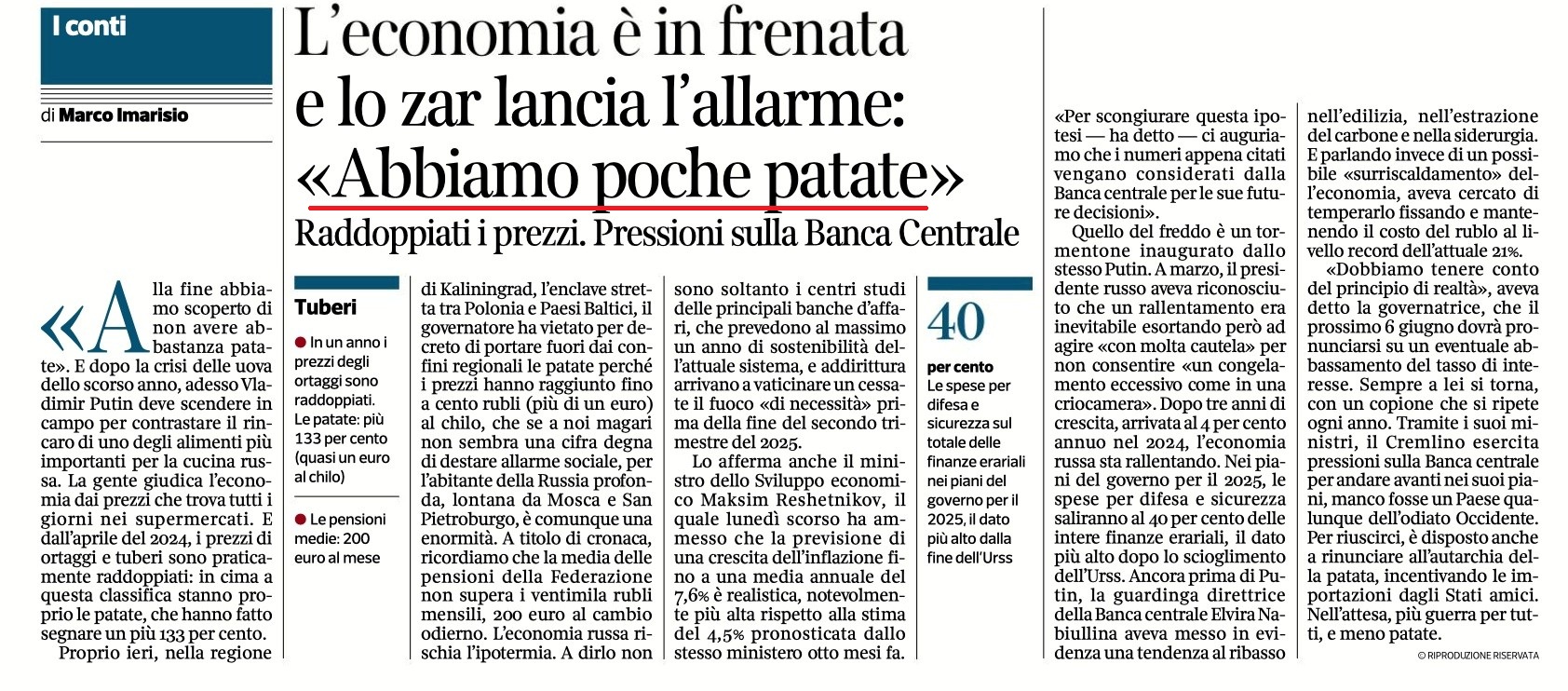
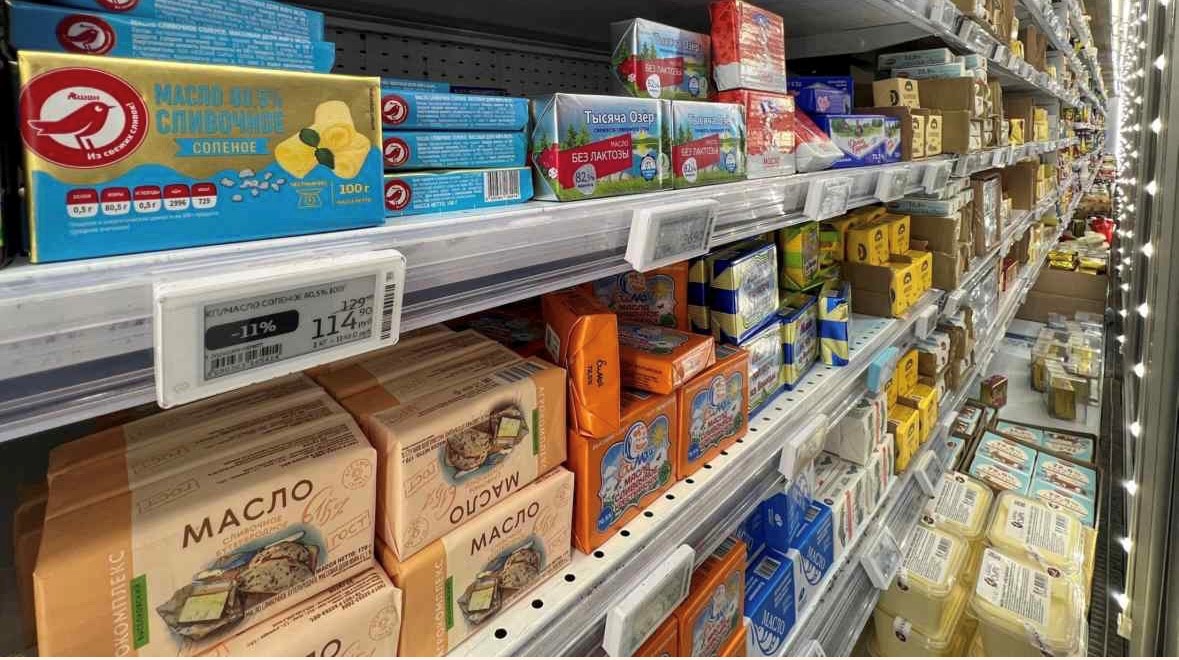
Above: butter on the shelves of an Auchan hypermarket (which has also decided to leave Russia). The price of butter increased by 26% year on year. Compiled 17 November, updated 19 November 2024
Butter thefts highlight the cost of Russia’s war economy
by Anastasia Stognei in Tbilisi and Max Seddon in Riga
Thefts of butter parcels highlighted the impact of skyrocketing inflation on Russia’s war economy.
President Vladimir Putin’s ‘out-of-control spending’ on arms and ammunition has helped Moscow maintain a battlefield advantage in Ukraine, but has caused rising prices for essential goods consumed every day.
Security footage in Yekaterinburg, the capital of Russia’s defence industry, recently captured two masked men breaking into a dairy shop. When one broke into the cash register, the other collapsed with 20 kg of butter.
Alexandra Prokopenko, manager of the Carnegie Russia Eurasia Center in Berlin [dairy company], said: ‘Your average butter-skimming factory would be more than happy to meet demand and even work three shifts. But there are not enough people to hire.” ‘You cannot fight inflation and a war at the same time,’ he said.
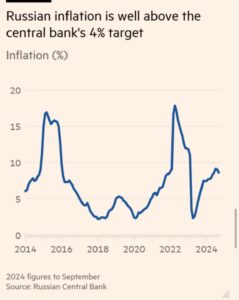
Russia’s central bank has estimated that inflation could reach 8.5 per cent this year, double its target. Consumer goods are becoming more expensive at a faster pace: butter prices have risen 26% year-on-year, prompting some shops to sell it in plastic boxes with magnetic [anti-shoplifting] locks.
Putin called on officials to stabilise the Russian economy and the central bank raised its key interest rate to a record 21% in October. But the president showed no indication of supporting defence spending, set for a record Rbs13.5tn ($138bn) in next year’s budget. “This is a classic case of targeting a ‘war economy beyond its [Russia’s] capacity,'” said Elina Ribakova, senior fellow at the Peterson Institute for International Economics.
High defence spending has led to a rush to hire in the sector, where many factories work in three shifts. This has sent unemployment to an all-time low of 2.4 per cent and forced private employers to raise wages to compete, making it almost impossible to increase production of goods and services without raising prices substantially.
Central bank governor Elvira Nabiullina told parliament at the end of October that persistently high inflation is a sign “thatdemand has significantly exceeded the economy’s production capacity“. “In some sectors, there is hardly any idle equipment left, not even obsolete machinery,” she said.
The chart below shows that Russian inflation is well above the central bank’s 4 per cent target
The out-of-control defence spending came at the same time as Russia’s declining commodity export revenues (*), difficulties in converting the rouble, and pressure from the US limiting payments for goods, increasing supply-side costs for everyday items.
This has left Russia increasingly dependent on imports at a time when the country actually has no way to limit their costs. “A year ago, I bought the same set of winter thermals for my daughter, one size down. The price doubled,” said Maria, mother of a three-year-old in Moscow. “I don’t understand why some people say nothing has changed. How much reality can they deny?” The additional defence spending means that the effects of inflation are felt differently depending on how close Russians are to the defence sector. Over the past seven years, wages in IT, heavy industry and construction have increased by 170%, according to the Russian state statistics provider Rosstat. In education and municipal services, meanwhile, they increased by 10% to 20%.
Nabiullina said in the State Duma: ‘Inflation is a direct deduction from citizens’ incomes. Wages and incomes are not rising for everyone, and there is a significant disparity’.
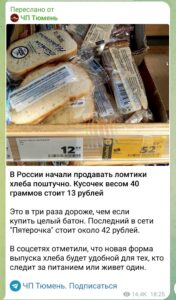
And in Europe, thefts of tons of high-quality cheeses from Parmesan to cheddarare on the rise. Below: even bread would be hard to find.
Revealing the motive, an investigation by the BBC tells of a multi-million euro a year black market that circumvents all sanctions and borders.
In the UK, a Welsh producer was swindled with a fake online order via a specialised website, which turned out to be a £300,000 heist, with containers of tomes disappearing into thin air.
What attracts the fences, above all, is the foreign market. In particular, Russia would be the final destination of many stolen loads, with routes via Belarus and Georgia.
Meanwhile, Coldiretti is also sounding the alarm: cheese is the most stolen food in the world.
The number one target is precisely our Parmigiano Reggiano, to the point that many supermarkets have adopted countermeasures, protecting the cheeses displayed on their shelves with anti-theft packaging.
Producers are also running for cover, adopting microchip forms with product-specific identity cards.
The only thing to smile about is the analogy with inflation and egg theft in the United States.
From the management of the war come other signs that confirm this situation :
- Moscow and the worsening accounts: cut in compensation for the wounded, the first sign of a turnaround
- The collapse of the rouble. The latest US sanctions hit hard. The currency is back to values not seen since the beginning of the war after Washington’s measures against Gazprombank and other Russian banks. “Solutions will be found, it’s impossible to completely block a country like Russia,” the Kremlin reassures, but the financial reaction to Putin’s military threats has hit home ( 27 November 2024)
- ‘Nobody expected to come back’: a former soldier reveals the dark reality of North Korea’s troops in Russia.
- Russia is now a war economy, here’s why Putin will never sign peace
Read also : Russian propaganda between bots, bitcoin and donations. And in Russia , as in the former USSR, food bartering is resurfacing.
Below: now missing potatoes (29 May 2025). confirmation on the state of the economy comes less than a month later, in June 2025 : Russia on the brink of recession, says Economy Minister