Compiled 17 April, updated 19 April 2026
For years, cocoa has been treated as a commodity: present in hundreds of references, manageable with seasonal contracts, relatively stable. Between 2024 and 2025, this approach has been overturned.
The price crisis: rise and correction
In 2024, cocoa futures reached unprecedented levels: at peaks over USD 10,000-11,000 per tonne on the New York and London markets, with even higher intraday peaks. The boost came from disappointing harvests in West Africa and a set of structural fragilities that all came together.
During the course of 2025 and early 2026, the market experienced a sharp correction: quotations fell back towards USD 3,000-4,000 per tonne, returning to the historical levels the market knew before the speculative flare-up. We are back, in essence, to the reference prices of the pre-crisis period. Which, in itself, is not enough to speak of normalisation.
The market remains volatile. The fluctuations reflect a fragile balance between expectations of production recovery, industrial demand and speculative dynamics that do not end with a single agricultural season.
The industry’s initial responses
The pressure on the cocoa supply chain is already producing reactions also in terms of product innovation.
Nestlé, the world’s largest food group, announced the launch in Germany of a new line of snacks developed without using traditional cocoa. The product – called Snack Vibes and linked to the Choco Crossies line – has been developed in collaboration with German start-up Planet A Foods, which uses alternative fermentation and ingredient processing technologies to recreate the aroma and texture of cocoa.
The commercial debut is planned for April 2026 in the German market.
A concentrated geography of risk
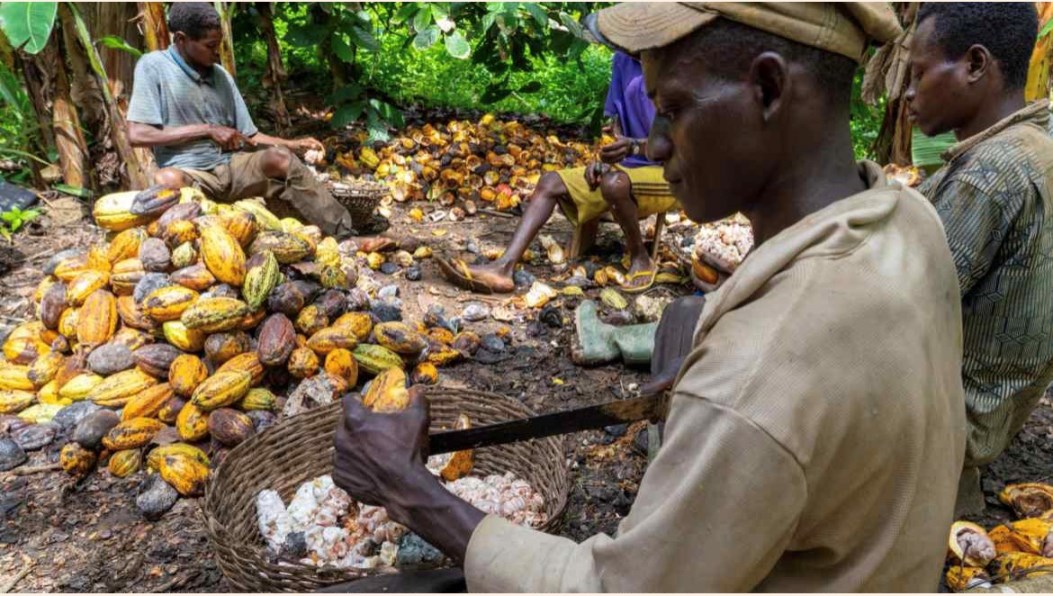
Côte d’Ivoire and Ghana produce more than 60% of the world’s cocoa. This concentration is the primary risk factor. It is not new, but became more visible when the harvests in these two areas began to fail systematically.
Cocoa is a demanding crop: it reacts to erratic rainfall, off average temperatures and plant diseases. In such a concentrated production system, even moderate climatic variations quickly translate into strains on the overall supply.
Alongside climate, there are long-term criticalities that cannot be resolved in one season: ageing plants, poor variety renewal, stagnating productivity. The Cocoa Barometer has been repeating this for years: when producers’ incomes remain too low and unstable, there are no conditions to invest in field maintenance, tree renewal or more robust agronomic practices.
The result is a circle that is difficult to break. Cacti do not renew themselves in a few months: several years pass between planting and full productivity. If several consecutive harvests turn out to be below average, the chain cannot recover quickly – and complicating matters are land fragmentation, difficult access to credit for small farmers and structural dependence on commercial intermediaries.
The supply chain lags behind the financial markets
There is a structural asymmetry that those who manage large-scale retail purchases know well: the financial markets react in hours, the physical supply chain in months or years.
Seasonal harvests, complex post-harvest processes, biological planting times, fragmented production among millions of small growers. When prices go up, supply cannot adjust quickly. When they fall, hedging contracts signed at higher prices continue to weigh on accounts for months more.
Therefore, even when prices fall, the reflection on consumer prices is slow and partial. Stocks bought at peak prices have to be disposed of. Hedge contracts have their own maturities. The end consumer, in the meantime, has already experienced the price increase – and does not always tolerate well that the downturn does not transfer with the same speed. For private label operators with a significant cocoa component, this is a value perception risk that must be kept under control.
The new European regulation: EUDR
Complicating the picture is the regulatory change. TheEU Deforestation Regulation (EUDR) – which introduces obligations for geolocation of agricultural plots, documentation of origin and stringent controls along the entire chain – is not yet operational: implementation has been postponed until December 2026. But the direction is set, and the most structured supply chains have already started to adapt.
Compliance will become a structural cost. Those who manage large volumes or highly fragmented supply chains will feel it the most. Those who moved earlier will have a competitive advantage in supplier management and transparency towards the consumer.
Three concrete impacts also for the retail sector
What changes, operationally, for those working in large-scale distribution?
Firstly, price management. Price volatility translates into pricing pressures that do not follow linear rhythms. Planning promotions, managing category margins, negotiating with suppliers: everything becomes more complex in a market that can move hundreds of dollars per tonne in a matter of weeks.
Second, the composition of products. When costs remain uncertain, the pressure to reformulate or reduce weights increases. This is nothing new, but with cocoa the phenomenon has taken on unprecedented dimensions. The consumer is attentive:shrinkflationstrategies are perceived and commented on.
Thirdly, the private label. Maintaining perceived quality and competitive price in branded products with a high cocoa content has become more difficult. The premium positioning of the private label – where cocoa is often a key ingredient of the quality promise – risks being eroded if the consumer price remains high while the raw material falls. Timing management is decisive.
Cocoa has become a system indicator: climate fragility, geographical dependence, biological timing that does not compress, financial speculation, new traceability rules. Those working in distribution can no longer treat it as a background variable. It has become, to all intents and purposes, a strategic raw material.
Conclusion :
three different cases confirm the changes taking place:
“If that were true, credit would go to the loyal fans who have been alarmed by Hershey’s actions,” Brad Reese told NBC News on Wednesday. “But I see a lot of warning signs. I think Hershey is trying to change the narrative through PR.”
Reese, whose calls for Hershey to stop skimping on chocolate went viral in February, said he trusts his palate more than the company that makes the iconic candies that bear his family name.
“If a product like Reese’s Mini Heart on Valentine’s Day still doesn’t taste like real milk chocolate next year, I’ll know they’re lying,” she said.
The announcement was made in early April by Hershey’s CEO Kirk Tanner in an interview with Bloomberg.
2) Shares of the world’s largest chocolate producer, Barry Callebaut, plummet as cocoa prices fall(Financial Times). The company reduces profit forecasts and warns of industry overcapacity and supply chain disruptions. The group, which supplies chocolate for products such as Magnum ice cream and Nestlé KitKat bars, said recurring EBIT fell 4.2 per cent in the first half to 310.9 million Swiss francs ($397 million) in local currency. Sales volumes fell 6.9% to 1.01 million tonnes, although the company said this was a better performance than the market in general in a market where demand is weak due in part to the spread of GLP-1 slimming drugs.