[vc_column_textDrafted 3 March, updated 4 March 2025
A Horrible Scene
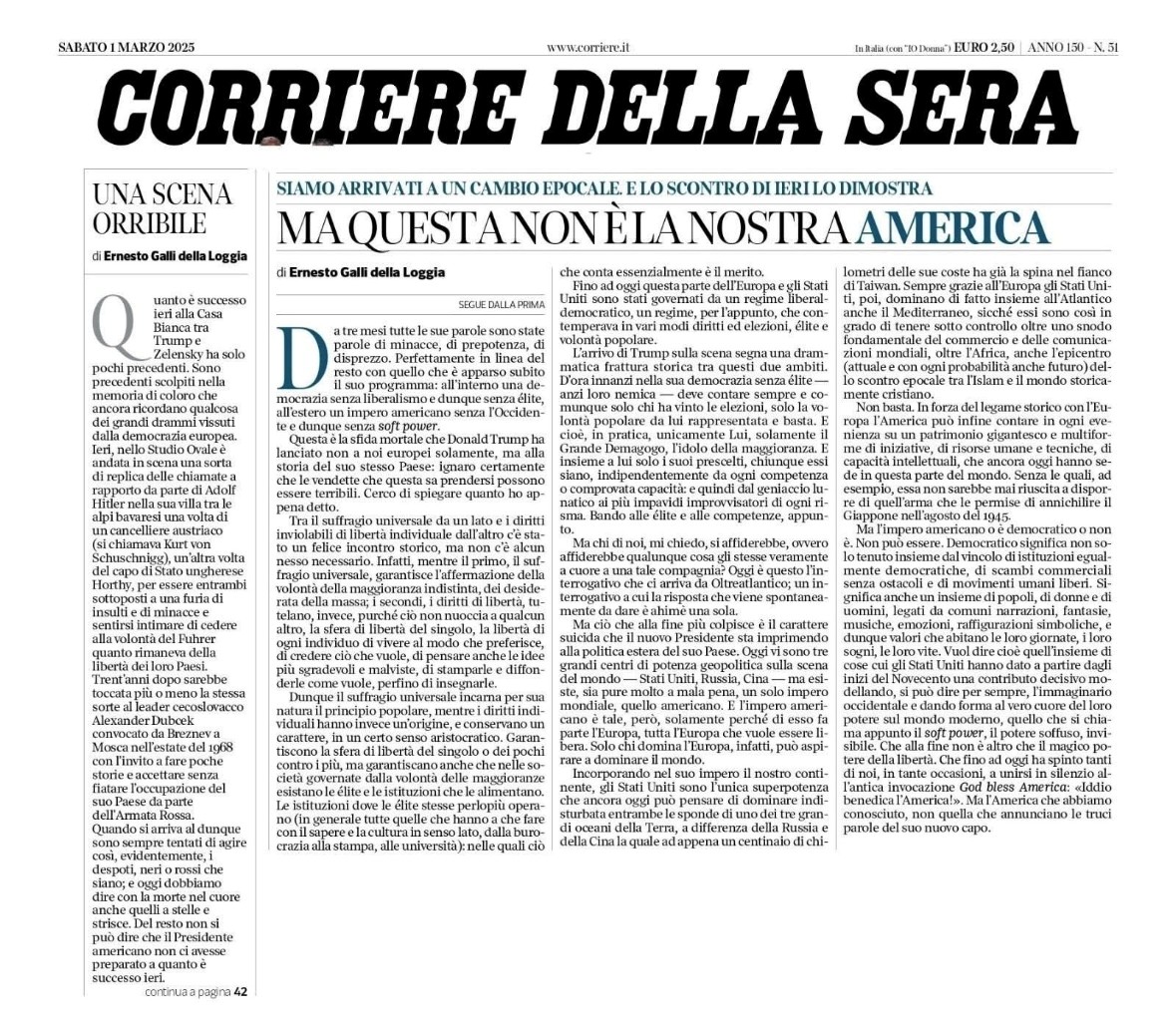
by Ernesto Galli della Loggia
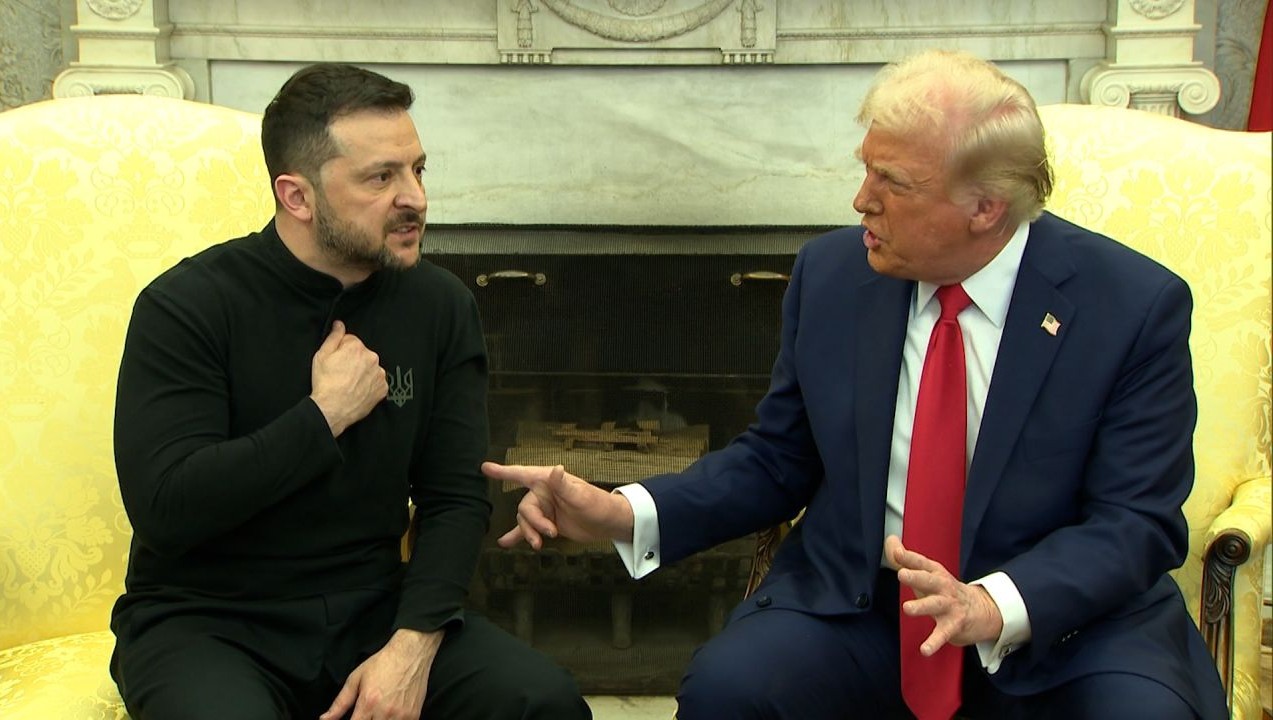
What happened yesterday at the White House between Trump and Zelensky has only a few precedents. They are precedents engraved in the memory of those who still remember something of the great dramas experienced by European democracy. Yesterday, the Oval Office was the scene of a sort of repetition of Adolf Hitler’s summonses to his villa in the Bavarian Alps, once of an Austrian chancellor (his name was Kurt von Schuschnigg (*)), another time of the Hungarian head of state Horthy, both of whom were subjected to a fury of insults and threats and were ordered to surrender what remained of their countries’ freedom to the Führer’s will.
Thirty years later, more or less the same fate would befall the Czechoslovak leader Alexander Dubcek, summoned by Brezhnev to Moscow in the summer of 1968 with the invitation to make little fuss and accept the Red Army’s occupation of his country without a word. When it comes right down to it, despots, whether black or red, are evidently always tempted to act in this way; and today we must say, with death in our hearts, those in the stars and stripes as well. After all, it cannot be said that the American president had not prepared us for what happened yesterday.
(*) Schuschnigg committed suicide during the Anschluss (the invasion of Austria by Germany in 1938).
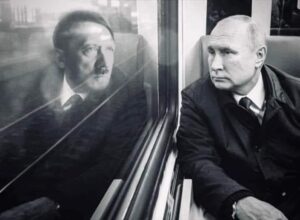
Below: a juxtaposition between Putin and Hitler, found on the net.
This is the mortal challenge that Donald Trump has launched not only at us Europeans, but at the history of his own country: certainly unaware that the revenge it can take can be terrible. I try to explain what I have just said.
Between universal suffrage on the one hand and the inviolable rights of individual liberty on the other there has been a happy historical encounter, but there is no necessary link. For while the former, universal suffrage, guarantees the assertion of the will of the indistinct majority, of the wishes of the masses; the latter, the rights of liberty, protect, on the other hand, provided it does not harm anyone else, the sphere of freedom of the individual, the freedom of each individual to live as he pleases, to believe what he pleases, to think even the most unpleasant and ill-liked ideas, to print and spread them as he pleases, even to teach them.
Thus, universal suffrage by its very nature embodies the popular principle, whereas individual rights have an origin, and retain a somewhat aristocratic character. They guarantee the sphere of freedom of the individual or the few against the many, but they also ensure that in societies governed by the will of the majority there are elites and the institutions that nurture them. The institutions where the elites themselves mostly operate (in general, all those that have to do with knowledge and culture in the broadest sense, from the bureaucracy to the press to the universities): in which what essentially counts is merit.
Up to now, this part of Europe and the United States have been governed by a liberal-democratic regime, a regime, in fact, that balanced rights and elections, elites and the will of the people in various ways.
Trump’s arrival on the scene marks a dramatic historical fracture between these two spheres. From now on, in his democracy without elites – indeed their enemy – only those who won the elections must count, only the will of the people he represents, and that is all. That is, in practice, only he, only the Great Demagogue, the idol of the majority. And together with him only his chosen ones, whoever they may be, irrespective of any competence or proven ability: and thus from the moody genius to the most fearless improvisers of all reckoning. Forget elites and skills, indeed.
But who among us, I wonder, would trust, or entrust anything that really mattered to them, to such a company? Today, this is the question that comes to us from across the Atlantic; a question to which the answer that comes spontaneously to mind is alas only one.
But what is ultimately most striking is the suicidal character that the new president is imprinting on his country’s foreign policy. Today there are three great centres of geopolitical power on the world stage – the United States, Russia, China – but there is, albeit very barely, only one world empire, the American one. And the American empire is only such, however, because Europe, the whole of Europe that wants to be free, is part of it. Only those who dominate Europe, in fact, can aspire to dominate the world.
By incorporating our continent into its empire, the United States is the only superpower that can still think of dominating both sides of one of the Earth’s three great oceans undisturbed, unlike Russia and China, which barely a hundred kilometres from its shores already has the thorn in its side Taiwan. Again thanks to Europe, the United States, then, together with the Atlantic, also dominates the Mediterranean, so that it is thus able to keep under control not only a fundamental junction of world trade and communications, but also Africa, the epicentre (now and in all likelihood also in the future) of the epochal clash between Islam and the historically Christian world.
This is not enough. By virtue of its historical link with Europe, America can finally count on a gigantic and multiform heritage of initiatives, human and technical resources, and intellectual capabilities, which are still based in this part of the world. Without which, for example, it would never have been able to possess the weapon that enabled it to annihilate Japan in August 1945.
But the American empire is either democratic or it is not. It cannot be. Democratic means not only held together by the bond of equally democratic institutions, unimpeded trade and free human movement. It also means a collection of peoples, of women and men, bound together by common narratives, fantasies, music, emotions, symbolic representations, and thus values that inhabit their days, their dreams, their lives. In other words, it means that set of things to which the United States has made a decisive contribution since the beginning of the 20th century, modelling, one might say forever, the western imagination and giving shape to the true heart of its power over the modern world, what is precisely called soft power, soft, invisible power. Which in the end is none other than the magical power of freedom. Which to this day has prompted so many of us, on so many occasions, to silently join in the age-old invocation God bless America. But the America we have known, not the one heralded by the grim words of her new leader.
Ernesto Galli della Loggia is a centre-right journalist
Nothing will ever be the same again.
It is possible that the game or perhaps it should be called Trump’s ‘war against the world’ will stall on the economy, where the US risks a rise in inflation, a drop in manufacturing orders, GDP and stock market indices. Meanwhile, however, Donald Trump brutally freezes military aid to Ukraine in order to bring Volodymyr Zelensky to a ceasefire.
Read also : Why Trump won. And what he stands to lose from now on