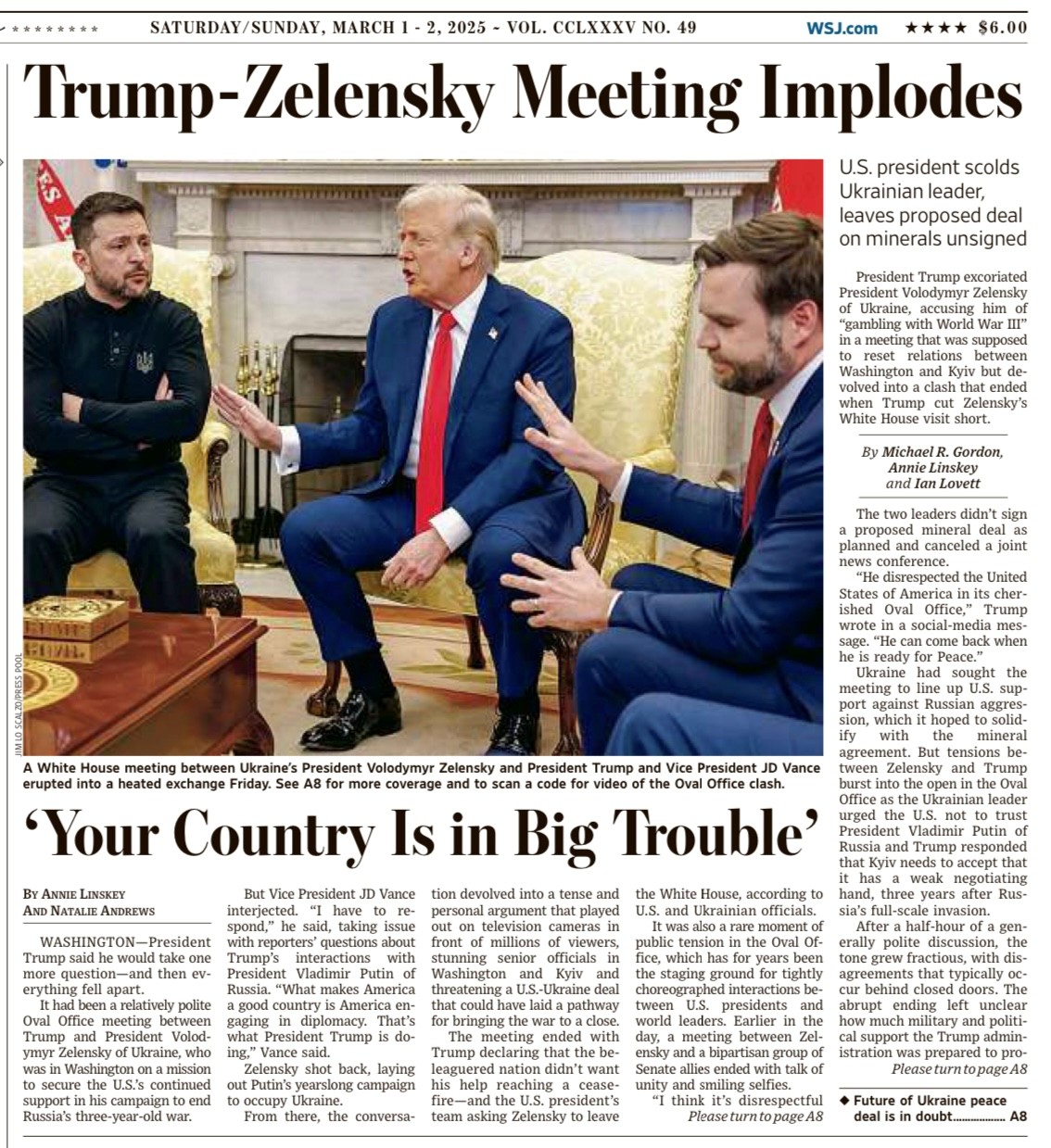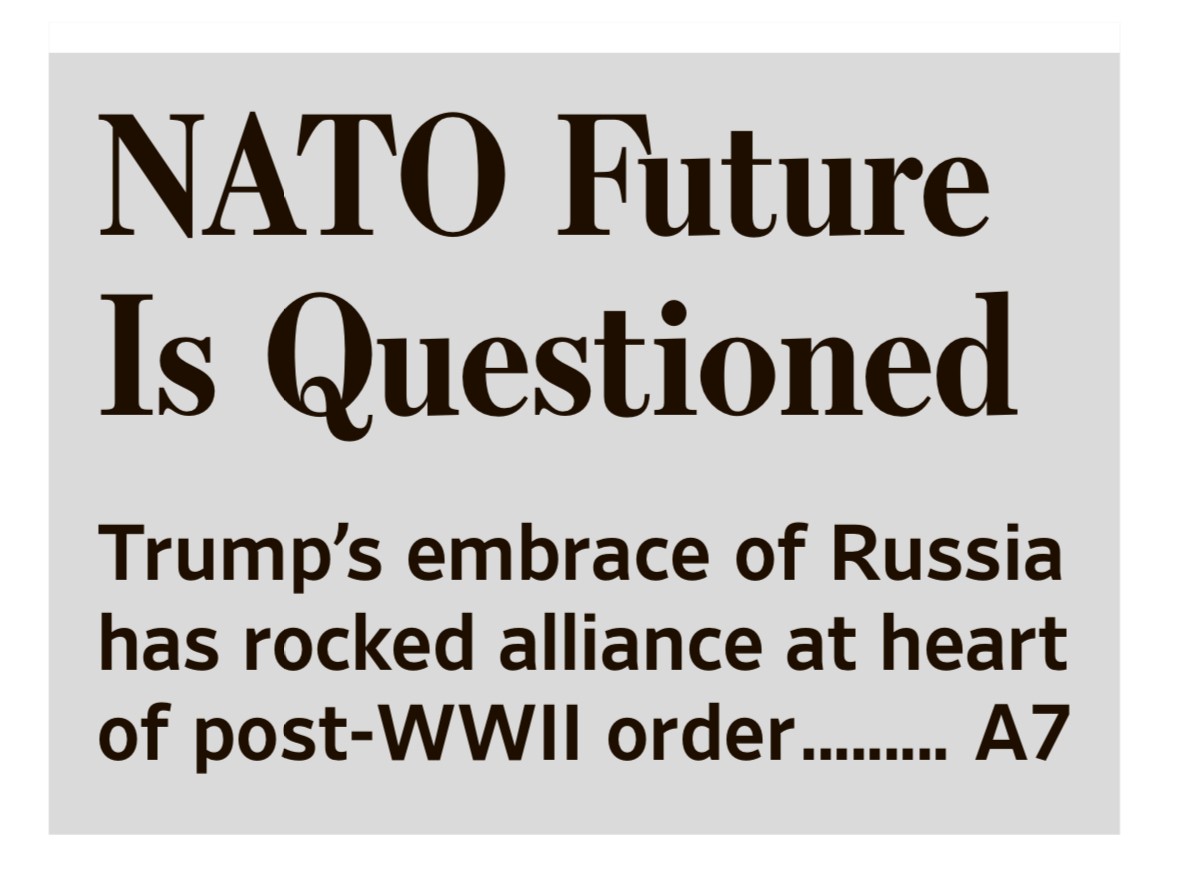
Compiled 17 February, updated 4 March 2025. Above: Nato’s future in doubt (The Wall Street Journal 4 March 2025).
As I very often do, I start from an article I find interesting to arrive, at the end, at my conclusions.
Vance’s real warning to Europe
Europeans must reduce their dangerous dependence on an adversary [if not enemy] America
GIDEON RACHMAN
When JD Vance took the stage at the Munich Security Conference last week, he issued a stark warning. The US vice-president told the assembled politicians and diplomats that freedom of speech and democracy are under attack by European elites: ‘The threat I am most concerned about to Europe is not Russia, it’s not China, it’s … the threat from within’.
If Vance hoped to persuade his audience rather than simply insult them, he failed. In fact, his speech backfired spectacularly, convincing many listeners that America itself is now a threat to Europe. In the crowd outside the conference room, a leading German politician said to me: ‘That was a direct attack on European democracy.
A senior diplomat said: ‘Now it is very clear, Europe stands alone’. When I asked him if he now considered the US as an adversary, he replied: ‘Yes’. The most positive verdict I heard on the speech was that it was ‘puerile bullshit’, but addressed to a US audience and therefore safely ignored. But by breaking down Vance’s speech, and putting it in the context of Donald Trump’s decision to engage Vladimir Putin, while sidelining Ukraine and Europe, it becomes clear that America’s culture wars, international security and European politics can no longer be disentangled. What Vance has done is subvert the ideas of freedom, democracy and shared values that have sustained the Western alliance for 80 years. In his world, the battle for freedom in Europe is no longer about deterring an autocratic and aggressive Russia, as it was for Harry Truman or Ronald Reagan. Vance’s fight for freedom is a battle to save ‘western civilisation’, as defined by Elon Musk and others, from the twin threats of mass immigration and the ‘waking mind virus’.
The Trump administration’s ideology means that, in important respects, it now feels more akin to Putin than Volodymyr Zelenskyy. Putin is seen as a warrior fighting for his country and conservative values; the Ukrainian is dismissed as a parasite with all the wrong friends in Europe.
The Trump administration sees the European far-right as its true allies. In appealing for people like the Alternative für Deutschland (AfD) party to be welcomed into government, Vance calls for Europe to turn into a bigger version of Viktor Orbán’s Hungary, a soft autocracy with a soft spot for Putin’s Russia. Significantly, in Munich, Vance found time to meet with AfD co-leader Alice Weidel, but not with Chancellor Olaf Scholz.
Before considering the implications for Europe of what Vance said, we should pause to note his profound hypocrisy. Trump attempted to overturn the 2020 US presidential election. And his vice-president presumes to lecture Europeans on respect for democracy?
Vance’s arguments were classic Russian-style ‘whataboutism’, diverting attention from the Trump administration’s assault on US democratic institutions and imminent betrayal of Ukraine, with anecdotes about the alleged persecution of anti-abortion activists in Britain. Whether he believes all this is of purely psychological interest.
It is the strategic implications for Europe that matter.
Trump clearly intends to strike a deal on Ukraine with Putin, going over the heads of Zelenskyy and the Europeans. This could have tragic consequences for Ukraine, which may soon be forced to accept the loss of territory without security guarantees for the future. The alternative would be to try to fight without American help.
The implications for the rest of Europe are also alarming. Putin wants NATO troops removed from the entire former Soviet empire. European officials believe that Trump is likely to agree to withdraw US troops from the Baltic countries and perhaps further west, leaving the EU vulnerable to a Russian army that Nato governments say is preparing for a wider conflict beyond Ukraine. It is clear that the US can no longer be considered a reliable ally for the Europeans.
But the Trump administration’s political ambitions for Europe mean that, for now, America is also an adversary, threatening democracy in Europe and even European territory, in the case of Greenland . So what to do? Europeans must start preparing quickly for the day when the US security guarantee for Europe is finally removed. This should mean the creation of autonomous defence industries. It should also mean a European mutual defence pact, outside NATO, extending beyond the EU to include Britain, Norway and others.
Trump will use whatever leverage he has to force America’s European allies to comply on issues ranging from trade and security to domestic policy. This means that Europe must now begin the painful process of ‘risk reduction’ of its relationship with the US, looking for areas of dangerous dependence on America and removing them from the system. Entrusting critical infrastructure to Musk would create a huge new vulnerability. The Trump administration would also put enormous pressure on the Europeans to buy more American armaments. In the current circumstances, this would be madness. Many Europeans will balk at these ideas, dismissing them as impossible. But they must realise that their freedom is now at stake. Vance was right about this. Just not in the way he thought.
gideon.rachman@ft.com
The only ones who have long understood what is really going on are the states bordering the former Soviet empire, such as Finland or the Baltic states. Or the inhabitants of Moldavia and Transnistria.
Indeed, many Europeans believe that such a deployment is only possible with substantial US support, but the Munich conference of 14-16 February and the remarks of various members of the new administration have dampened their hopes. ‘All Europeans fear that this support will ultimately be very low, or even non-existent,’ says Elie Tenenbaum, director of the Centre for Security Studies at the French Institute of International Relations.
Until now, most Europeans had hoped to be able to count at least on American support for command and control of operations, supplies and, above all, support in the event of a hard blow. But the signals sent by Washington in recent days do not point in this direction.
Is it heading towards the end of NATO? If so, Putin would have won, definitively. Even if Trump has an Achilles heel, which Europe should see and assess.
Read also:
Donald Trump’s hoaxes and assists to Russian propaganda against Zelensky and Ukraine
The honeymoon between finance and the Trump administration already seems to be over: share prices have fallen sharply but the really serious fact, and former French President François Hollande realises this, is that ‘Donald Trump is no longer our ally’.
The demands of US-EU summits, with the addition of Starmer (UK) are perfectly useless by now.