Drafted 25 February, updated 1 March 2025
InAugust 2024 I wrote: one of the greatest threats to the region comes from raising meat animals, another comes from gold diggers.
N.B. : the largest meat producer in the world is Brazilian, called JBS, and is third in the ranking of food producers in the world.
Fortunately, after much wavering, Lula’s government is cracking down on illegalgold mining: How Brazil is fighting destructive illegal mining. President Lula’s government is stepping up action against criminals operating in the vast Yanomami indigenous reserve.
Unfortunately, after eight months, it seems that Lula has only made announcements and that Brazil’s real problem today is inflation.
But we cannot refrain from reporting on thefurther worsening of the situation in the Amazon:
In Amazonia, ‘rivers of cocaine’ plague the region
Drug traffickers transporting drugs from the producing countries to the Atlantic coast increasingly use the Amazon waterways since Brazil has intensified its fight against illegal air transport.
By Bruno Meyerfeld (Sao Paulo, correspondent)
Today they are considered the most dangerous rivers in the Amazon. Not because of navigation difficulties or dangerous rapids, but because of the dangerous boats that frequent them. The ‘rios de c ocaina’ (cocaine rivers), as they are called in Brazil, have become the prey of drug traffickers.
The Amazon and fifteen of its tributaries have earned this sinister nickname after the publication, on 30 January, of a memo dedicated to the new routes of drug trafficking. The document, published by the collective Amazônia 2030, a summary of a study carried out in 2024 by the German research centre IZA, denounces the growing influence of organised crime along the river routes of the rainforest.
Among these rivers, where white powder now flows freely, we find well-known rivers (Negro, Madeira, Acre, etc.) but also others that are more discreet, such as the Abuna, which flows for ‘only’ 375 kilometres, compared to the 1,500 kilometres of the others. All connect the cocaine-producing regions of Bolivia, Peru and Colombia to the main Brazilian ports of the Amazon and the Atlantic coast.
This acquisition has direct and tragic consequences for the local populations. To transport, store and protect the drugs, traffickers enlist the locals living along the rivers, hiring them as boat pilots, security guards or handlers. At their own risk.
Violence has erupted
On the banks of the rivers, violence has exploded, especially in the medium-sized towns of the Amazon. In Eirunepé, a town of 33,000 souls located on the Rio Jurua, the homicide rate has increased almost tenfold in 20 years, with 3.7 homicides per 100,000 inhabitants on average between 1996 and 2004 compared to 34 between 2005 and 2020. According to IZA, at least 1,430 people died in 67 municipalities between 2005 and 2020, victims of the violence caused by drug trafficking along the sixteen ‘cocaine rivers’.
For the authors, these alarming figures are primarily the result of an increasing ‘fluvialisation’ of drug routes. In 2004, to counter the then predominant cocaine air traffic, Brazil authorised its armed forces to shoot down any aircraft suspected of carrying drugs from neighbouring countries. During the same period, Brasilia increased its aerial surveillance capabilities in the Amazon. The effects are rapid and the number of illegal flights plummets.
The traffickers immediately turned to the waterways. Geography plays in their favour: labyrinthine and countless, Brazilian rivers are uncontrollable. Brazil, a transit country for drugs, has 8,000 km of borders with Bolivia, Peru and Colombia. “Traffickers have shown great adaptability, using local technologies and networks to continue their operations despite intensified aerial surveillance,” explains the IZA study.
In the Brazilian Amazon, the murder rate has doubled in 20 years. The vast state of Amazonas has thus become the second most violent state in Brazil, with 42.5 murders per 100,000 inhabitants in 2022, twice the national average. ‘The strengthening of criminal factions exposes the people of Amazonas to constant risk and weakens national sovereignty ‘, warns Aiala Colares Couto, lecturer at the University of the State of Pará and specialist in the geopolitics of drug trafficking in Amazonas.
Bloody territorial war
Could the region fall under the control of drug traffickers? According to the NGO Brazilian Forum for Public Security, factions are now present in more than a third of the municipalities in the Amazon. In addition to clashes with the police, the traffickers are engaged in a bloody war among themselves for control of the waterways. In particular, the powerful groups of the Comando Vermelho (‘red commando’, CV) and the First Capital Commando (PCC), from Rio and São Paulo respectively, are pitted against each other.
Faced with this deterioration, Brazilian President Luiz Inacio Lula da Silva launched an Amazon plan worth 1.2 billion reais (EUR 200 million) in 2023 to strengthen the security forces in the Amazon. Since then, captures have increased. “In 2024 we seized more than a tonne of drugs! “, exults Harrison Bezerra, prosecutor of Breves, a town in the Marajó archipelago on the Amazon estuary, over the phone. He praises the merits of a new river police base in the region, consisting of some thirty men equipped with heavy weapons, marine radar and armoured boats.
But traffickers adapt and constantly change their routes, using more discreet waterways. Far from stopping at drug trafficking, they are also diversifying their activities. ‘Drug trafficking is increasingly linked to gold mining, timber smuggling and land theft, ‘ says Aiala Colares Couto, resulting in ‘an increase in violence, but also deforestation and the encroachment of indigenous lands, among other things’.
Conclusion: we are losing the largest green lung on earth, a treasure trove of biodiversity.
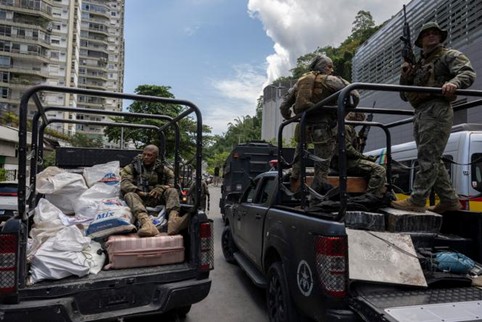
Military police officers guard cocaine seized during an operation against drug traffickers in the Rocinha favela in Rio de Janeiro, Brazil, 17 December 2024. PABLO PORCIUNCULA / AFP