First published: 24 November 2019, last updated on 1 August 2026.
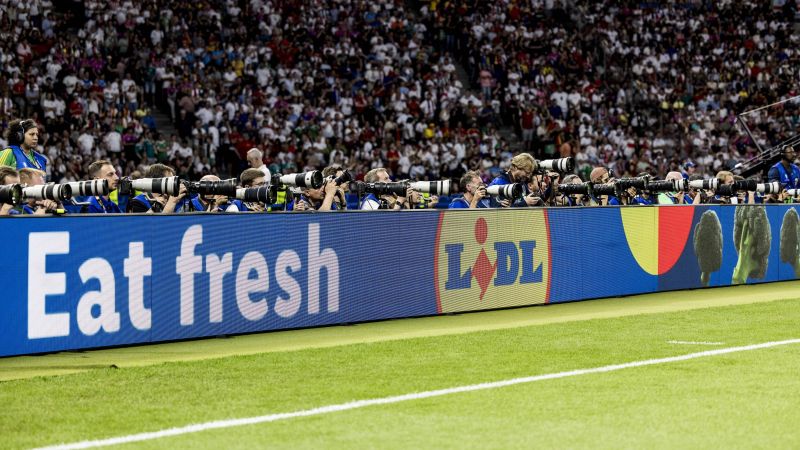
Lidl: Eat Fresh? But are we really sure that’s the case? An advert I saw during the 2024 European Football Championship
We’ve talked about Lidl several times over the pastfewyears, both in relation to France and Italy.
The company has become a global giant, ranking among the top ten retailers worldwide by turnover.
Over the years, Lidl has continued to try to convince us that it has moved on from being a discount retailer to becoming a fully-fledged supermarket.
It has certainly been very successful in launching its ‘Deluxe’ and‘Italiamo’ brands , and inpromoting its products through Gambero Rosso.
The quality of the Lidl own-brand products that we have personally tasted, alongside a panel of other connoisseurs, is good. It has also introduced many products from major brands, just as Aldi has done.
Lidl was a sponsor of the 2024 European Football Championship. We’ll see later on how this is indirectly linked to the freshness of the food offered by the German discount chain.
But supermarkets are a completely different matter, despite what a large proportion of customers think.
Supermarkets have departments where products are prepared.
Lidl, which we visited on Viale Sarca in Milan at a newly opened branch, does not have such departments.
It does a lot of ‘marketing’ with ‘department’ displays for bread and flowers at the entrance, but the bread isn’t produced there; it’s warmed up in the ‘department’, unlike what happens at Esselunga and Iper, for example – see, for instance: Made right in front of the customer: the case of Finiper’s salmon; and the flowers are simply delivered daily, as is the case with fruit and vegetables.
There is no proper meat-processing, deli or fishdepartment.
And when I asked on social media who checks the use-by dates on fresh produce, I received no reply.
The presence or absence of staff affects costs, wastage and, above all, the safety of the products: in Esselunga’s butchery departments, for example, the bacterial load of minced meat – which was reprocessed several times a day – was monitored.
Returning to the subject of costs, it is no coincidence that Migros, Delhaize and Mercadona have sought – with mixed success – to eliminate (1) their meat departments: in Esselunga , this sector had , as a percentage, labour costsalmost four times higher than those for cold cuts, pre-packaged dairy products and cheeses, with wastage and in-store packaging costs far higher than in other departments (groceries, non-food and dairy, for example).
And indeed, there are those, such as El Corte Inglés, who have focused on the high-end market, creating ‘Gourmet’ stores where you’ll find an excellent delicatessen but no meat, fish (2), bread or fruit and vegetable sections .
In conclusion, Lidl has a marketing strategy that is very adept at passing off the discount chain as something it is not, namely a supermarket operator (despite the quality of some of its products…).
And its strategy is paying off, even in France, where it is one of the few retailers to be growing.
But Lidl is a ‘soft discount’ retailer, just like Aldi.
This is hardly surprising, given the strict cost control – particularly of labour costs – which means that Lidl and Eurospin have higher profit margins than the majority of other retailers. You may also be interested in: Lidl is Italy’s growth champion, according to Mediobanca, with sales growth of 8.7 per cent between 2015 and 2019.
And it has rightly continued to follow this trajectory in recent years as well.
Quality controlis likely to be affected by these cost constraints (you can read more on this in *Consumi*: a fall in volumes across Italy but a sharp deterioration in food quality in the South).
(1) At that time, they were supplying meat that had already been packaged elsewhere, exactly as Lidl does.
(2) This is incredible in Spain, where fish is the ‘king of the table’ (you can find photos of El Corte Inglés here).
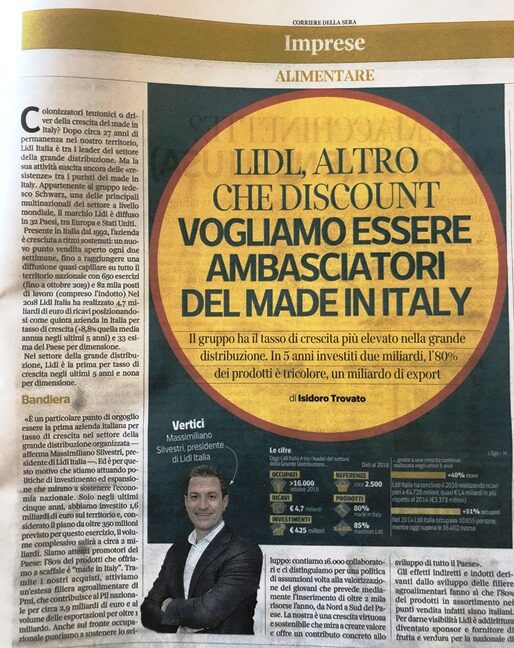
Above: the CorriereEconomia of 25 November 2019.
Lidl might be right about one thing: it exports more abroad than any other Italian retail company…
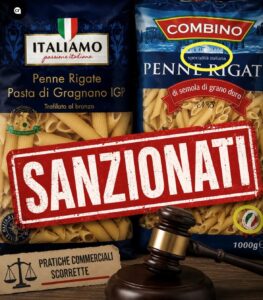
In 2018,Lidl Italia had a turnover of €4.7 billion with 16,000 employees and is said to have exported “Italian goods” worth €1 billion , although I fear that at the time no one checked whether these were actually ‘Italian-sounding’ products, as in the case of Italiamo or Combino pasta.
Conclusion: The ‘Lidl eat fresh’ advert shown at the 2024 European Championships is therefore decidedly misleading. And this isn’t the first time this has happened: Lidl describes itself as the ‘fresh food partner’ of cycling…
And besides, if you want to use Italian identity to establish yourself (“we want to be ambassadors for ‘Made in Italy’”), in this country and around the world, do it properly .
Otherwise ,the riskof a “boomerang effect” is very real: in both cases – those concerning pasta – the Competition Authority ruled that the emphasis on Italianness misled consumers, as the wheat used was largely foreign (both EU and non-EU) and this information appeared only on the side or back of the packaging, in very small, barely legible print…
The Court of Justice of the European Union has put an end to the long-running legal battle over Lidl-branded pasta, confirming that the use of patriotic symbols to conceal the foreign origin of the wheat constitutes an unfair commercial practice. In its judgment C-301/25, handed down on 30 April 2026, the judges in Luxembourg ruled in favour of the Italian Competition Authority (AGCM), reaffirming that the one-million-euro fine imposed on the supermarket chain is legitimate: transparency on packaging must be immediately apparent and cannot be hidden away in the small print on the back of the packet.
This blunder damages Lidl’s image, as the company would like – and, on paper, has the potential – to be a ‘brand’.
If you’d like to read more on this topic, see Lidl: ‘Don’t change your lifestyle, change your supermarket’?
Below: image by Paolo Caruso