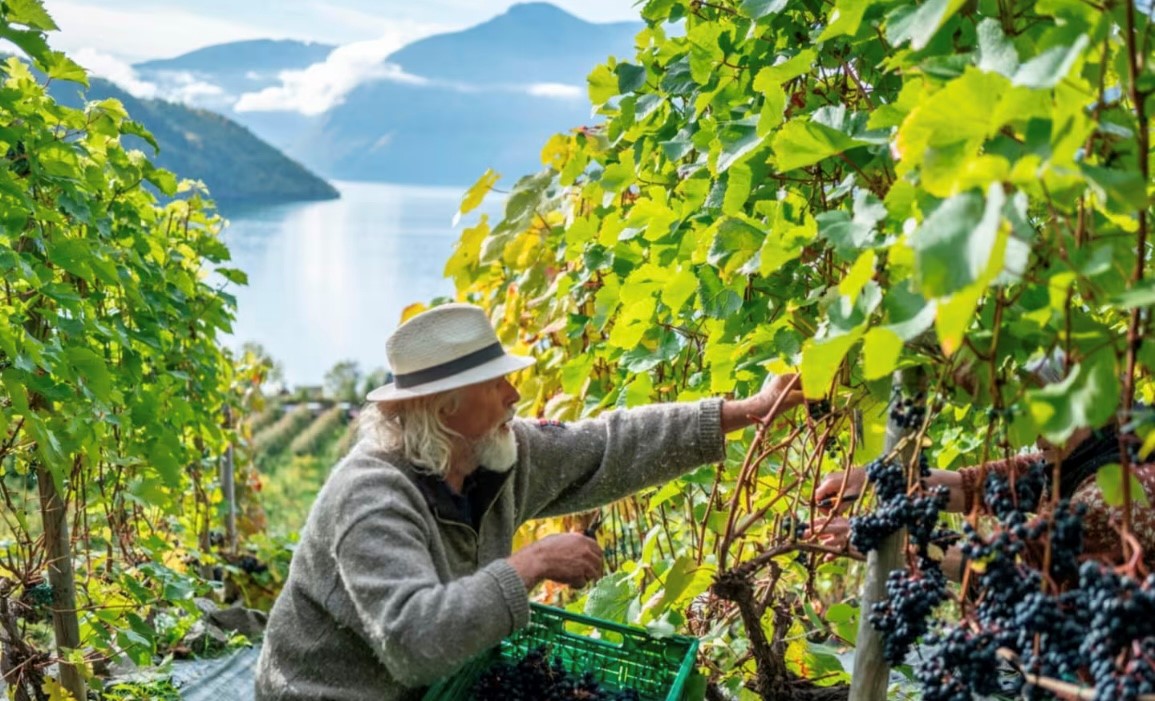
Compiled 1 March, updated 2 March 2025. Above: winegrower in Denmark
Background: wine consumption falls regularly in both the US and France.
In 2024, wine volumes in Italy were down 3.4%.
In this context, the whole market is changing, influenced by the weather:
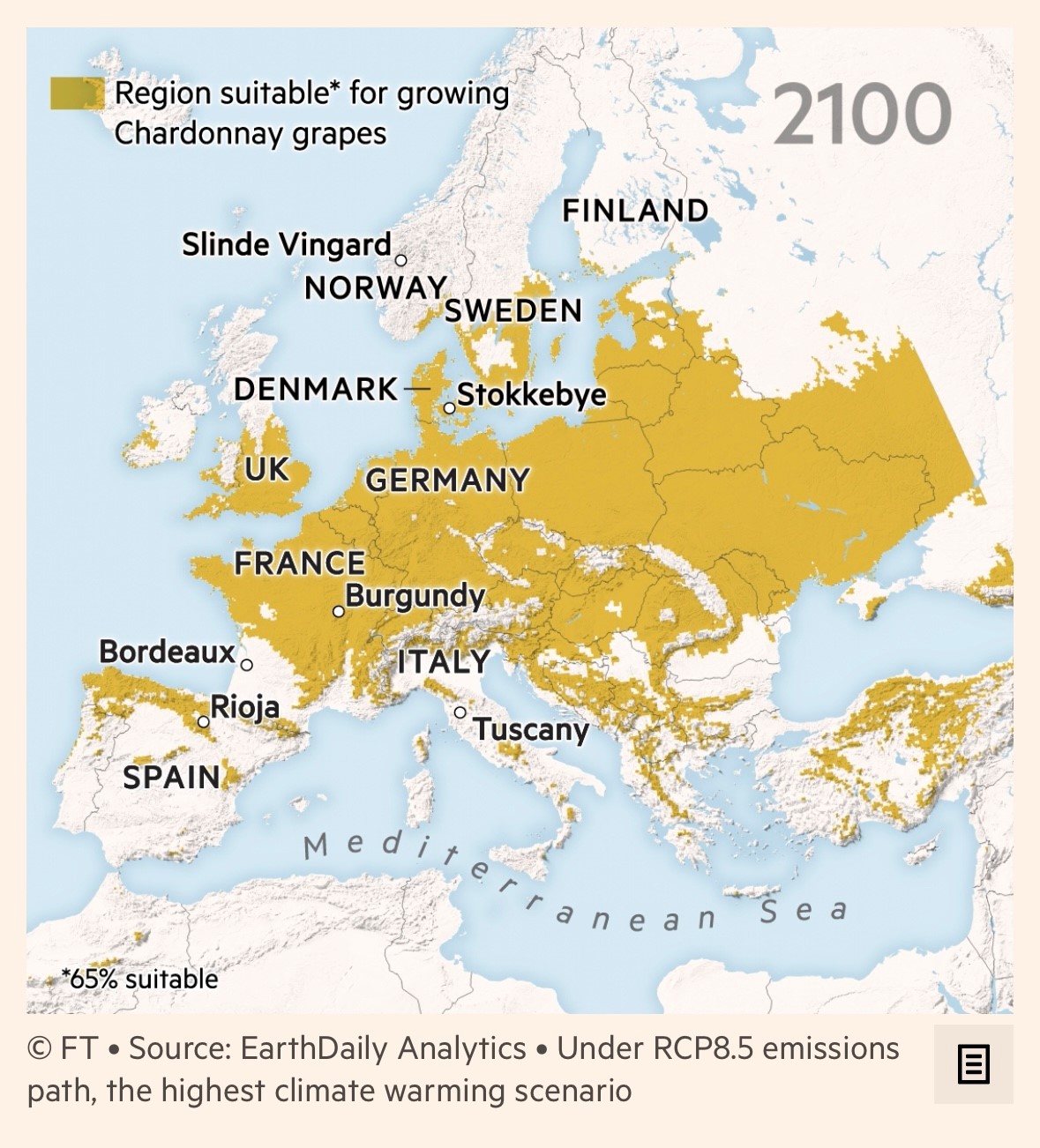
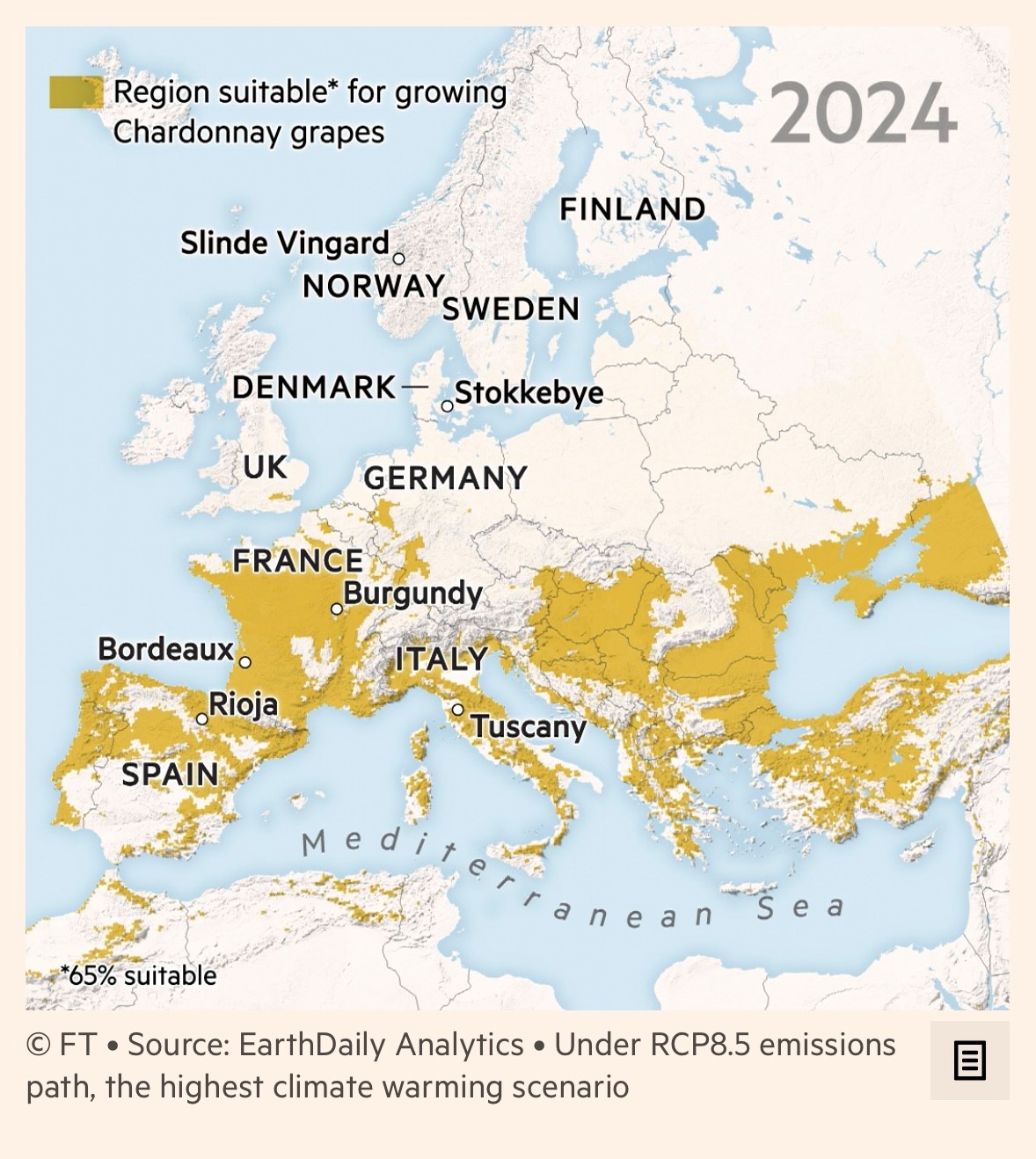
How climate change redraws the wine map of Europe
Extreme weather is pushing viticulture into colder northern territory and forcing traditional wine regions to adapt Charlie Bibby/FT
At Les 110 Taillevent, a Michelin-starred Parisian restaurant specialising in pairing dishes with wines at various price points, the wine list reflects a traditional European hierarchy: French labels dominate, then Italian, Spanish, plus the occasional Californian bottle.
One entry [on the menu] stands out: a white wine from Denmark. The Cuvée Frank, €28 for a small glass, comes from Stokkebye domaine in southern Denmark. Partially aged in oak, this fresh wine with flavours of green apple and pineapple also has ‘a certain nutty taste’, says Paul Robineau, chief executive sommelier of the Taillevent group.
Its presence also signals something else: a redrawing of Europe’s wine map as climate change expands into territories long considered too cold, challenging traditional wine regions to adapt. “Ten years ago, you would never see a Danish wine on the list,” says Robineau. “But, with climate change, Denmark can make great wines.”
Located on the island of Funen, a two-hour drive from Copenhagen, Stokkebye started in 2009 as an experiment. Jacob Stokkebye, a trained sommelier, and his wife Helle decided to see if the climate could support a serious vineyard. At that time, Danish wine was largely limited to a few hobbyists experimenting with hard, cold grape varieties.
But a combination of global warming and advances in viticulture has turned this once unlikely pursuit into a small but vibrant industry. In the last ten years, the number of vineyards in Denmark has doubled overall, while production has tripled. “The weather we have here in Denmark today is similar to what they had in parts of France in the 1960s,” Jacob explains. “Today, our climate allows us to produce wines with a freshness and acidity that could be found in wines
… Coastal and lowland regions such as those in Spain, Italy and Greece are particularly vulnerable. Sgubin’s team predicts that droughts and heat waves could make 90 per cent of these areas unsuitable by the end of the century. While southern Europe is grappling with potentially existential challenges, warming temperatures have turned once marginal lands in the northern parts of the continent into promising vineyards. With chalky soils and a cool climate reminiscent of Champagne, England has become a sparkling wine production powerhouse. As summers become warmer, English wine is also gaining traction. Poland’s wine industry has also rapidly taken off in the last decade, while Estonia, Lithuania and Latvia are producing wines that, although modest in terms of quantity, suggest a future in which Northern Europe is a serious player on the global stage.
…Scandinavian countries are also making their mark. In Norway, Bjorn and Halldis Bergum, who run the world’s northernmost commercial vineyard, have witnessed first-hand the impact of climate change on their winemaking. Perched on the steep slopes above Sognefjord, north of Bergen, their Slinde vineyard is a mosaic of low rows of grapes carefully tended by hand. “It’s early spring and later winter,” explains Bjorn, “maybe a month less frost than 40 years ago.” He believes that Norwegian wines could soon rival those of France. The country’s long summer days provide up to 30 per cent more light for photosynthesis, improving sugar and aroma development in the grapes. ‘If we here in Norway can ripen Riesling, Chardonnay… we might have a chance to make even better wine than them,’ he says. He is not bound by appellations. ‘In Norway we have no rules,’ says Bjorn, who has tested 55 different grape varieties. His mission is to invent something completely new, adapting his choices to the Norwegian microclimates. Every season is a gamble, as some varieties flourish while others prove unsuitable. Jacob and Helle Stokkebye with volunteers on their vineyard Jacob and Helle Stokkebye with volunteers on their vineyard. “Today, our climate allows us to produce wines with a freshness and acidity found in wines
[Lamberto] Frescobaldi in Italy says that the rise of new competitors like England or Denmark ‘pushes us all to produce better wine’. But to do so and to cope with climate change, Mediterranean producers must adapt…
Faced with these changes, there are those in France who are diversifying their production: not only wine but also, for example, fruit and vegetables or officinal herbs, which are more resistant to drought.
Climate change is a serious threat. “Not strictly because of warmer temperatures. It is the catastrophic events – hailstorms, spring frosts, rainfall or prolonged drought – that have become much more frequent and pose the greatest threat,” writes Asimov [ Eric Asimov in the New York Times] . “Our job now, is to maintain minerality, freshness and acidity….
In 2024, many winegrowers in Chablis had to abandon organic farming because the vines were overwhelmed by downy mildew and to save part of the crop, they were forced to resort to chemical treatments…
Conclusion : “If you love the Bordeaux wines of the 1970s and 1980s, those are gone forever”, says Elisabeth Wolkovich (University of British Columbia, Canada).
In the charts: the evolution of Chardonnay vineyard coverage in Europe, note the almost disappearance of vineyards in Italy by 2100