Drafted 13 January, updated 22 January 2025
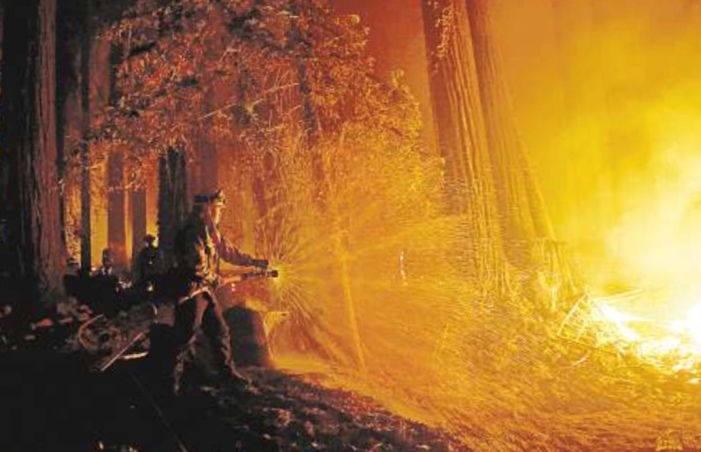
The fire situation in California should surprise no one. Above photo from 2020. I have been writing about this climate change situation since back in 2013.
It is now common knowledge – especially among homeowners – and endemic.
Los Angeles fires: ‘What is going to happen to the world is visible on the map’ of the city
Aaron Paley, who directs Community Arts Resources, an activity centre involved in the social and cultural life of Los Angeles, traces the effects of the fires that are still ravaging the city.
Interview by Corine Lesnes (Los Angeles, special reporter)
Trained in urban planning at the University of California, Berkeley, Aaron Paley is a specialist in the social history of Los Angeles. A well-known figure in the local cultural scene, he describes the upheaval represented by the great fires that are devouring the American megalopolis.
What is the significance of these fires for Los Angeles?
It is the end of an era. We are at a turning point. What is happening right now here in Los Angeles is not like an ordinary fire. It’s like a war. There are fires everywhere, danger everywhere, incredible stress. Everyone feels threatened. We feel like an evacuation order could come at any time.
Normally, a natural disaster has a limited duration. An earthquake lasts a few seconds. A hurricane passes. Here it has been five days and it could go on for another five days, we don’t know. At this stage, we are still in the emergency period. The priority is to mourn and help each other survive collectively. Accept that we really have to say goodbye to our homes, our lives, ourselves.
Will the disaster lead to changes in the future?
I hope that Los Angeles will rise to the occasion and that we will work together to rethink our future. Some of the inhabitants will leave the city. But they will come to another place where the same problems will arise, although not on the same scale. Climate change is everywhere. What is going to happen to the whole world is visible on the map of Los Angeles right now. So visible that we can no longer refuse to see it. I hope that this catastrophe is also an alarm for the world. It is not just us who have to respond, but the whole world.
But isn’t it unthinkable that Los Angeles should question its growth model?
The Europeans who arrived in Los Angeles in the late 18th century did not understand the local ecological system. They tried to replicate their villages. Their successors always thought it was enough to shape nature according to their wishes. There was a cascade of decisions that proved they did not understand where they lived. In 1926, the voters rejected the underground railway. They protested that they did not want to ‘become New York or Chicago’ and that the future was the car.
In 1930 an urban plan (the Olmsted-Bartholomew Plan) was presented to the Chamber of Commerce that aimed to create large green spaces, playgrounds for children, it was called the ‘green necklace’. It was ignored. The authorities preferred to build as much as possible. We built in fire-prone areas, and fires are repeated there, like in Malibu.
We have always imposed our will on the landscape instead of understanding how to deal with it. We love nature, but we ignore it. We go hiking, we go to the beach, we go skiing. The city is surrounded – and crossed – by mountain ranges that reach almost 1,800 metres above sea level. Interaction with the hills is part of our landscape. Yet, we ignore nature in the way we build our cities.
Can we say that the disaster has affected the rich more?
No, the disaster will affect everyone. It is true that the fires tend to hit the ravines and that, unlike in Latin America, it is not the disadvantaged neighbourhoods that are in the hills here. But there are more than 100,000 displaced people, which means that the people who work in these neighbourhoods are losing their jobs. These are gardeners, domestic workers, who have no unemployment benefits. There will be consequences for those who live in other neighbourhoods and take the bus to work or take their own car. If they don’t work, they won’t be able to do it. It is a disaster for everyone.
In north Pasadena, in the black neighbourhood where baseball great Jackie Robinson grew up, many houses were also destroyed. The residents were all the more affected as they began to accumulate what is called ‘generational wealth’ [the building up of capital over several generations to access property].
How can the city be rebuilt?
It is not enough to rebuild in a more resilient way or to build fortifications around houses to resist the flames. We cannot live walled in. We have to live with nature, in this incredible space called California, without ignoring it. I hope it becomes clear to all Los Angeles residents that there are ways to create a city that is more in tune with its geography. I remain optimistic because I have no other choice.
This article completes the picture: ‘No human technology, no matter how sophisticated, can defeat a megafire’.
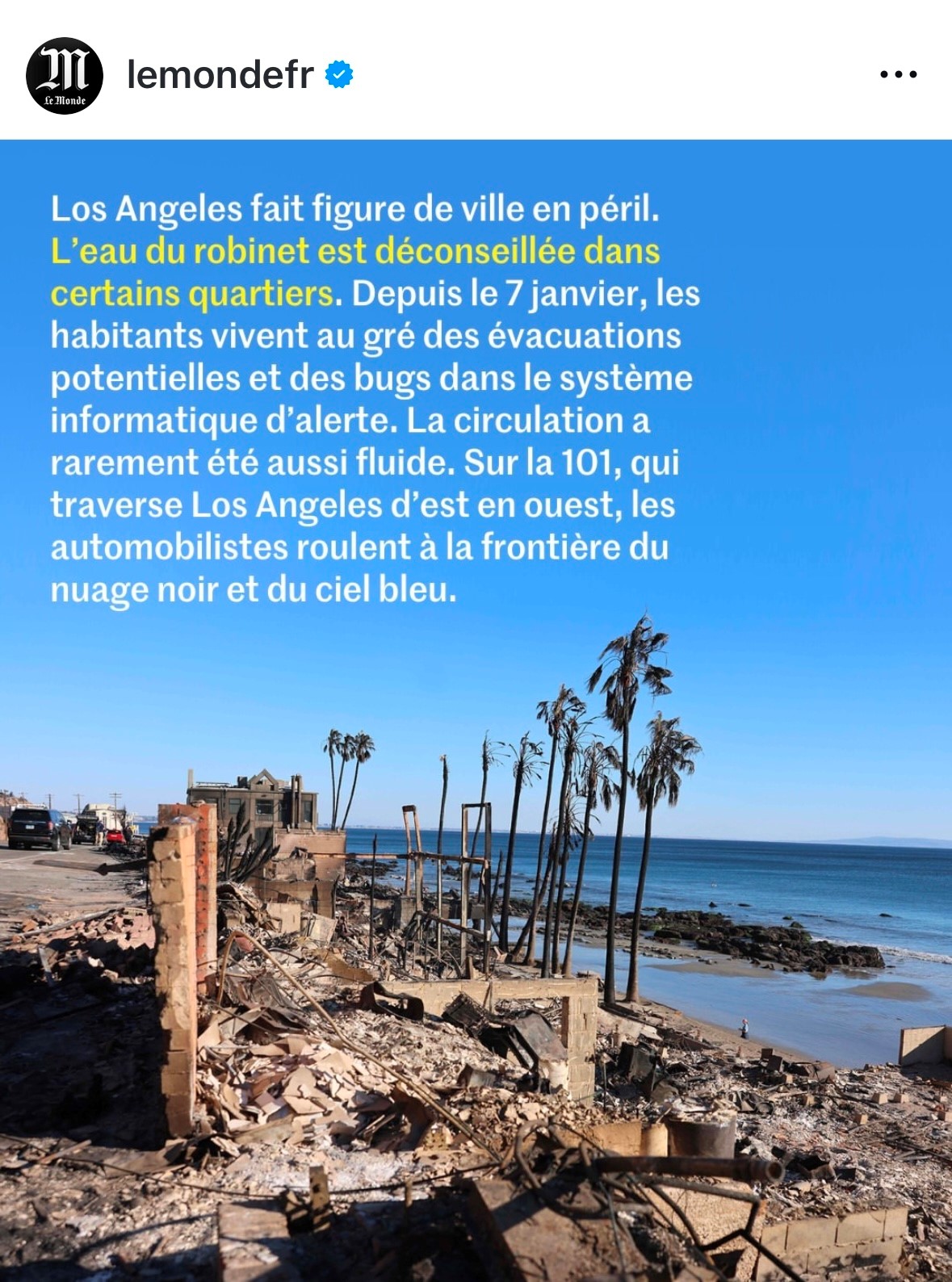
Below : Le Monde reports that in many areas you can no longer drink tap water.