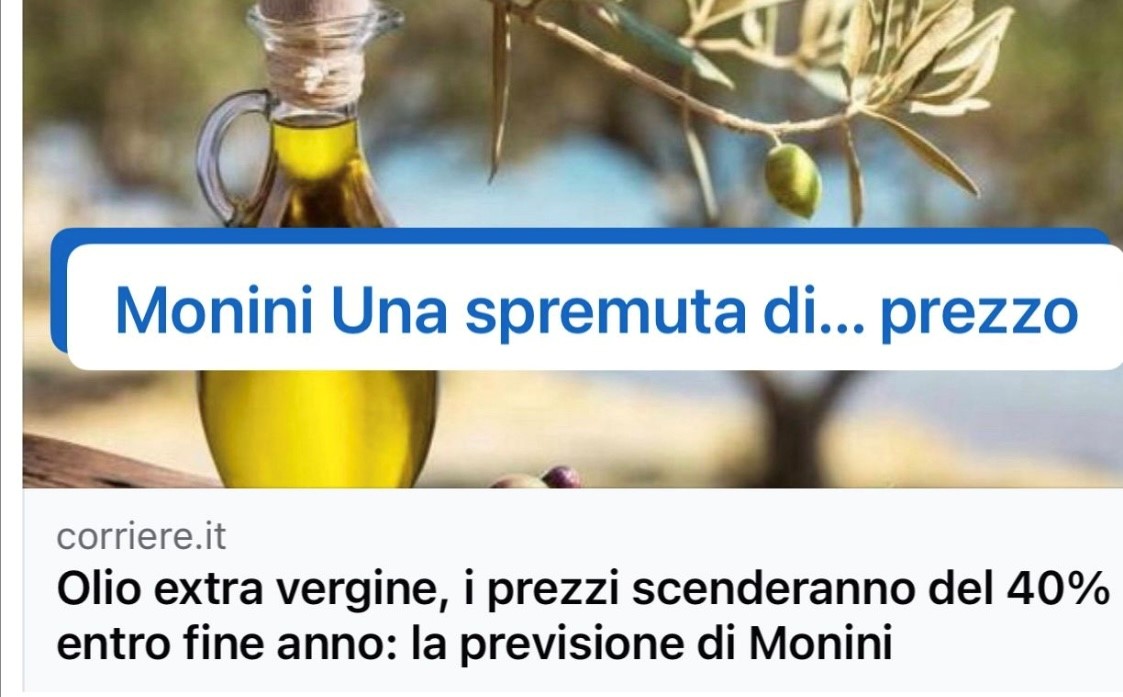
Let’s start with this cue : Monini announces: extra virgin will cost less. But it’s not good news, here’s why
Stefano Polacchi explains that it is not, especially from a health point of view, but also from a marketing point of view. You can find the confirmation at the end of the article.
Extra virgin olive oil, Monini announces, will cost less. But this is not good news: we need higher and more profitable prices for higher quality, not higher consumption
The announcement is made by Zefferino Monini, CEO of the Umbrian extra virgin olive oil industry of the same name, which is sold all over the world: production in Spain has returned to normal levels after last year’s drops and prices on the global market (which are determined by the Spanish) should therefore fall. Consequently, global consumption should go up. But if this forecast – by the way probably not even entirely accurate – makes an industrialist like Monini happy, at the same time it should make us think about where we want to go. Of course, Zefferino is talking about the global market and the (more or less) extra virgin oils that every year cause discussion with respect to absurd prices (even below 3 euro a bottle) and dubious qualities that are often highlighted (and sanctioned) even by seizures and controls by the authorities in charge.
The first question is: why should it be better to sell more at lower prices and not sell less and at higher prices? Of course, if the quality were the same, it would just be a balancing act between supply and demand. But we in Italy should ask ourselves another question: why not aim to sell less but at higher prices that are profitable for our artisan-farmers?
Extra virgin: why should we pay more for it?
The desire for higher prices for better quality may turn the noses of many. And it is not easy to explain to a consumer that it is better to pay more for extra virgin oil. The first consideration, however, is that the race to reduce the cost of food, if on the one hand it has allowed access to food for many in the world, on the other hand it has also led to a production chain that ‘needs’ to waste and throw away so much food in order to sell more of it, that needs to feed unbridled consumption to the point of making obesity endemic in many parts of the world, to wage a price war and to pay those who produce less and less. And since food is essentially an agricultural product, this race to consume and lower prices concretely leads to the impoverishment of farmers at the expense of traders. We see it everywhere: from milk to wheat. Except, at least in Italy (but not only there), on the wine front: here, consumption that has fallen drastically in the space of 40 years has led to exponential growth in both the quality levels and the value of the product. For a country like Italy, ‘selling off’ extra virgin olive oil means selling off its history, its agri-food culture.
Historic turning point: Spanish oil is worth more than Italian oil in the USA
For the first time, the price of Spanish oil exceeds that of Italian oil on the American market, thanks to an impressive growth in value (105%).
In essence, Spain dominates the market on both the volume and value side.
There is little to rejoice about!