Drafted 8 March, updated 14 March 2026
We are talking about a vital substance to ensure abundant harvests of wheat and cereals, the mainstays of our diet. With the war in Iran turning the straits into a shooting gallery, the situation has become critical. Prices are out of control: urea has risen by 25% in just one week, putting spring sowing at risk If with the Russian invasion the problem affected wheat and sunflower oil, the war in Iran shifts the critical issues to fertilisers.
‘If the situation continues, consumers could see higher prices for bread within six to ten weeks, for eggs within a few months, and for pork and broiler chicken within six months, estimates Raj Patel, a food systems expert at the Lyndon B. Johnson School of Public Affairs’.
Source: the Financial Times, which adds:‘The Middle East is one of the world’s biggest fertiliser producers, while the Strait of Hormuz is a crucial sea route for exports.
According to CRU data, about 35 per cent of global urea exports pass through this waterway. Urea is the most widely used nitrogen fertiliser, which in turn supports about half of the world’s food production.
The route also handles 45 per cent of global exports of sulphur, a key ingredient used to produce phosphate fertilisers, as well as significant volumes of ammonia, a key ingredient for nitrogen fertilisers,’ he says. Furthermore, according to recent work, oil and gas price increases of similar amounts to those observed so far, if sustained over time, would lead to a price increase of 1.4 per cent one year from now, compared to a scenario without the shock.
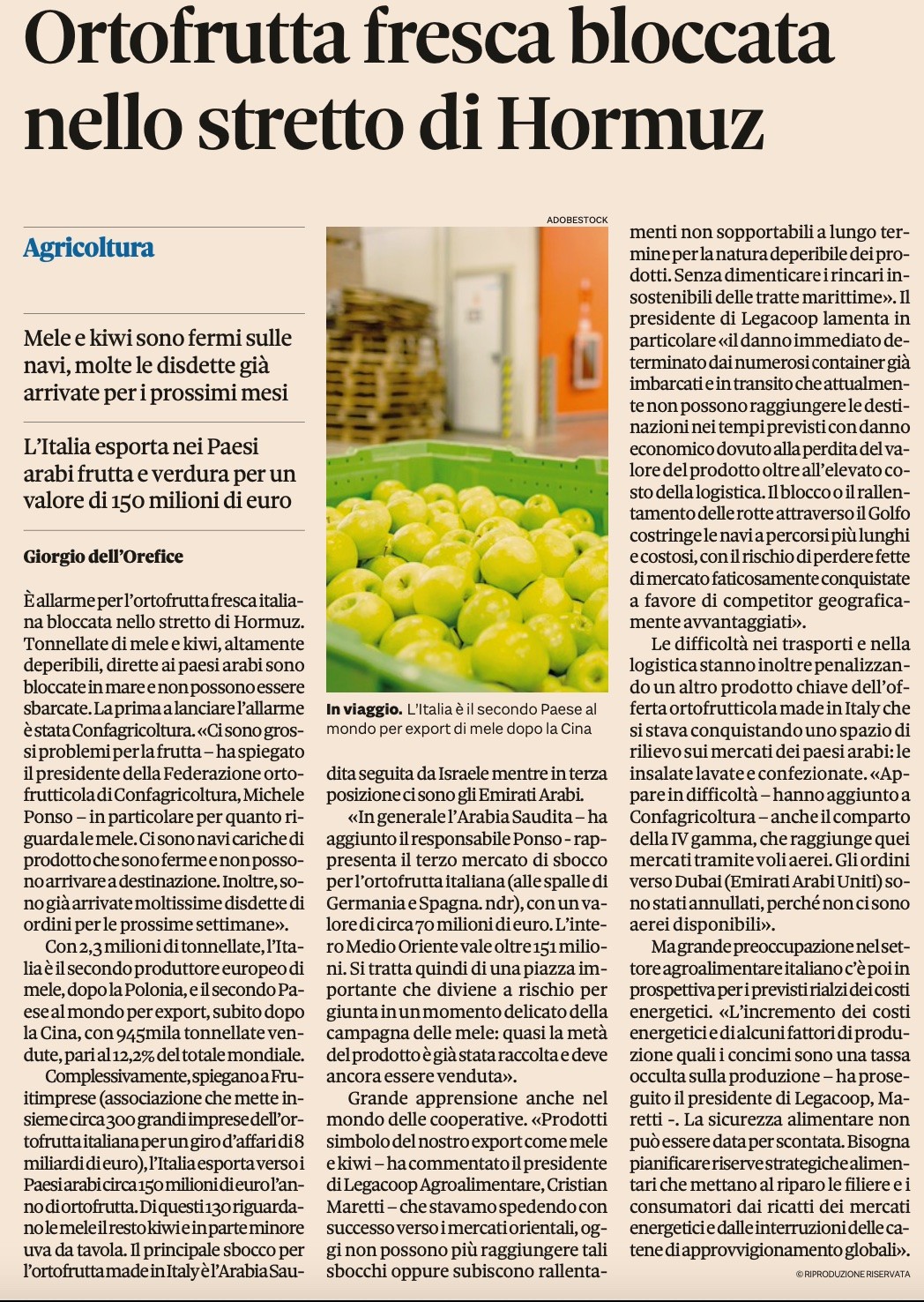
The article in Il Sole 24 ore of 6 March below highlights the problems in the fruit and vegetable sector
The case of apples is just one example of the dependence of these countries on imports to feed their populations. According to a study published in December 2025 by the French Ministry of Agriculture, imported products accounted for 85% of total food consumption in the member countries of the Gulf Cooperation Council (GCC) (Saudi Arabia, United Arab Emirates, Qatar, Kuwait, Bahrain and Oman) in 2024, including 90% of cereals, 100% of rice and 60% of meat. Between 80% and 100% of the grain destined for Qatar, Kuwait and Bahrain transits through the Strait of Hormuz.
On the Iranian side, although the country produces a significant part of its food needs, it imports almost 14 million tonnes of grain and soya. The decision to stop all exports is therefore explained by the leadership’s desire to prioritise supplying the population. This food security is further strengthened by strategic reserves of flour. However, Iranians have been suffering from soaring food prices for many months. Further disruptions in the distribution of goods and their prices could aggravate the situation.
And the energy situation worries European farmers, but there is worse: the water war. It is more precious to the Gulf than oil. And Iran knows it.
Tehran in response to the raids on a desalinator on the island of Qeshm attacks one in Bahrain. In the Arabian Peninsula there are 400 of them, 70% to 90% of the drinking water of the countries in the area depends on desalination plants. Hitting them would cause a humanitarian catastrophe, the last to do so Saddam Hussein
P.S.:
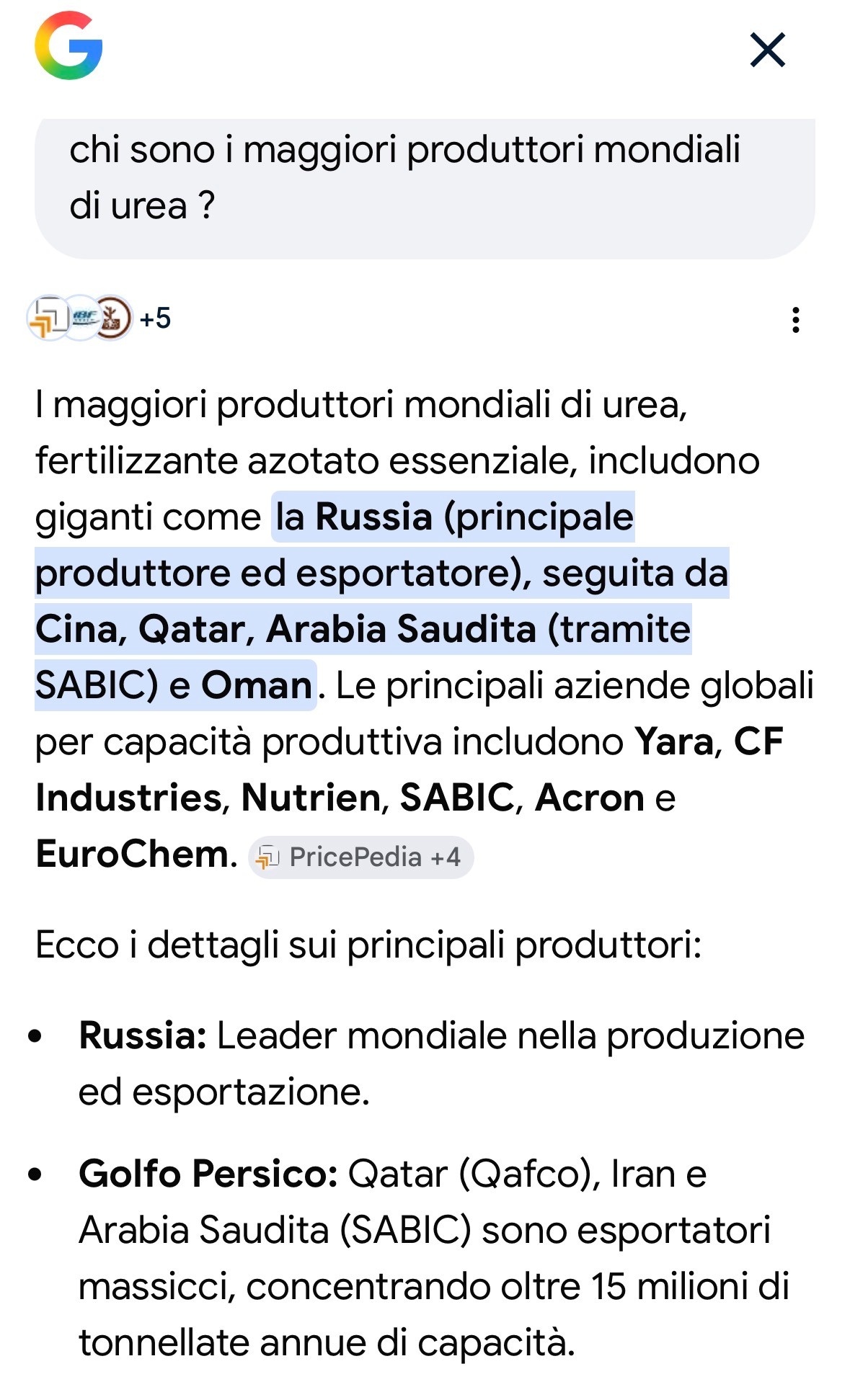
The world’s largest urea exporters are Russia and China, followed by Iran, Saudi Arabia and Egypt. Russia has a strong competitive advantage due to its abundance of raw materials (gas and ammonia), while China regulates exports to secure its domestic needs.
Here are the main details:
- Main Exporters (Countries): Russia, China, Iran, Saudi Arabia, Egypt, Qatar.
- Market Leaders: Russia is often the world’s leading exporter.
- Role of China: Although a major producer, China influences global prices by modulating its exports.
- Other key players: Qatar, Egypt, Oman and the Gulf countries play a significant role in the maritime urea trade.
Urea production is closely linked to the availability of natural gas, making countries with large energy reserves the main exporters.
With oil ( at $100 a barrel and no longer sanctioned) and fertilisers Trump has given Putin two key cards to survive and possibly win the war in Ukraine.