Written on 17 August, updated on 30 August 2026
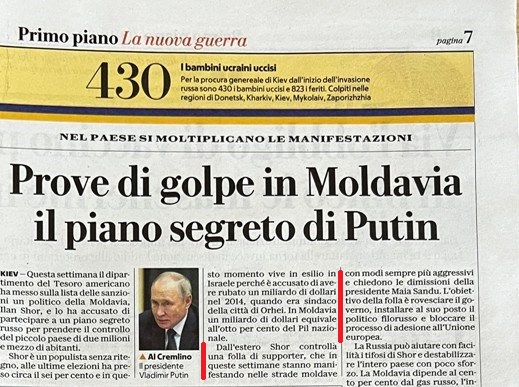
This headline from *La Repubblica* in October 2022 is interesting, as it already mentions one of the key figures in the current attempt at destabilisation: Ilan Shor, an Israeli-Moldovan oligarch living in Russia.
Shor fled Moldova in 2019 when he was accused of defrauding Moldovan banks of $1 billion. He settled in Russia, where he answers to Sergei V. Kiriyenko, Putin’s right-hand man in the Russian-occupied territories of Ukraine.
Essentially, history is repeating itself today:rumours of attempts to exert control over Moldova, already rife in October 2022, continued into 2023 –Putin revoked the decree on Moldova’s sovereignty –and continued in earnest in 2025and 2026 when Moldova decided to break away from Russian energy supplies.
In reality, Russia has never accepted that the former Soviet republic – which had been incorporated into the USSR following the infamous Molotov–Ribbentrop Pact – should become independent after the USSR’s dissolution in 1991.
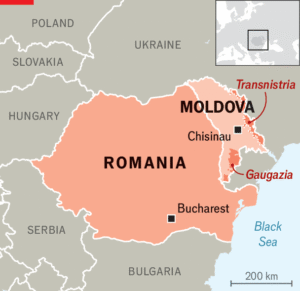
Indeed, Russia cut off gas supplies to Transnistria for a period in order to destabilise Moldova and attempt to extend its influence over states bordering NATO,including Romania (Moldova was part of the Kingdom of Romania from 1918 to 1940).
The findings of the *New York Times* (*)investigation into Russia’s ambitions regarding Moldova therefore come as no surprise.
What is striking is the scale and scope of the affair: at least 150,000 Moldovans, out of a population of 2,381,000, were involved in this subversive plot.
And Russia spent tens of millions of euros on it.
(*) This article is based on interviews with activists who took part in the Russian operation; senior officials from the Moldovan law enforcement and security agencies; and more than half a dozen European and American intelligence officials. The New York Times has also examined thousands of documents relating to Russia’s attempts to interfere in the Moldovan elections.
Over the past two years , Moscow has paid Orthodox priests, organised a system of vote-buying and set up training camps – in Serbia and in Moscow – to interfere in the elections: all in an attempt to bring down the pro-Western governmentof President Maia Sandu, who has made accession to the European Union one of her priorities, thereby becoming a target of the Kremlin.
In all recent elections — including the presidential elections and the 2024 referendum on accession to the European Union, as well as last year’s parliamentary elections — Moscow has poured resources into attempts to oust Sandu and her party, the PAS.
This was also the objective last autumn (2025), when Moldova held parliamentary elections that were decisive in determining whether Sandu’s party would retain power or hand it over to a Moscow-backed coalition. The Kremlin had been preparing for months. Its cyber warriors had infiltrated the electoral commission; vote-buying and propaganda campaigns were in full swing; and teams of recruits trained in Serbia, Bosnia and Russia were ready to sow chaos.
Russia denied this version of events, but Putin summoned his top officials for a secret briefing in which he conveyed a message that was the exact opposite. The objective for 2026, Putin told them, is ‘the collapse of NATO and the European Union from within’. Moldova was, and remains, central to this plan.
In the Kremlin’s hierarchy of priorities, Western intelligence officials claim, the conquest of Ukraine comes first and theseizure of control over Moldovasecond.
Although it belongs to neither the European Union nor NATO, the country occupies a strategic position, sandwiched between NATO members and Ukraine.
The methods employed were those of a high-level military and sabotage operation, the logical follow-up to the one carried out in Transnistria: in early March, a Russian attack on a Ukrainian hydroelectric power station near the border with Moldova contaminated the water supply for parts of Ukraine and Moldova.
Ilan Shor has been at the centre of operations to buy votes, spread disinformation and train the Moldovan paramilitaries involved.
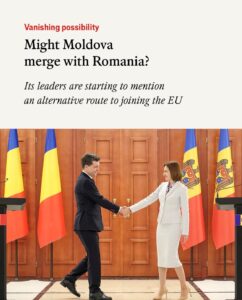
The situation is so serious that Prime Minister Maia Sandu is considering a possible meeting with Romania, which has the advantage of being a member of both the EU and NATO.