Written on 26 November 2021 and updated on 29 August 2026
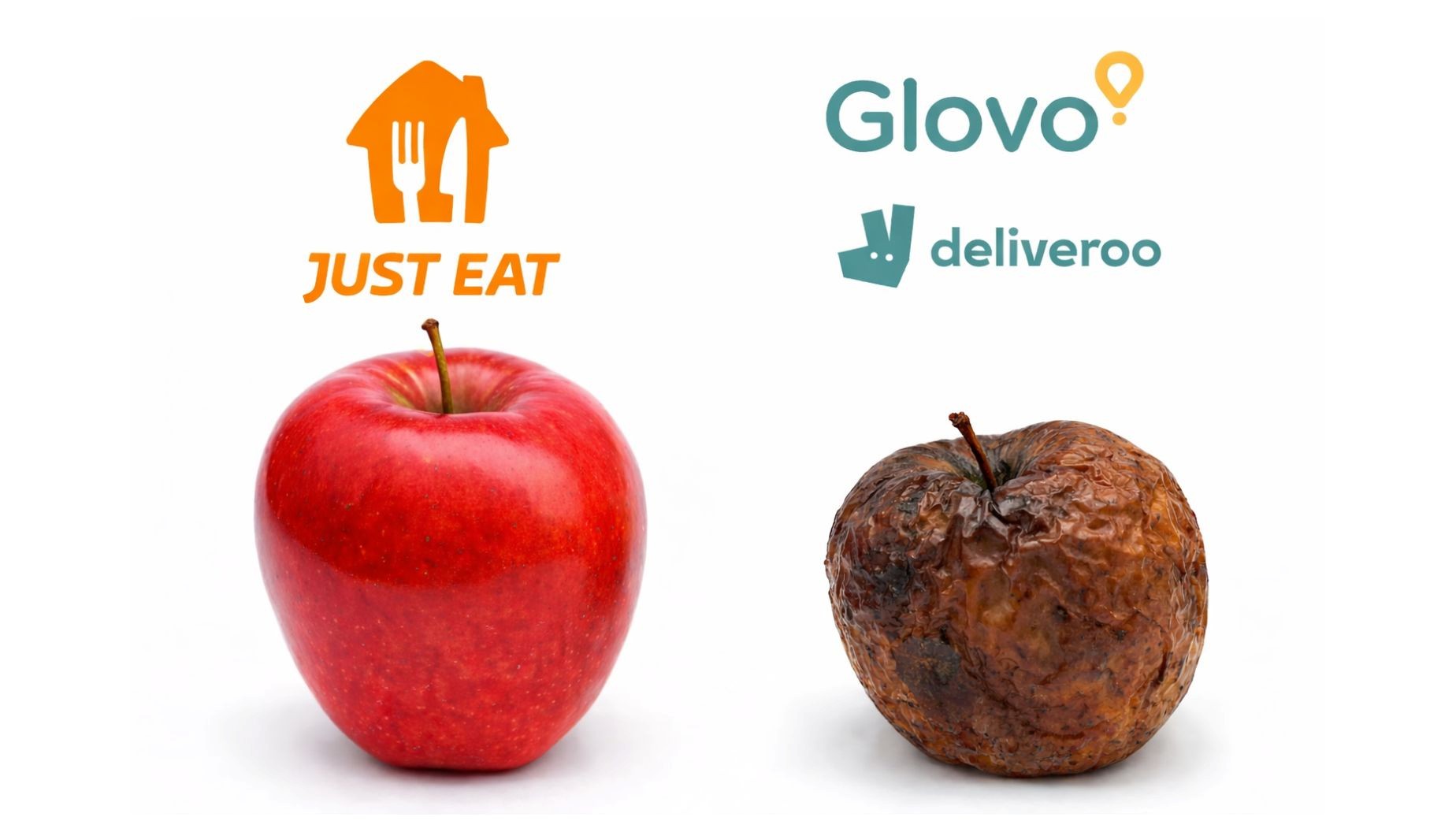
In July 2026, Uber and Delivery Hero announced an agreement: there are now three major players in the delivery sector in the West (DoorDash, which owns Deliveroo; Prosus – Just Eat; and Uber – Delivery Hero, which owns Glovo): Just Eat’s employees are covered by the National Collective Labour Agreement for Logistics, whilst the other two are covered by the Assodelivery/Ugl contract and are accused of exploiting workers.
But let’s take a step back: a brilliant article in *The Economist* from November 2021 highlighted how the nine publicly listed delivery companies (Uber, Lyft, Didi, DoorDash, Delivery Hero, Meituan, Zomato, etc.) had:
- raised $100 billion in funding
- grown by an average of 103 per cent over the past few years
- generated revenue of $75 billion last year
- the nine companies’ combined losses totalled $11.5 billion
The impression, looking at things from the outside, is that, in many cases, the precarious working conditions of delivery riders (the French call this ‘uberisation’) were being exploited to try to make profits – which were taking ever longer to materialise – at the riders’ expense.
The situation in France has worsened considerably with fast-food delivery services, which have ‘industrialised’ precarious work (Le Monde, 23 November 2021).
These articles from The Economist and Il Sole 24 Ore form the starting point for this report, which provides an overview of the evolution of the delivery sector from 2020 to 2026. They discuss workers and trade unions, as well as business models that affect food quality.
REGULATIONS AND TAXES
Il Sole 24 Ore
25 NOVEMBER 2021
EMPLOYMENT
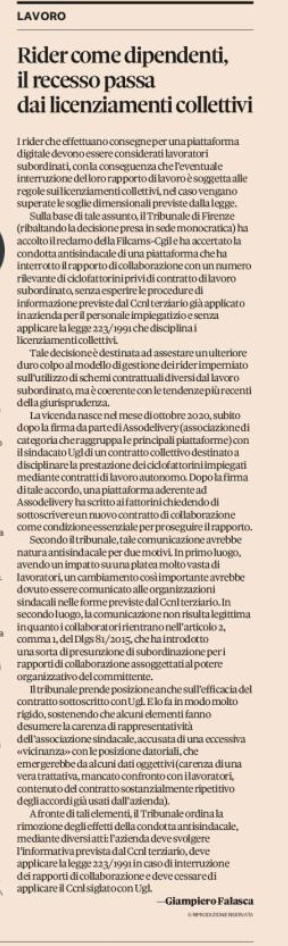
Delivery riders as employees: termination now subject to collective redundancy rules
Giampiero Falasca
Delivery riders working for a digital platform must be regarded as employees, with the consequence that any termination of their employment relationship is subject to the rules on collective redundancies, should the size thresholds laid down by law be exceeded.
On this basis, the Court of Florence (overturning the decision made by a single judge) upheld the complaint lodged by Filcams-Cgil and found that a platform had engaged in anti-trade union conduct by terminating its working relationship with a significant number of cycle couriers who did not have an employment contract, without following the notification procedures laid down in the National Collective Labour Agreement for the tertiary sector – already applied within the company for office staff – and without applying Law No. 223 of 1991, which governs collective redundancies.
This decision is set to deal a further severe blow to the management model for delivery riders, which relies on contractual arrangements other than employment contracts, but is consistent with the most recent trends in case law.
According to the court, this communication was anti-trade union in nature for two reasons.
Firstly, as it affected a very large number of workers, such a significant change should have been communicated to the trade unions in accordance with the procedures set out in the National Collective Labour Agreement for the tertiary sector.
Secondly, the notice is not valid as the workers fall under Article 2, paragraph 1, of Legislative Decree 81/2015, which introduced a presumption of subordination for collaborative relationships subject to the client’s organisational authority.
The court also ruled on the validity of the contract signed with UGL.
And it does so in a very strict manner, arguing that certain elements suggest a lack of representativeness on the part of the trade union, which is accused of ‘proximity’ to the employers’ position—a fact that would appear from certain objective data (lack of genuine negotiation, failure to consult with workers, and a contract whose content essentially replicates agreements already used by the company).
In light of these factors, the Court orders the reversal of the effects of the anti-trade union conduct through various measures: the company must provide the information required under the National Collective Labour Agreement for the tertiary sector, must apply Law 223/1991 in the event of termination of employment relationships, and must cease to apply the National Collective Labour Agreement signed with UGL.
My only comment: it is strange to report on this without mentioning the name of the ‘offending’ company. But this is Italy, and everyone has a family to support.
.
These developments have increasingly begun to affect the large-scale retail sector as well, as many companies, such as Rewe and Carrefour, had invested in it, offering e-commerce for packaged food products as well as ready meals.
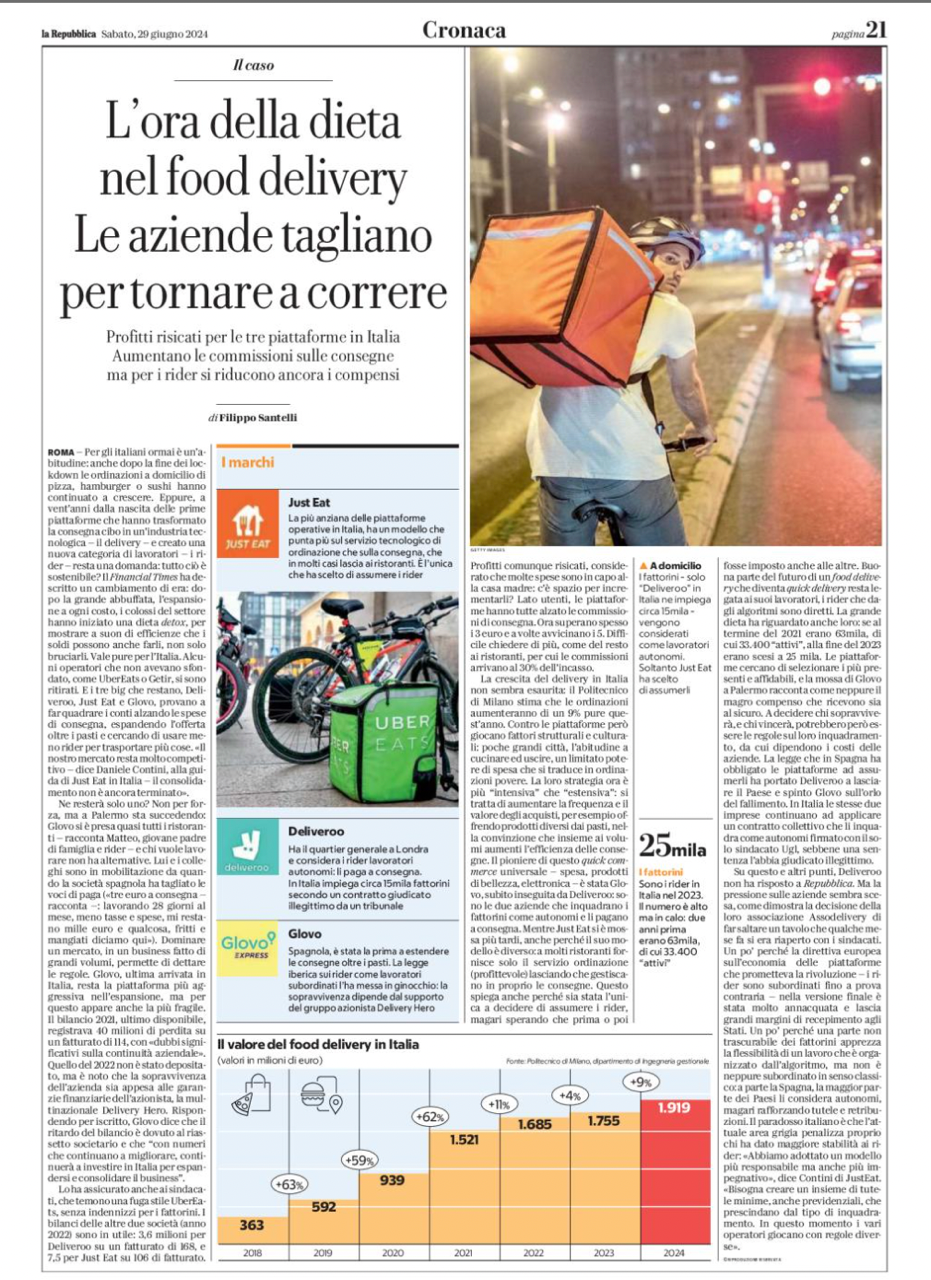
By June 2024, only three companies remained in Italy: Just Eat, Deliveroo and Glovo.
And from retail, via ‘quick commerce’, they appear to have moved on to managing ‘dark kitchens’ for the catering sector:
- Milan: what are ‘dark kitchens’? These are the ghost warehouses where food delivered by riders is prepared – places that clearly illustrate how the world of food and catering is evolving:
“The customer who has ordered sushi, pizza or fried chicken via a platform from a restaurant they know assumes it’s being prepared there: in reality, we riders go and collect it from somewhere else entirely, ina dark kitchen”…
According to theCorriere, there are at least six large‘dark kitchens’ [ in Milan], each run by a different catering brand. Inside these industrial warehouses, which operate behind closed gates, entry is restricted to staff working for Glovo, Deliveroo or Just Eat – the leading food delivery services.
The reason why places like these exist is easily explained: online orders often far exceed those placed in the actual physical restaurant. Consequently, restaurants struggle to keep up with all the orders and end up directing riders to a ‘secondary’ restaurant, of which the customer is unaware.
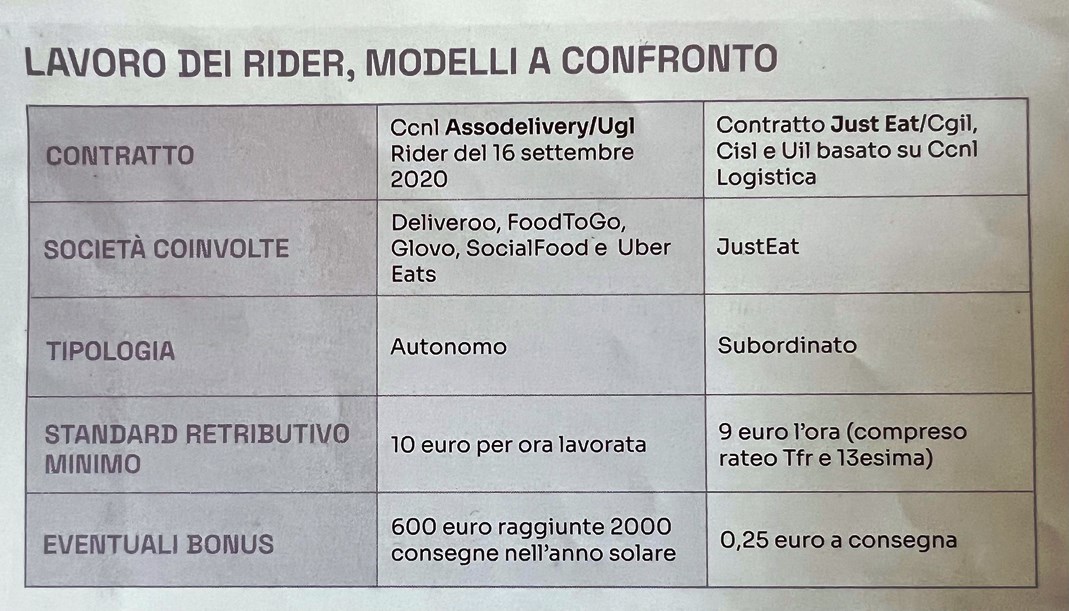
Below: delivery riders, a comparison of models. Source: Retail & Food, January–February 2023.
….Glovo… remains the most aggressive platform in terms of expansion, but for this very reason it appears to be the most fragile. The 2021 financial statements – the latest available – showed a loss of 40 million against a turnover of 114, with significant doubts regarding the company’s going concern. The 2022 financial statements have not been filed, but it is known that the company’s survival hangs on the financial guarantees provided by its shareholder, the multinational Delivery Hero…
….Much of the future of a food delivery service that is shifting towards quick delivery remains tied to its workers, the riders who are directed by algorithms. The major cutbacks have affected them too: whilst there were 63,000 at the end of 2021, of whom 33,400 were ‘active’, by the end of 2023 this figure had fallen to 25,000. The platforms seek to select the most reliable and consistent riders, and Glovo’s move in Palermo shows that not even the meagre pay they receive is secure.
However, it may be the rules governing their employment status – on which the companies’ costs depend – that determine who survives and who comes out on top.
The law in Spain that forced platforms to employ them led Deliveroo to leave the country and pushed Glovo to the brink of bankruptcy.
In Italy, the same two companies continue to apply a collective agreement classifying them as self-employed, signed solely with the Ugl trade union, even though a court ruling has deemed it unlawful.
Deliveroo has not responded to *La Repubblica* on this and other points. However, the pressure on the companies appears to have eased, as demonstrated by the decision of their trade association, Assodelivery, to call off negotiations that had been reopened with the trade unions a few months ago. This is partly because the European directive on the platform economy – which promised a revolution (with riders deemed to be employees unless proven otherwise) – has been significantly watered down in its final version, leaving considerable scope for national implementation. This is partly because a significant proportion of delivery riders appreciate the flexibility of a job organised by an algorithm, whilst not being employed in the traditional sense: apart from Spain, most countries consider them self-employed, perhaps whilst strengthening protections and pay.
The Italian paradox is that the current grey area penalises precisely those who have brought the greatest stability to delivery riders: ‘We have adopted a more responsible but also more demanding model,’ says Contini of JustEat. ‘We need to establish a set of minimum safeguards, including social security provisions, that are independent of the type of employment classification. At the moment, the various operators are operating under different rules.’
Conclusion:
The great ‘rush’ or craze for food delivery during the Covid-19 pandemic has passed; the sector is now consolidating with the elimination of unnecessary costs ( e.g. standalone warehouses for ‘quick commerce’).
For now, in terms of revenue, “the mountain seems to have given birth to a mouse”; in Italy, €1.9 billion in turnover – by the end of June 2024 – is a drop in the ocean compared to a supermarket’s food departments [but we cannot help but wonder whether these figures are accurate, as the lack of transparency in the catering and delivery sectors suits many people just fine].
And given that food delivery overlaps with the restaurant sector, it is natural to recall what FIPE president Lino Stoppani said in 2016: ‘The risk is that in the city centre [of Milan] only chains or establishments offering standardised service will find a place.’
To this statement I would add: the majority of cafés and fast-food outlets use pre-cooked food, but many restaurants too – especially at lunchtime – use food that has been prepared in advance and is then simply reheated.
This trend will be exacerbated by delivery-only ‘dark kitchens’.
On the social front, I recommend reading the concluding note at the bottom of the article.
- Riders: the EU is preparing a revolution in digital work – platforms will have to employ them.
- Quick commerce: how the high-speed delivery services of Glovo, Gorillas and Getir work.
- Gorillas has acquired Frichty.
- Deliveroo – which, as we recall, is partly owned by Amazon – is branching out into the restaurant business: Deliveroo is set to open its own pizzeria in London. And it is on trial in Paris
- Getir is expanding into Rome
- Getir: a new funding round of $800 million brings the company’s valuation to $11.8 billion
- Delivery: two start-ups have closed down
- US delivery firms are struggling to prevent riders from becoming employees; see article at the end
- Delivery, Quick Commerce: a step backwards?
- Gorillas exits Italy and three other markets
- Getir is one of the latest tech firms to announce a significant reduction in its workforce
- Deliveroo fined €375,000 for disguised employment. Two former executives of the platform were also given twelve-month suspended prison sentences.
- Delivery: a single large ghost kitchen for all operators?
- Delivery: Amazon is reportedly set to acquire 2 per cent of Grubhub (Just Eat Takeaway)
- Delivery: Gopuff is cutting 10 per cent of its global workforce and closing dozens of warehouses
- Gone in a Jiffy: Why thequick-commerce grocery sector is destined to collapse, highlighting two key points: perhaps delivery speed isn’t all that essential for many customers and, above all, it is far too expensive for those providing the service. Current data seems to support this view: Capital flight from quick commerce
- Just Eat is to sell its 33 per cent stake in the Latin American joint venture IFood to the multinational Prosus
- Delivery: Gopuff is leaving Spain. In 2022, the German companyDelivery Hero , based in Berlin , acquired 94 per cent of Glovoapp23 S.A., the parent company of Glovo
- France: dark stores at risk of closure
- Glovo faces a massive fine in Spain: 79 million. “It has failed to ensure its delivery drivers are legally compliant.”
- Uber Eats in France is accused of using undocumented drivers (without valid residence permits).
- Rider dies after an accident; Glovo’s cold reaction: “Nobody is asking them to race”
- Getir joins forces with Just Eat
- Delivery riders are like employees: the Milan court orders Glovo to take them on
- Illegal labour practices are on the rise among delivery riders: bicycles, scooters and accounts in exchange for money
- A delivery rider’s real pay | The video
- Getir to make between 200 and 300 people redundant
- Delivery: Marc Lore launches Wonder: it’s surprising that, whilst Getir (Quick Commerce, which has taken over Gorillas) is struggling, there are those investing $850 million in Marc Lore’s start-up (formerly of Walmart and Amazon), which, however, will focus solely on food delivery (no groceries, just deliveries from restaurants).
- In *The Rider Racket*, not only is there confirmation of the highly questionable methods of some operators, but it has also ‘come to light’ that Just Eat, the only operator to have taken on riders, is laying off staff hired in the UK.
- Quick commerce is collapsing: will Getir, after France, leave Italy? Confirmation came on 27 July 2023
- France: Getir and Gorillas in liquidation
- DoorDash had to write off a net loss of $1.36 billion in 2022 alone
- Kroger: Kitchen United is closing seven ghost kitchens specialising in ready meals
- EU legislation: delivery riders to be treated as employees
- Getir completes the acquisition of Ahold Delhaize’s FreshDirect.
- Delivery: European food delivery apps are starting to turn a profit (EBITDA, not EBIT).
- Delivery Hero exits Deliveroo as demand for takeaway food declines (Deliveroo’s shares fell by 4 per cent in early trading on Tuesday, whilst Delivery Hero’s shares fell by 8 per cent, extending a decline of over 60 per cent over the last 12 months), although global turnover has quadrupled since before the Covid-19 pandemic
- Delivery: Getir is withdrawing from the US and Europe. The company is set to remain operational only in Turkey.
- Losses in the food delivery sector in May 2024.
- Just Eat is forced to sell off Grubhub; the Covid-19 ‘binge’ is over
- Walmart is partnering with China’s Meituan for ‘anytime, anywhere’ 30-minute deliveries
- Food delivery in India: Zomato delivers in 15 minutes
- Prosus (Glovo) also takes over Just Eat. Mergers on the horizon in the delivery sector (DoorDash, which holds 67 per cent of the US market, is in profit).
- Deliveroo in DoorDash’s sights: a £2.7 billion bid
- DoorDash acquires its British rival Deliveroo.
- Glovo and Delivery Hero have been fined for forming a commercial cartel
- “We can’t stop working in this heat – we’re on starvation wages.” A delivery rider’s confession
- Glovo under investigation for labour exploitation: riders exploited in Milan and across Italy (2026)
- Uber enters seven new European markets with food delivery (2026)
- DoorDash – which owns Deliveroo – ended 2025 as the leading third-party marketplace by order volume in the food and retail sector in the United States (2026).
- Permanent contracts and a fixed salary. This is how Just Eat is turning over a new leaf with its riders (2026)
- US / Uber launches Cart Assistant: shopping made easy with AI (2026).
- Glovo raises riders’ wages to emerge from administration (2026)
- Uber and DoorDash are vying for Delivery Hero to gain control of Glovo (2026).
- Glovo: Milan Public Prosecutor’s Office claims pay rises were fictitious; riders must be regularised (2026).
- Deliveroo: ‘estimated’ hourly pay rises to 14 euros, with a cap on working hours
From a business perspective, DoorDash’s marketplace figures are impressive: we’re talking about more than $100 billion in turnover ( Uber’s figures are also interesting…). In our country, they seem to be struggling for various reasons, including the habits of the Italian provinces.
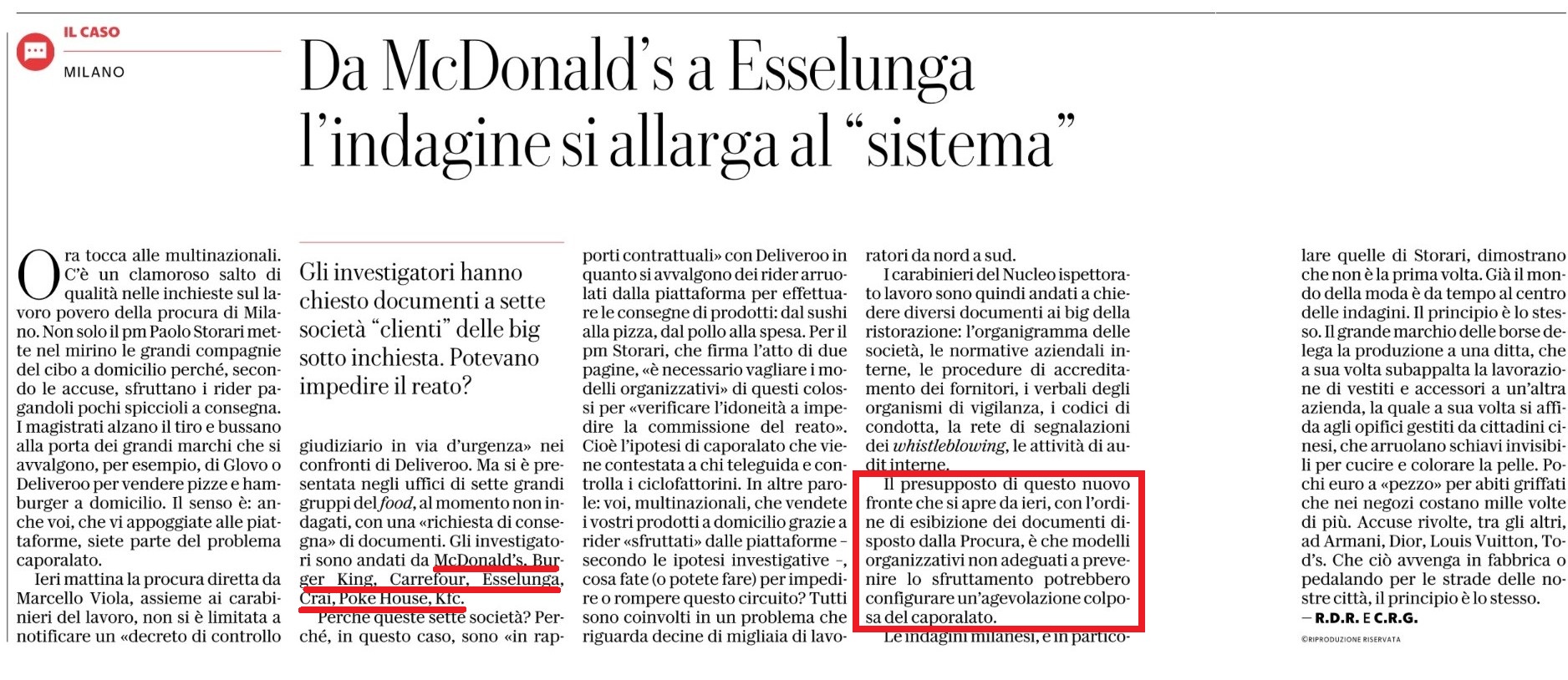
Then there is the social aspect: in February 2026, the investigation that had already involved Glovo was extended to Deliveroo.
But also to McDonald’s, Esselunga, Burger King, Carrefour, Crai, Poke House and Kentucky Fried Chicken.
There are signs of negligent facilitation of illegal labour recruitment. This should perhaps apply to all subcontracting, not just food delivery. It is incredible that public prosecutors have to intervene in this sector, yet the world of work – with three million workers employed off the books or in the ‘grey area’ – remains unregulated and unmonitored.
The article below is from *La Repubblica* and is dated 26 February 2026