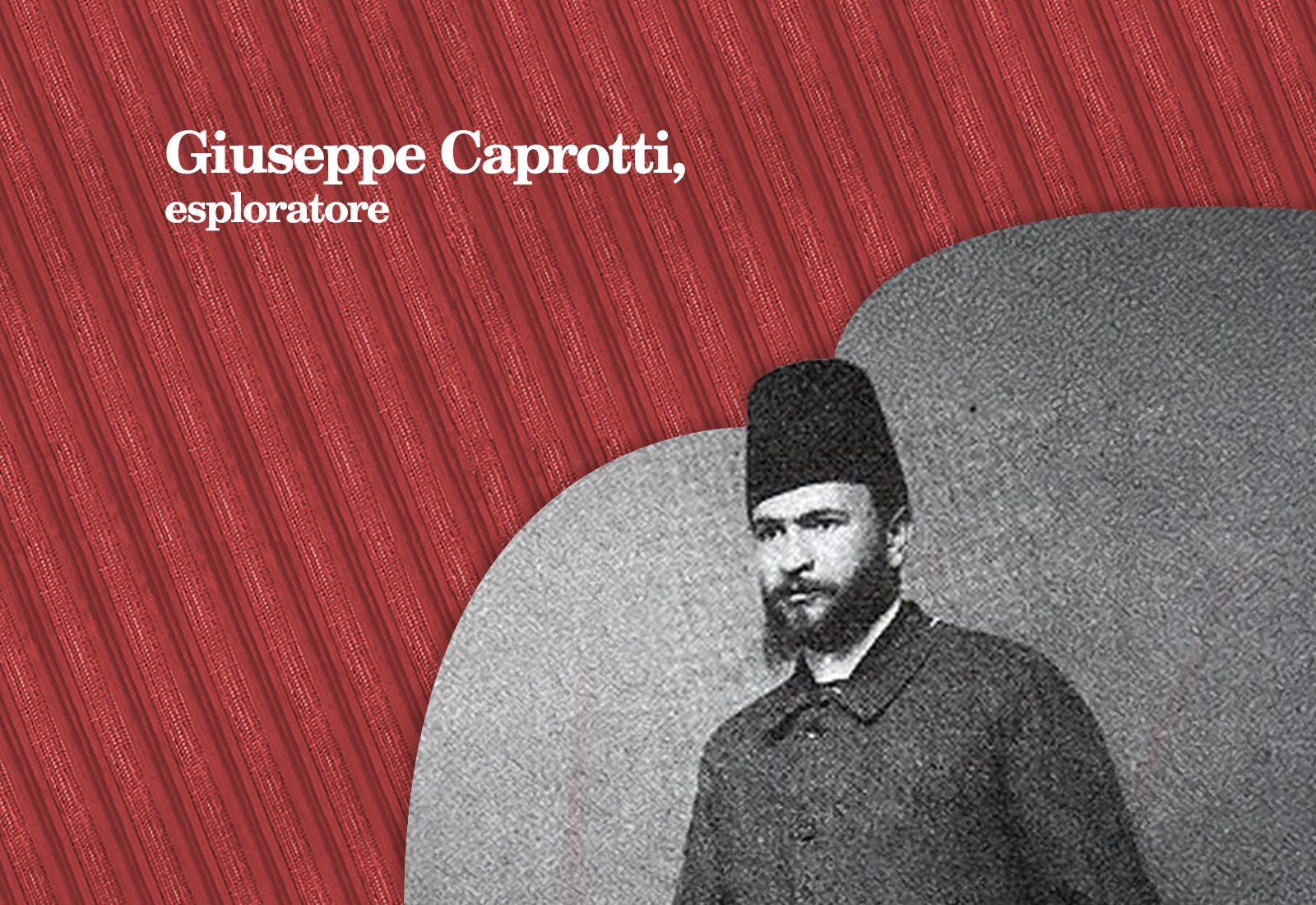
Giuseppe Caprotti had close contacts with another Giuseppe Caprotti, his exact namesake and from Brianza like himself, perhaps a ‘very distant relative’ (ROMANO, I Caprotti, p. 177), and who was my great-great-grandfather. A man of a thousand interests, he also did not miss the one – exciting for sure – for ‘incomparable medals, rare, priceless cameos, sons of tenebrosa, sublime antiquity’, as Don Profondo sings in Rossini’s ‘Journey to Reims’. Thanks to his contacts with his distant namesake and with a number of art and numismatic dealers of all kinds, Giuseppe built up a collection, known in the family as the ‘Caprotti Museum’, consisting of artistic objects, but above all coins, for which he had a great passion. The idea of smuggling certainly does not stop the two. With absolute nonchalance, Giuseppe the explorer wrote to Giuseppe the entrepreneur that, although the governor had forbidden the export of antiques, as he had excellent relations with the authorities he was almost certain not to encounter any opposition, “if not (…) I will send them via Aden, as it is very easy from the land side to smuggle” (Giuseppe the explorer to Giuseppe the entrepreneur, Sanaa, 24 July 1890).
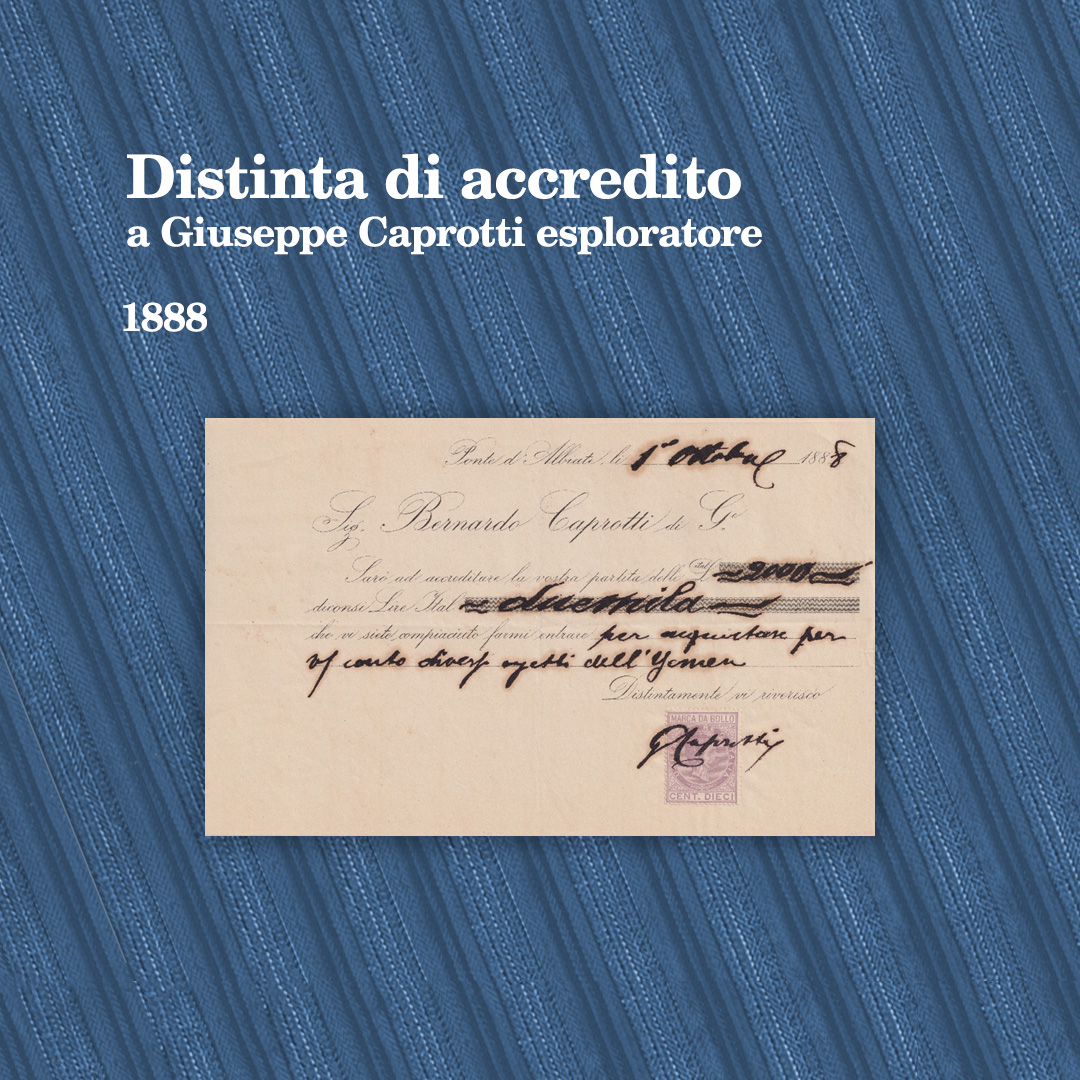
Every time Giuseppe the explorer returned to Italy, he usually paid a visit to Giuseppe the entrepreneur, by whom he was always well received and who credited him with not inconsiderable sums, such as the 2,000 lire of 1 October 1888, “to buy various objects from Yemen on your behalf“, no matter what kind they were. On 22 November, from Sanaa, having just arrived after a journey of almost a month, Giuseppe the explorer announced that he had already bought “with the money you gave me for about 400 fr[anks] of arms and coins, with which I hope you will be very satisfied [sic]. In two or three months I hope to be able to send you a collection of [sic] different objects [sic] for the amount of what you have delivered to me (…)’.
Luigi Caprotti, Giuseppe’s brother and the first Italian to reside in Yemen, even at the risk of his life, as there was no consulate to refer to in case of trouble, also procured and sent objects, coins (“a small collection of ancient or, in part, rather recent coins, but all very rare in Europe or even unknown“, letter from Sanaa dated 23 February/7 March 1889), but also “carpets from the country, so that you can arrange an Arab room” (Sanaa, 27 May 1889). The story of the “Arab room” lasted for a while, until Giuseppe the explorer informed Albiate in Albiate in June that “to arrange an Arab room” did not need furniture, but “narrow straw mattresses around the room with many small cushions, and covered with some brightly coloured cotton cloth” (Sanaa, 10 June 1889). After this, and perhaps also thanks to the family’s reactions, ‘Arab rooms’ in a Caprotti mansion would never be spoken of again..
There is, however, talk of the fabrics sent by Giuseppe the entrepreneur for sale in Yemen. Through them, Giuseppe the explorer communicates the differences in views between totally different cultures: ‘they were well received by the Arabs; however, I fear that when they realise that the colours are not very durable, they will complain; however, up to now, nothing gives me the right to think so (…). P.S. Here is a defect, a ridiculous one I know, found in some of their fabrics according to the Arabs: instead of tearing in the weft direction like percale, they tear in the warp direction; since they make little use of scissors here, they find this a serious defect!(Giuseppe explorer to Giuseppe entrepreneur, letter from Sanaa, 18 July 1889).
Of course it is not easy to trade in conditions that are always very difficult, both for trade and the political situation. On 21 January 1892, Giuseppe explorer wrote from Sanaa complaining, and not for the first time, about the ‘spitefulness’ that his competitors (or even his Genoese employers) do to him, trying to steal his goods with tricks and pretexts in order to resell them in neighbouring countries at a much higher profit. Giuseppe the entrepreneur, however, perhaps also thanks to direct contact through his family in Italy, who often passed on his relative’s letters to him, never lacked support: ‘Even though you knew me penniless, you gave me your trust by entrusting me with many goods, and for this I will always be grateful (…). On the contrary, there is a great demand for your goods, and I hope to procure very important orders this year, because I have managed, for now, to beat the indigenous fabrics themselves (…)’. As always (and as is often the case in correspondence “from afar”), Giuseppe the explorer concludes with notes on the environment: “It is bitterly cold here, and in living memory it is the first time that winter has been so cold and persistent. The thermometer in the mornings is always below zero, and one only has to throw water on the ground to see it freezing fast‘.
Unfortunately, we do not have the part of the correspondence relating to Giuseppe the entrepreneur, which presumably remained in the archive of the receiver, i.e. Giuseppe the explorer.
Sources:
Albiate (MB), Villa San Valerio, Villa San Valerio Archives, Giuseppe Caprotti, Giuseppe Caprotti explorer.
The National Library of Israel, Giuseppe Caprotti 1869-1919, Giuseppe Caprotti, 1900-1909, סימול ARC. Ms. Var. 525 02 01.1 Hermann Burchardt Archive, Hermann Burchardt Archive.
Bibliography:
L. BELTRAMI, ‘Eugenio Griffini Bey, MDCCCLXXVIII-MCMXXV’, Milan, 1926
G.B. ROSSI, ‘El Yemen, Arabia Felix o Regio Aromatorum. Appunti di geografia, storia, usi e costumi (…)’, Turin, 1927.
M. CARAZZI, ‘Caprotti, Giuseppe’, entry in Dizionario Biografico degli Italiani – vol. 19 (1976), from https://www.treccani.it/enciclopedia/giuseppe-caprotti_(Dizionario-Biografico)/
R. ROMANO, “I Caprotti. L’avventura economica e umana di una dinastia industriale della Brianza”, Milan 1980.
I. SANZÒ, “1897 – 1926. Over 100 years of relations between Italy and Yemen’, in ‘Bilqis. La Regina di Saba”, published by the Embassy of Yemen in Rome, no. 2, June 2012, pp. 24-26.
P. F. FUMAGALLI, “Giuseppe Caprotti (Pobiga Di Besana Brianza, 1862-Magenta 1919): Quelques notes biographiques’, in ‘Chroniques du Manuscrit au Yémen’, no. 9 (28)/Juillet 2019, ‘Giuseppe Caprotti de Brianza (29 mars 1862-15 mai 1919). In memoriam’, pp. 36 – 40.
A. D’OTTONE RAMBACH, ‘Giuseppe Caprotti et son double – Entre manuscrits et monnaies yemenites’, in ‘Chroniques du Manuscrit au Yémen’, no. 9 (28)/Juillet 2019, ‘Giuseppe Caprotti de Besana Brianza (29 mars 1862-15 mai 1919). In memoriam’, pp. 46 – 55.
G. CAPROTTI, “Le Ossa dei Caprotti. Una storia italiana’, Milan, 2024/3.