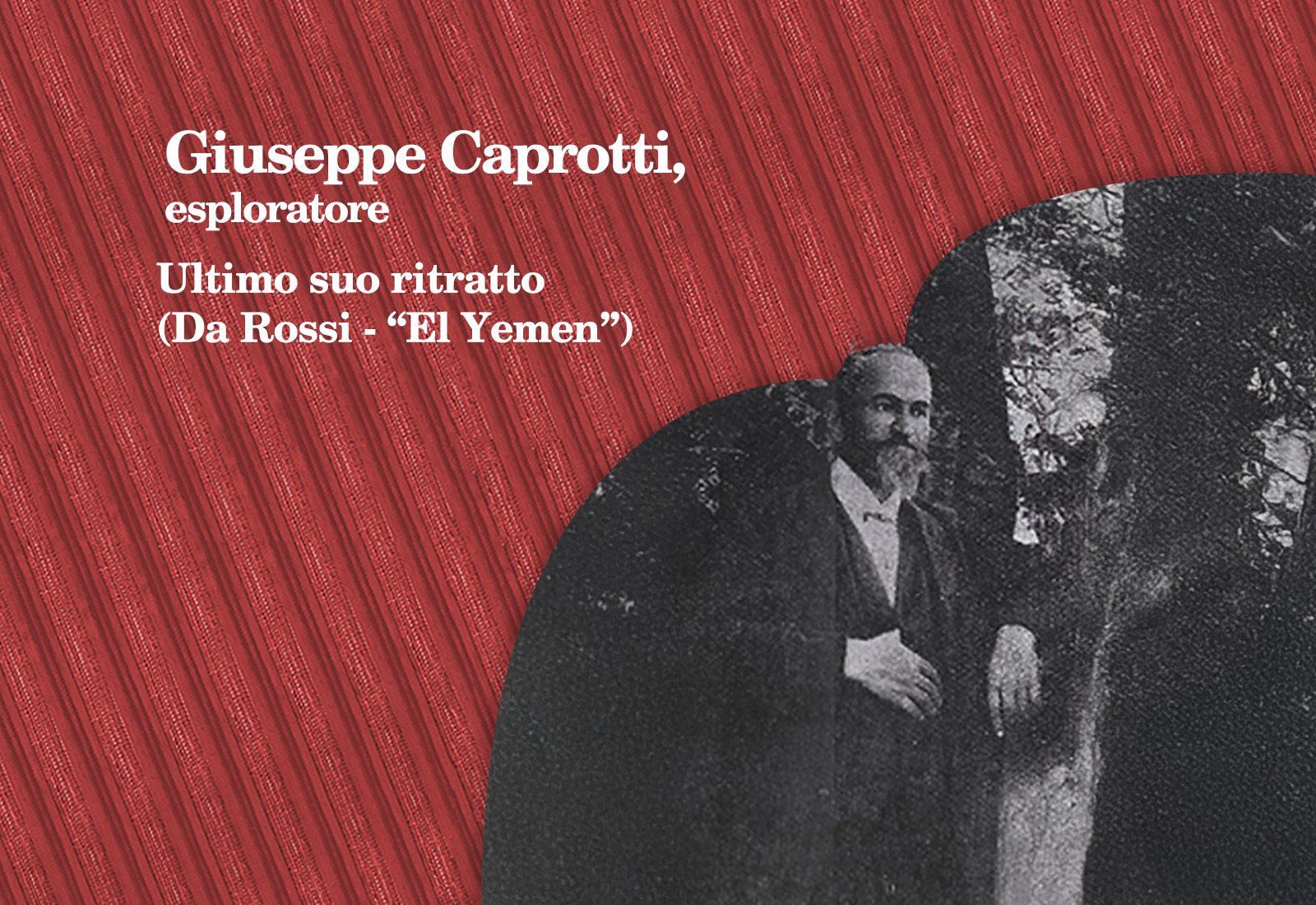
Eugenio Griffini, a great Arabist and scholar, future librarian to the king of Egypt, met Giuseppe Caprotti as a young student. Invited to Magenta, where he lived, Griffini’s first impression of the dwelling must have been double that of Giuseppe Caprotti’s in Sanaa, full of his life, his commerce and his passions: ‘I enter, but I am immediately stopped by a barricade of palm mats, bulging with coffee. The house is a quintessence of “Arabia felix” (…). Yemeni and Persian carpets, old and new, princely and gypsy. Furs and feathers. Perfume vials and stills. Weapons and bronzes. Goods of all kinds, European and Indian. But for me, shimmering like stars in the void, were large, heavy zinc cases, filled with delicate sheets (…) covered with casts of ancient inscriptions (…). And books, books, oh, how many books! A whole mora, along one wall, and all manuscripts, in Arabic. (…)’ (BELTRAMI, ‘Eugenio Griffini Bey‘, p. X).
Indeed, during his very long stay in Yemen, Giuseppe amassed an important and very rich collection of manuscripts, coins and antiquities of various kinds, scouring them all over the country. A real treasure that Caprotti managed to ship to Italy before the Great War, usually by taking advantage of the coffee wrapped in palm leaf mats where it was easy to slip in other wrappings.
Eugenio Griffini had the impression that his extraordinary friend did not always know the full value of the treasures with which he had filled his house, and in fact Giuseppe, after a while, entrusted them to him for an initial cataloguing and valuation with a view to selling them. At the time of the myth of ‘Arabia felix‘ and the European fascination for its history, art and products, many scholars were hoarding manuscripts (among them was Hermann Burchardt, a German Jew and friend and long-time guest of Caprotti’s in Sanaa), and those in Giuseppe Caprotti’s collection were among the most beautiful and numerous. Fearing an unreceivable offer from Germany, which would secure the collection for the Berlin Library, Griffini involved his cousin, the architect Luca Beltrami, a great restorer of historic buildings, famous above all for the restoration of Milan’s Castello Sforzesco; thanks also to his contacts and the interest of Msgr. Achille Ratti, Prefect of the Biblioteca Ambrosiana in Milan (and future Archbishop of Milan, later Pope under the name of Pius XI), a large part of the Caprotti collection became part of the collections of the library founded by St. Carlo, making it one of the most valuable and one of the largest collections of its kind in Europe today. A smaller part was acquired in 1926 by the Vatican Library, again through the good offices of the now Senator Beltrami, still in contact with the former prefect of the Ambrosiana, now Pope Pius XI.
Renato Traini, who edited the last volume of the total cataloguing of the Library’s Arabic manuscripts, notes that “even this last part of the collection (…) records the presence of unique or rare texts (i.e. existing in no more than two other copies). It is not an exaggeration to recognise a double privilege for the Biblioteca Ambrosiana: not only does it possess the richest collection of Arabic manuscripts compared to other Italian libraries, but it also has the richest holdings of Yemenite codices in the Western world” (TRAINI, “Arabic Manuscripts in the Biblioteca Ambrosiana”).
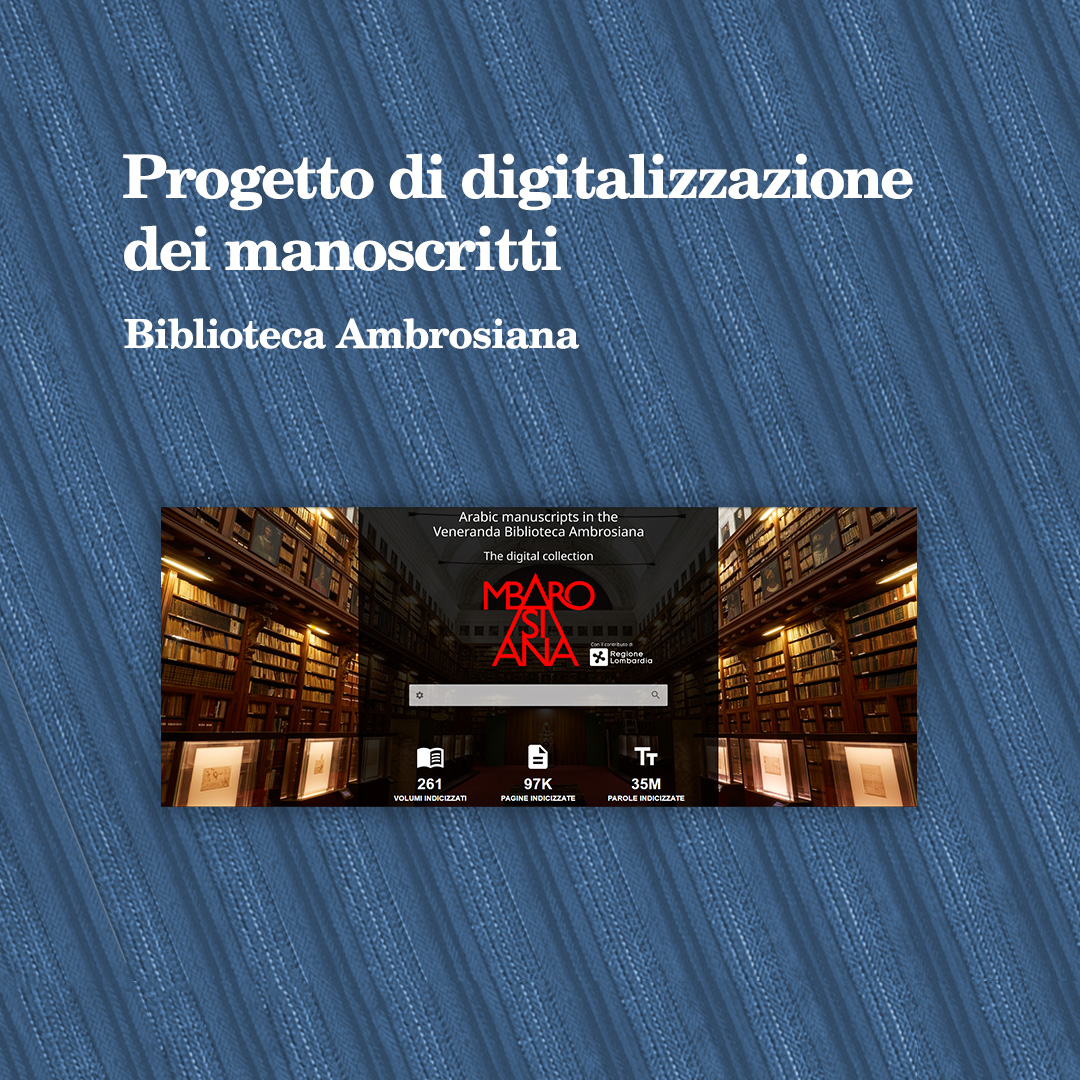
In March 2025, the project ‘Arabic Manuscripts in the Veneranda Biblioteca Ambrosiana: the digital collection”, which, thanks to the support of the Lombardy Region and the collaboration of the Catholic University of Milan and the University of Notre Dame (USA), aims to digitise, with the use of advanced artificial intelligence tools, all the Arabic manuscripts preserved in the Library, including, of course, the third of the three main fonds, the Nuovo Fondo, the one from the Caprotti collection (“Ambrosiana, i manoscritti arabi digitalizzati”, 7 March 2025).
Bibliographic references:
L. BELTRAMI, Eugenio Griffini Bey, MDCCCLXXVIII-MCMXXV, Milan, 1926.
G.B. ROSSI, ‘El Yemen, Arabia Felix o Regio Aromatorum. Appunti di geografia, storia, usi e costumi (…)’, Turin, 1927.
M. CARAZZI, “Caprotti, Giuseppe”, entry in “Dizionario Biografico degli Italiani” – vol. 19 (1976), from https://www.treccani.it/enciclopedia/giuseppe-caprotti_(Dizionario-Biografico)/
I. SANZÒ, ‘1897 – 1926. Over 100 years of relations between Italy and Yemen’, in ‘Bilqis. La Regina di Saba”, publication edited by the Embassy of Yemen in Rome, no. 2, June 2012, pp. 24-26.
P. F. FUMAGALLI, “Giuseppe Caprotti (Pobiga Di Besana Brianza, 1862-Magenta 1919): Quelques notes biographiques’, in ‘Chroniques du Manuscrit au Yémen’, no. 9 (28)/Juillet 2019, ‘Giuseppe Caprotti de Brianza (29 mars 1862-15 mai 1919). In memoriam’, pp. 36 – 40.
A. D’OTTONE RAMBACH, ‘Giuseppe Caprotti et son double – Entre manuscrits et monnaies yemenites’, in ‘Chroniques du Manuscrit au Yémen’, no. 9 (28)/Juillet 2019, ‘Giuseppe Caprotti de Besana Brianza (29 mars 1862-15 mai 1919). In memoriam’, pp. 46 – 55.
G. CAPROTTI, “Le Ossa dei Caprotti. Una storia italiana’, Milan, 2024/3.
R. TRAINI (ed.), “Arabic Manuscripts in the Biblioteca Ambrosiana”, IV, Milan, 2011.
(f.p.) Ambrosiana, the digitised Arabic manuscripts, in “Terra Santa”, 7 March 2025(https://www.terrasanta.net/2025/03/ambrosiana-i-manoscritti-arabi-digitalizzati/ ).
BIBLIOTECA AMBROSIANA, “Arabic manuscripts in the Biblioteca Ambrosiana. The digital collection”, presentation of the Project, 4 March 2025(https://ambrosiana.it/partecipa/mostre-e-iniziative/arabic-manuscripts-in-the-biblioteca-ambrosiana-the-digital-collection/ ).
G. CAPROTTI, “Biblioteca Ambrosiana : fruibili i codici di Giuseppe Caprotti”, 08/03/2025(https://www.giuseppecaprotti.it/flash/biblioteca-ambrosiana-fruibili-i-codici-di-giuseppe-caprotti/ ).