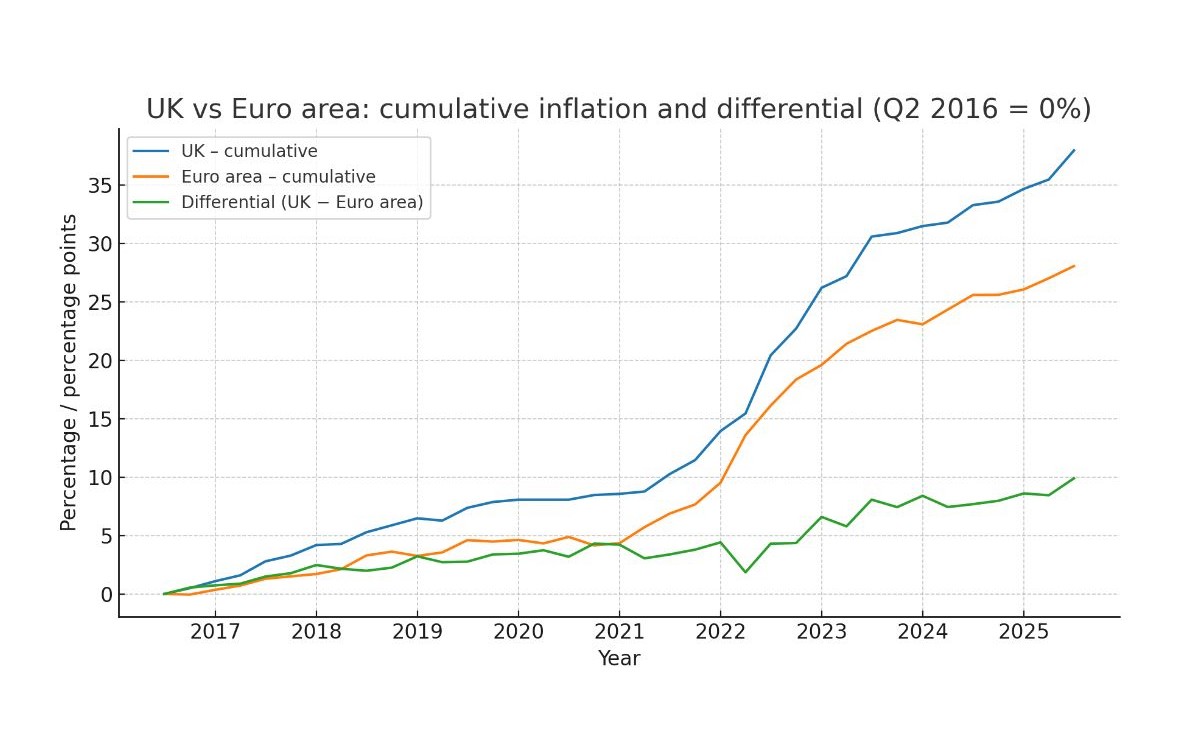
I wrote this in *Il Foglio*, regarding tariffs and Walmart: “The medium-term outlook bears a strong resemblance to what we’ve already seen with Brexit: since 2016, the pound has fallen by 12 per cent against the euro, and inflation in the UK has been 9 per cent higher than the Eurozone average.”
Inflation in Britain has taken a turn for the worse since Brexit. Or, to put it another way, the European Union has brought greater price stability (and therefore income stability) to its member states.
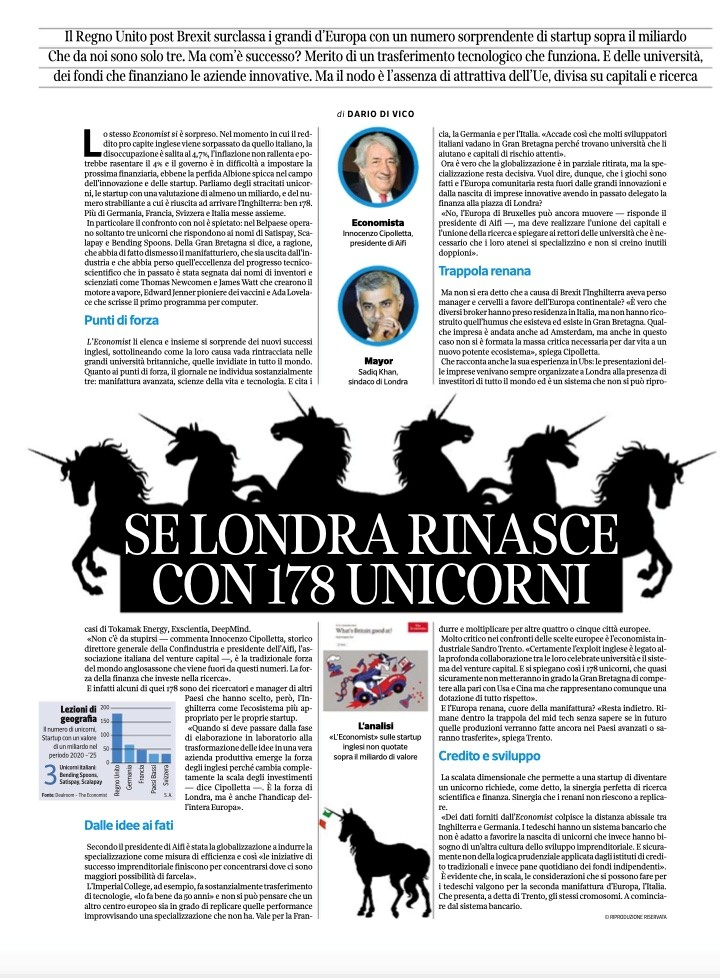
But Brexit – and policies aligned with those of the US – have enabled the development of innovative start-ups that the EU lacks:
… This is, in fact, Trump’s second state visit to Britain, following the one in 2018: an unprecedented honour, granted as a reward for keeping tariffs on London to a minimum.
On Thursday, the President will meet Prime Minister Keir Starmerat Chequers: there,major technological agreements on artificial intelligence and quantum computing will be announced, alongside previously revealed nuclear deals. This is the crux of the visit, as far as the British are concerned: Trump’s entourage includesSam Altman of OpenAI and Jensen Huang of Nvidia, with the Americans bringing with them two billion in tech investment [in reality, it is much more, see below] and one and a half billion in the financial sector, featuring names such as Blackrock, Bank of America and Citi.
Thanks to Brexit, Britain has broken free from the EU’s regulatory orbit and is now in a position to ride the wave of the American technological revolution, positioning itself as a high-tech hub. But the moment of greatest risk will be the final press conference, when journalists are sure to raise the Epstein case: and here, Trump’s potential wrath could end up spoiling the party.
But if all goes well, it will be a diplomatic masterstroke by Starmer, who has managed to forge an unlikely yet cordial personal relationship with Trump. As disastrous on the domestic front as he is skilful on the international stage, Starmer has made post-Brexit Britain a crucial hub, whether the talk is of European security or new technological frontiers. And Trump is coming to seal the deal.
As Corriere Economia aptly puts it below: “the crux of the matter is the EU’s lack of appeal, given its divisions over capital and research”.
Speaking of Europe’s largest industrial producer (Germany), the economist Sandro Trento adds:
… “The Germans have a banking system that is not suited to fostering the emergence of ‘unicorns’ [privately held start-ups, not listed on the stock exchange and valued at $1 billion], which instead require a different culture of entrepreneurial development. And certainly not the prudential approach applied by traditional credit institutions, which is, on the other hand, the daily bread of independent funds”.
It is clear that, on a similar scale, the observations made about Germany also apply to Europe’s second-largest manufacturing nation, Italy. According to Trento, Italy shares the same fundamental characteristics, starting with its banking system.
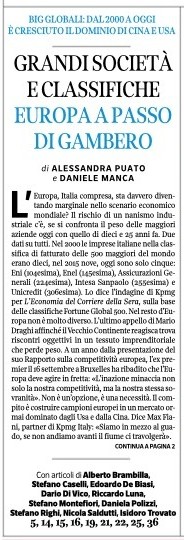
Below is an article on the growing gap between the European economy and the rest of the world (Corriere Economia, 22 September 2025).
Published on 17 September, updated on 30 September 2025