Written on 20 August, updated on 23 November 2024
How Big Tech is quietly trying to reshape the way pollution is reported
Critics say a proposed rule change backed by Amazon and Meta could allow major energy users to hide their true emissions.
Amazon is a green business leader. The world’s most-visited online marketplace and leading cloud services provider claims to have achieved its target of 100 per cent renewable energy seven years ahead of a self-imposed deadline. But on the other hand, Amazon is a major polluter, emitting far more climate-warming greenhouse gases through its electricity consumption than its cloud computing rivals. In the United States, Amazon’s vast domestic market, fossil fuels accounted for around 60 per cent of electricity generation in 2023. The company can be portrayed as either a hero or a villain depending on the rules governing the calculation of greenhouse gas emissions, under which companies can use investments in clean energy systems to offset their real-world energy-related emissions.
The social media group Meta, for example, claims to have already achieved ‘net zero’ emissions in its energy use. But the FT’s analysis of its sustainability report shows that its actual CO₂ emissions from energy consumption stood at 3.9 million tonnes in 2023, compared with the net 273 tonnes cited in the report.
These tech giants are set to become some of the largest energy consumers of the future as they ‘race’ to develop energy-hungry artificial intelligence, potentially jeopardising their net-zero commitments.
With this in mind, they are working behind the scenes to shape a once-in-a-decade overhaul of the rules governing how energy-related pollution is disclosed. Companies such as Amazon, Meta and Google have funded and lobbied the Greenhouse Gas Protocol, the body overseeing carbon accounting, and have funded research that helps support their positions, according to documents seen by the FT.
But Big Tech is itself divided over how to shape the rules…
…Globally, the International Energy Agency has estimated that the electricity consumed by data centres will double by 2026, amounting to roughly the equivalent of Japan’s current annual consumption. This expansion threatens the feasibility of Big Tech’s net-zero targets.
Microsoft’s emissions rose by 30 per cent between 2020 and 2023, whilst Google’s increased by almost half [50 per cent] between 2019 and 2023, …
both companies have partly blamed the need for new data centres. Much of this growth is expected to take place in the US, where many power grids are still dominated by fossil fuels…
Below: accounting measures distract from the spiralling growth in emissions from big tech companies
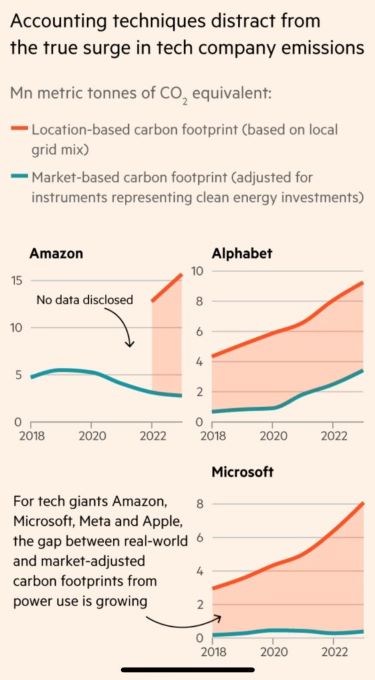
Essentially, big tech firms have made many fine pledges that, in practice, come up against reality: their data centres consume too much water and electricity – the cover image below is from Lifegate – far more than they save by investing in renewable energy or purchasing REC certificates (whenever a wind, solar or hydroelectric plant generates a unit of clean energy, its owner can issue an energy attribute certificate, typically known in the United States as a Renewable Energy Certificate, or REC), a system that is supposed to generate ‘clean energy’ and offset emissions.
However, this system does not appear to offset harmful emissions; it is controversial and is currently being redefined ( even though ‘Amazon, the world’s largest corporate purchaser of renewable energy’) is acting as a highly influential lobby: the influence of Amazon and Jeff Bezos’s $10 billion charity on the carbon credit market is raising alarm bells, amid a growing battle over how Big Tech and corporate groups are seeking to meet challenging climate targets. The Bezos Earth Fund is one of the largest funders of the Science Based Targets initiative, a world-renowned body relied upon by groups such as Apple and H&M to set voluntary standards and strict limits on the use of carbon credits to offset emissions…
And at the COP 29 climate conference: Energy-hungry Big Tech firms are shying away from the spotlight at the UN climate summit. Executives are keeping a low profile at COP29 as attention mounts on the power demands of artificial intelligence.
According to a recent analysis by Morgan Stanley, global emissions from data centres will almost triple by the end of the decade due to the development of generative AI, compared with a scenario in which this technology were not used. According to the study, data centres could account for 5.1 per cent of global emissions by the end of the decade, up from 1.9 per cent this year – in both cases compared with global emissions in 2022.
Read also: Amazon: from new supermarkets to energy