In the book ‘Le Ossa dei Caprotti’, family memory emerges as a thread that runs through the generations, without ever running out. It is precisely by following this thread that, alongside the Caprottis’ history, the roots of the Maire, Mallarmé, Kampmann and Koechlin families, linked to my grandmother Marianne Maire Caprotti, a Frenchwoman from Alsace, resurface. These pages preserve her memory.
The Koechlin family originated in German-speaking Switzerland; one of its branches settled in Mulhouse, Alsace, in the 17th century. In 1746, Samuel Koechlin (1719-1776) joined forces with two other industrialists and founded the first printing factory on cotton fabrics, the so-called ‘Indian cloths’. From the 19th century, the textile factory contributed to the city’s economic prosperity and political influence. In addition to numerous renowned industrialists and chemists, five members of the National Assembly and four mayors of Mulhouse belong to the family. It counts, to date, twenty-four members of the Legion d’Honneur, the highest and most important honour of the French state.
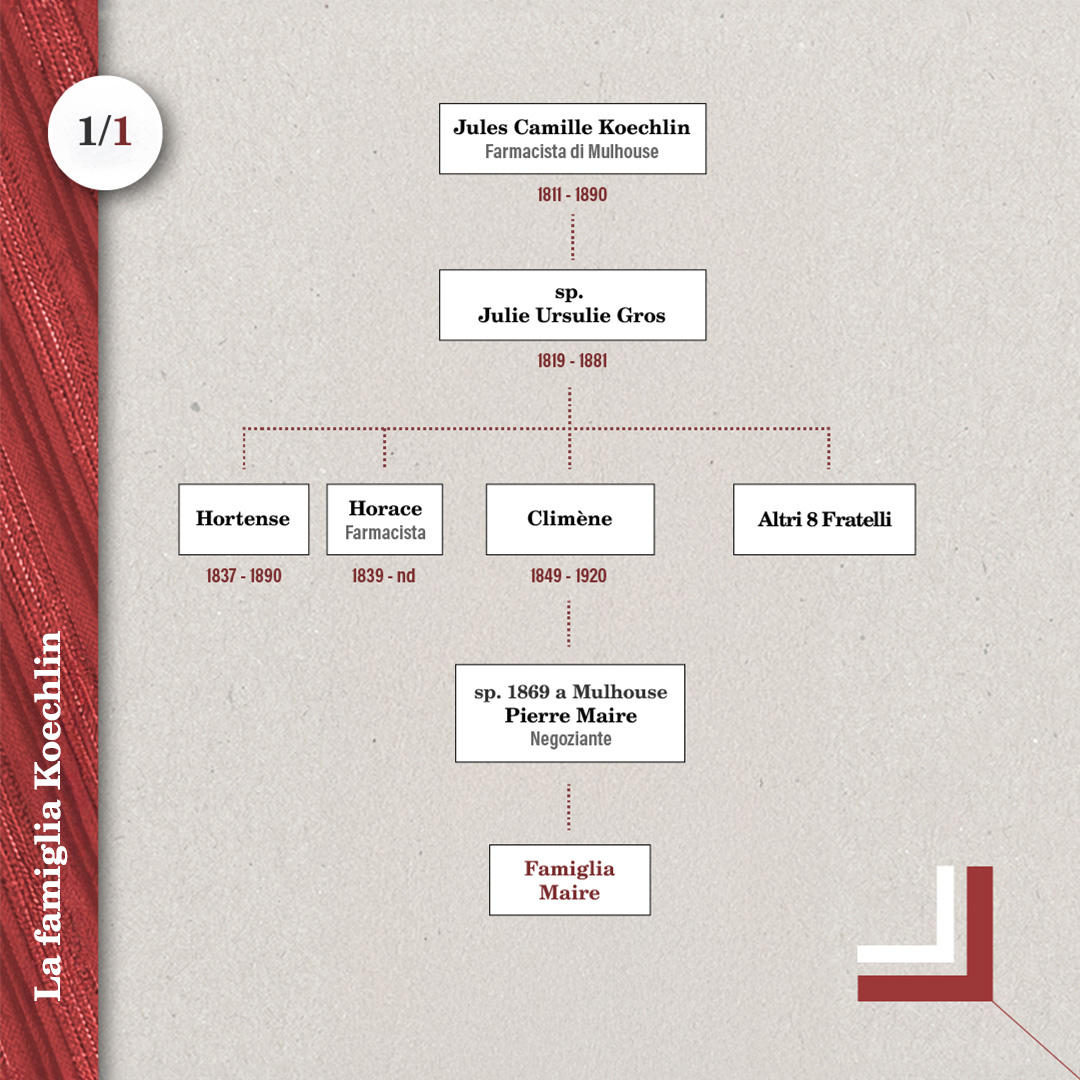
To a branch of the Koechlin family descended from Samuel belongs Climène Koechlin, the grandmother of my grandmother Marianne, thus my great-great-grandmother.
Thanks to the photographs kept in the archive of my uncle Claudio Caprotti, the last of my father Bernardo Caprotti’s brothers, Climène comes to us at all ages of her life, from a young girl to an elderly and elegant lady cloaked in lace and ruffles. She is descended from Jean Koechlin (1746-1836) and Climène Dollfus (1753-1828), who fathered twenty children, giving rise to a truly numerous clan, branching out and full of characters from the well-known to the famous. From Jean comes what Uncle Claudius still recites as a family nursery rhyme, passed down through the centuries word for word: ‘”Ma fille, va dire à ta fille, que la fille de sa fille pleure” (“My daughter, go tell your daughter that her daughter’s daughter is crying”). In fact, it is a phrase that has become famous in the lineage because it celebrates the astonishing age attained by the patriarch, who died so old that he was able to see three generations of grandchildren, the last one – the crying child – born in 1832, when he was 86 years old.
The great-great-grandmother Climène is the daughter of Jules Camille (1811-1890), a chemist like her father Daniel Koechlin-Schouch (1785-1871, awarded the Legion of Honour for his research in the field of textiles). In contrast to the other male members of her family, who tended to settle in Mulhouse at the time, Camille used her talents from 1837 to 1852 from Glasgow to Moscow. Four of her eleven children, including Climène, were born in Russia on 11 August 1849. Horace (1839-1898), the third great chemist of the line and just as nomadic as his father, was born in Glasgow. (Stoskopf. ‘La face cachée’, p. 2). His uncle also keeps a photo of his great uncle Horace, who was also awarded the Legion of Honour like his grandfather.
On 18 September 1869, aged 20, Climène married Pierre Maire, a shopkeeper from Mulhouse, and followed him to Épinal when he chose the French side after the annexation of Alsace by victorious Germany in the Franco-Prussian War (1870-1871). The eldest son, my great-grandfather Georges, was born on the other side of the Vosges not even a year after the wedding, on 7 July 1870. Two more children followed, Jeanne, on 7 December 1873, and Louis, on 10 February 1876. When her husband died in 1898, Climène returned to Mulhouse and died there on 9 October 1920.
As already mentioned, the Koechlin family, Alsatian with its main centre in Mulhouse, played a significant role in French history: 24 Legions of Honour awarded to as many members prove this. It is therefore worth spending a few words on them.
To limit ourselves to a few of the many personalities who have distinguished themselves since the end of the 19th century, mention may be made of them:
René Koechlin (1866-1951), who conceived the design of the Great Alsace Canal and its hydroelectric dams;
Maurice Koechlin, René’s brother (1856-1946), an extremely talented structural engineer, who was hired by Gustave Eiffel’s firm in 1879 and played a key role in the design of the Eiffel Tower. Gustave Eiffel was also involved in the construction of the Statue of Liberty in 1880, and Maurice was also the structural designer of the skeleton.
Paul Koechlin (1881-1916), pioneer of the aviation industry and pilot in the Great War, during which he died in combat.
Rodolphe Koechlin (1778-1855), botanical painter.
Florence Koechlin (1857-1896), renowned genre painter and sculptor, Daniel Koechlin (1845-1914) and Alfred Koechlin (1845-1878) also painters.
Raymond Koechlin (1860-1931), medieval art historian, collector, president-founder of the Société des amis du Louvre.
Charles Koechlin (1867-1950), important 20th century music theorist and composer, among the founders of the Société musicale indépendante in 1909 in Paris together with Maurice Ravel, Gabriel Fauré and Florent Schmitt, with the aim of promoting contemporary music.
In short, directly or indirectly, the Koechlin family is linked to the history of France in practically all its forms; to conclude with a final, ‘fragrant’ quotation, the daughter of a Koechlin, Andrée Isabelle Suzanne Bouffet (1884-1965) married Jacques Guerlain (1874-1963), grandson of the founder of the Maison Guerlain and his chief perfumer from 1890 to 1955. Family reunions had to – and still have to – be very intense!
Sources:
Florence, Claudio Caprotti Archives, Photographic Archives.
Climène Sylvanie Marie Octavie Françoise KOECHLIN, Arbre Généalogique Familial par D.Pradier001, entry in ‘Filæ. Registre des naissances en France – Etat civil à partir de 1529’.
Bibliography:
“Famille Koechlin”, article in “Wikipédia. L’encyclopédie libre’.
Association du Musée des familles Dollfus, Mieg et Kœchlin, “LES KŒCHLIN DE L’ALIGNEMENT N° 2 au cimetière protestant de Mulhouse. Pour faire connaître les vies des membres de cette famille ainsi réunis et honorer leur mémoire’, 2024.
Nicolas Stoskopf. “La face cachée de la famille Koechlin. Annuaire historique de Mulhouse’, 2023, 34, p. 53-61. ffhalshs-04392808f.
“Tableaux généalogiques de la famille Koechlin, 1460-1914” / [Jean et René Koechlin] ; [publié par Georges Koechlin], Ernest Meininger (Mulhouse), 1914, plates 114 and 307.
LA TOUR EIFFEL (official website), ‘Maurice Koechlin, The Engineer Without Whom the Tower Would Not Exist’, Article in ‘History and Culture’, Thursday 5 May 2022, Modified on 05/05/22.
KOECHLIN, Maurice, Article From “Wikipedia, the free encyclopedia”.
Maurice Koechlin, entry on the Koechlin family website, Koechlin.Net.
Statue of Liberty, Article from “Wikipedia, the free encyclopedia”.
KOECHLIN, Charles, entry in ‘Treccani. Online Encyclopaedia’.