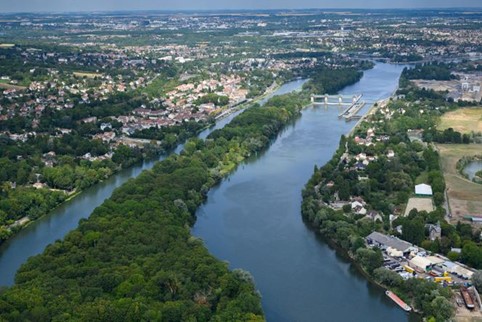
Aerial view of the Oise and the Seine, in August 2019. ERIC FEFERBERG / AFP
Compiled 7 February, updated 14 February 2025
More than half of European lakes, rivers and streams in ‘very critical’ condition
The goal of restoring the ‘good status’ of water bodies, both groundwater and surface water, by 2027 will not be achieved.
By Léa Sanchez
By 2027, European states will not be able to restore the ‘good status’ of their water basins, both groundwater and surface water . This target, set by the 2000 Water Framework Directive, will not be met, the European Commission assures in a report published on Tuesday 4 February. The document, which closes a six-year monitoring and measurement cycle, points to modest improvements across Europe compared to the previous assessment, but the overall picture remains bleak. “Our waters are polluted, our water supply is threatened,” the new European Commissioner for the Environment, Jessika Roswall, summed up at a press conference.
More than half of the surface water bodies – rivers, lakes, etc. – are in a ‘very critical’ state according to data reported by the Member States for 2021. The ‘good ecological status’, assessed on the basis of biological, physico-chemical and hydromorphological criteria (flow rate, width of the water body, etc.), is only achieved for 39.5% of them. Furthermore, only 26.8% of these surface water bodies are considered to be in good chemical condition (compared to 33.5% in 2015). Most of the others are affected by above-standard concentrations for some pollutants, including in particular mercury and nitrates of agricultural origin. According to the report, polycyclic aromatic hydrocarbons, toxic compounds resulting in particular from the combustion of fossil fuels, “continue to enter the aquatic environment
However, the evolution of these overall balances since the previous assessment in 2019 should be interpreted with caution, as should the comparisons between the different country situation reports, also published on Tuesday 4 February. The deterioration in surface water quality reported by some Member States may actually reflect an improvement in monitoring, notes the European Commission, which notes disparities in monitoring between countries. According to her, some positive trends are also “masked” by historical pollution or “eclipsed by new emerging pollution
The question of the amount of water available at depth
Despite these methodological precautions, the Commission concludes that there has been a slight improvement in the groundwater situation. Indeed, “86% of aquifers were in good chemical condition” in 2021, compared to 82.2% in 2015. In France, it is mainly pesticides and nitrates that degrade the quality of these water reserves. They affect 31% of the monitored groundwater masses and “show sustainable upward trends” reflecting ‘pressures from agriculture’, writes the European Commission. Given the slow degradation of these substances at depth, the situation is likely to remain worrying for many years to come.
In several European countries, the issue of the quantity of water available at depth is also compounded by quality problems. In France, at least 10.6% of metropolitan aquifers have been classified as ‘poor’ in terms of quantity related to withdrawals exceeding the available resource. However, it is they that provide most of the drinking water in France.
The Commission is addressing a series of recommendations to member states, the first of which concerns increasing the ‘level of ambition’ of the policies implemented to improve the status of water bodies. “Water is no longer a given, “ says Jessika Roswall, who also points to a “funding gap” that is all the more worrying considering that the cost of decontaminating certain substances, such as PFAS (perfluoroalkyl and polyfluoroalkyl substances), will be high. “We all need clean water, so this concerns everyone,” assures the Commissioner, who is “working on a water resilience strategy for this spring “.
But the most impressive thing is that this article was the most read by Le Monde subscribers the day it came out in France. This is the difference between us – Italians (with no interest in the environment) – and the French.
The warning was also published by the Financial Times, with a different but no less interesting slant: The EU’s obsession with energy has left the water crisis unchecked, warns a senior official Environment Commissioner Jessika Roswall says the bloc urgently needs to address the water shortage affecting businesses.