Compiled 9 April 2022, updated 11 March 2025
Foreword: What it means to be part of NATO; it means above all receiving military protection but also implies fulfilling political obligations, as seen throughout Finland‘s accession process
Article by Gary Dargon for Le Monde. Translation notes and conclusion by the undersigned.
For the plans: NATO (North Atlantic Treaty Organisation) in French translates as OTAN (Organisation du Traitè de l’Atlantique Nord).
Far from being a provocation, as Vladimir Putin claims to justify his war in Ukraine, NATO’s enlargement towards the East was not decided without taking Russia’s interests into account (the headline is by the journalist. I explain my point of view in the conclusion).
Created during the Cold War, long opposed to its communist opponent, theNorth Atlantic Treaty Organisation (NATO) found itself, all of a sudden, without an enemy in 1991, when the Union of Soviet Socialist Republics (USSR) and the Warsaw Pact were dissolved.
The Atlantic Alliance survived, with difficulty, the first years following the demise of the USSR and for several years tried to set itself new goals. Enlargement to Central and Eastern Europe, and the international terrorist threat heavy on Western countries after 11 September 2001, partly justified its continuation. But the isolationism of President Donald Trump ‘s United States in 2017, which his successor Joe Biden has not completely undermined, and their anxieties about Chinese ambitions in the Indo-Pacific region have fragilised the Alliance’s raison d’être in recent years, and lent credence to the idea of European defence.
Declared in a state of ‘brain death’ by French President Emmanuel Macron in 2019, NATO has found itself once again strengthened after the invasion of Russian forces in Ukraine on 24 February 2022.
To justify the tensions and then the attack by its neighbour, Russian President Vladimir Putin has not stopped for a moment to accuse this military alliance of constituting a ‘betrayal’ for having expanded towards Eastern Europe from 1997 to 2004, after the collapse of the Soviet empire.
but let us see what really happened :
1991-1993 : Eastern countries knock on NATO’s door, which refuses to accept them
After the dissolution of the USSR in 1991, several former Warsaw Pact countries turned to NATO to ensure their military security, especially against Moscow.
Fifty years of Soviet domination made the peoples of Eastern Europe deeply distrustful of Russian power even though the first president of the Federation of Russia, Boris Yeltsin, had liquidated what remained of communism in Moscow. But the new power is not without ambitions about the future of its old satellites and the old Soviet republics.
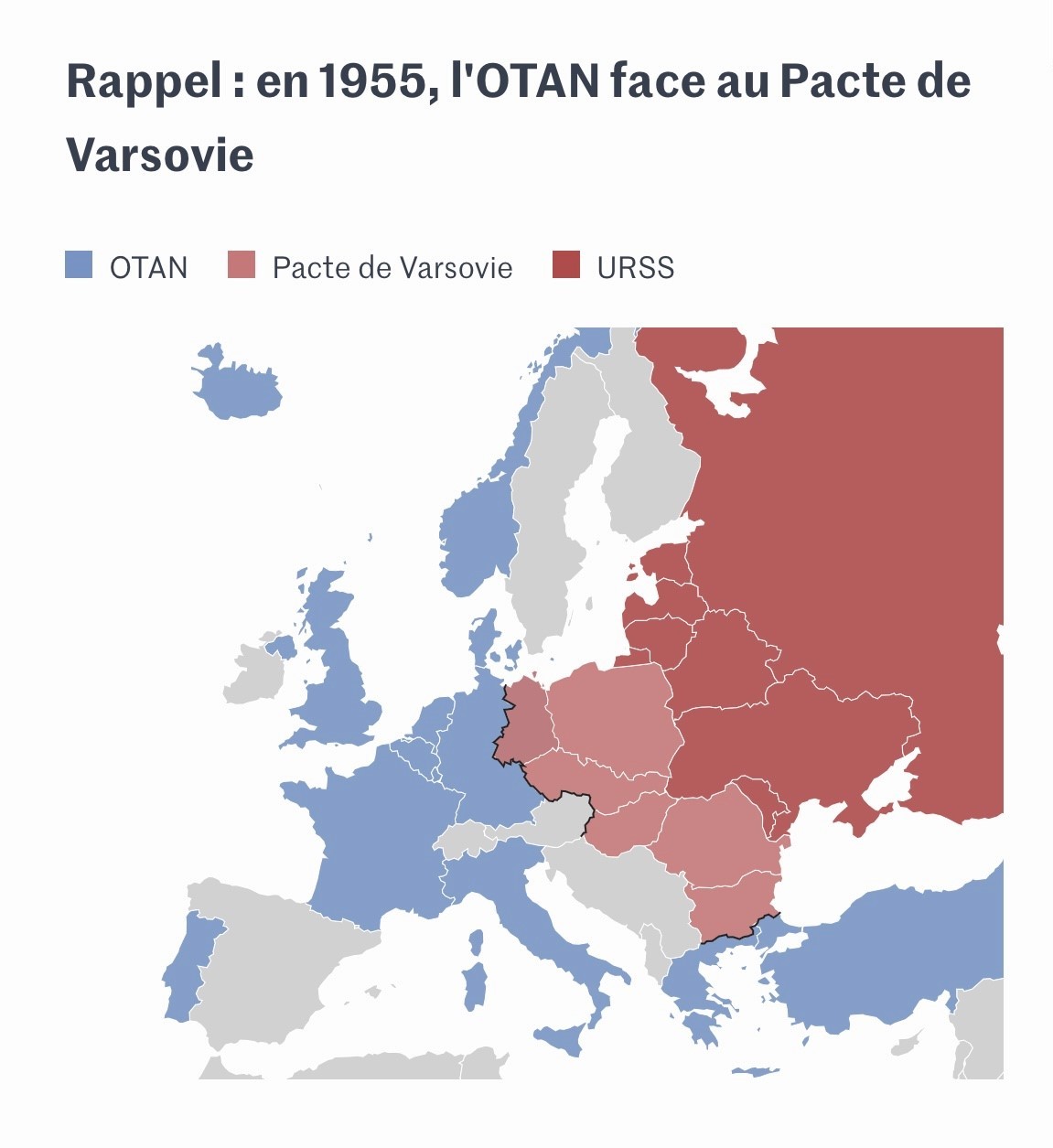
As a reminder, in the map below: 1955, NATO facing the Warsaw Pact
In 1991, the Russian president created the Commonwealth of Independent States (in French CEI, Communautè des Etats Independants), an intergovernmental organisation proposing economic, political and military integration to the newly independent states that had belonged to the USSR.
Ten of them became members of the CEI, because Moscow was pressing, while Turkmenistan and Ukraine declined the invitation. But this integration will be a failure because Moscow has preponderant political weight, which prevents the weaker countries from having any room for manoeuvre. To such an extent that some form an alliance among themselves, such as the Organisation for Democracy and Development (GUAM), created between Georgia, Ukraine, Azerbaijan and Moldova (and for a time Uzbekistan).
It is in this context that, since 1991, numerous former European satellite states of Moscow have been knocking on NATO’s door, which they see as a kind of insurance to escape Russian tutelage. Also because Moscow does not hesitate, in the name of defending Russian-speakers, to intervene militarily, as the conflict in Transnistria (1), a region seceding from Moldova, in 1992 illustrates.
Russia views this possible emancipation very poorly and makes this known to the West, which has from the outset put the brakes on these countries’ expressed desire to join…
(1) Home of Nicolai Lilin, author of ‘Siberian Education’ (novel, 2009). The Moldavian Republic of Pridnestrovie – the official name of Transnistria – is ‘under Russian protection’ and its flag has remained that which Moldova had at the time of the USSR.
Did Westerners promise Russia that NATO would not expand eastwards?
This is one of the central questions in the progressive degradation of relations between Russian and Western leaders. Since the 1990s, the former are regularly accused of betraying their original promise.
“They have lied to us repeatedly, made decisions behind our backs, put us in front of a fait accompli. This came about with the expansion of NATO towards the EAST, as with the deployment of military infrastructure close to our borders,’ Vladimir Putin had accused on 18 March 2014, after illegally taking back Crimea from its Ukrainian neighbour.
The Russian president bases his claims on promises made by American, British, French or German leaders to Mikhail Gorbachev in 1990, a year of intense diplomatic negotiations designed to set the conditions for German reunification. “Nothing had been written. It was Gorbachev‘s mistake. in politics everything has to be written down, even if a guarantee on paper is often violated,’ Vladimir Putin had said, when questioned in 2015 by American filmmaker Oliver Stone. “Gorbachev merely discussed with them and considered that their word was sufficient”….
Between February and May 1990, Mikhail Gorbachev had in fact received assurances, notably from James Baker, the US Secretary of State that ‘Nato will not expand one inch to the East’.
Helmut Kohl, Margaret Thatcher and George Bush Sr. also attempted to reassure Yeltsin, claiming that the Atlantic Alliance would not expand beyond reunified Germany.
These exchanges are detailed by Georges Washington University’s National Security Archive project, which has many documents on the subject that are no longer secret.
Vladimir Putin ‘s version has been criticised many times by NATO members, who explain that the context of 1990 was not that of 1991. In 1990, Western reassurances were given at a time when the USSR and its satellites were still bound by the Warsaw Pact military alliance, which made an extension of NATO unimaginable.
The events of 1991 changed the context: the fall of the Soviet Union led to the birth of 15 new sovereign states in nine months.
The Soviet borders, which the West did not want to threaten a year earlier, are no longer the same: under international law they no longer correspond to the USSR but only to those of the Federation of Russia. No promises would therefore have been made concerning countries like Poland, the Czech Republic and Hungary. A conclusion supported by many historians and specialists in the matter.
Mikhail Gorbachev himself reinforced this reading of events. Asked by Russia Beyond in 2014, a state media funded by the Russian government, what prompted him not to ask the Americans to translate their promise into a binding treaty, the last leader of the USSR replied:
” NATO enlargement was not a topic of discussion at all and did not emerge during this period. Another challenge we put on the table was to ensure that NATO ‘s military infrastructure did not advance and that additional armed forces were not deployed on the territory of what was then the GDR. Baker ‘s statement was made in this context…. Everything that could be done and everything that had to be done to make this political obligation a reality was done. And respected. “
One episode, however, sheds light on why Boris Yeltsin ‘s government may have felt misled. On 22 October 1993, US Secretary of State Warren Christopher meets with Boris Yeltsin for forty-five minutes to present him with the idea of the Partnership for Peace advanced by US President Bill Clinton. This partnership is presented to him as a way to include Russia in the process. “There would be no effort to ignore or exclude Russia from its full participation in the future security of Europe,” Christophersaid.
Boris Yeltsin, who has been pushing for two years for the West to recognise his country as a great power, is seduced by the principle, but interrupted him to verify that he understood and that there would be a partnership and no membership, referring to NATO. The Secretary of State replied: ‘Yes, it is, there won’t even be a secondary status’ (3). “It’s a brilliant idea, a stroke of genius!” exclaimed Boris Yeltsin, who was relieved in front of his interlocutor, explicitly mentioning the tensions around NATO. The Russian president, who is actively fighting the conservatives on the domestic political scene, needs to show results with his American ‘partners’ to stay in power.
(3) I confess I do not know what ‘secondary status’ is.
From Partnership for Peace to NATO enlargement
In January 1994, during an official visit to Russia, Bill Clinton told Boris Yeltsin that NATO was ‘clearly considering expansion’, but tried to spare him by adding that the Partnership for Peace was his administration’s priority. An assurance he repeated at a private lunch on 27 September 1994.
The Partnership for Peace was established in 1994. Joined that year by 34 European and Asian countries, including Russia, it provides for bilateral military cooperation between these signatory countries and NATO.
But it does not meet the expectations of Moscow’s former satellites, such as Poland, the Czech Republic and Hungary, which, having joined the Visegrad Group in February 1991, insist on being integrated into NATO.
Russian military interventionism in Chechnya (1994-1996) only motivates them more.
Initially reluctant, the Clinton administration gradually changed its mind.
As the speeches of NATO officials became more and more explicit, Boris Yeltsin accused his American counterpart, in a resounding speech at the Budapest summit on 6 December 1994, of wanting to divide Europe. “Why are you planting the seeds of distrust?” he asked the sixteen NATO members.
These Russian warnings worried part of the US administration, but by the end of 1994, the idea of NATO enlargement had almost caught on in President Clinton’s circle.
1994-2004: with Clinton and Kohl’s support, NATO expands eastwards
The first change of tone occurred in January 1994, at the Brussels summit, where the Alliance explicitly declared itself open to new accessions. Later, President Clinton, on a visit to Prague, declared together with the Czech, Polish, Hungarian and Slovak prime ministers that it was no longer a question of whether NATO would expand, but ‘when and how’.
In September 1995, NATO published the prerequisites to serve as a basis for negotiations. The text specified that the Alliance would not install nuclear weapons on the territory of the new members, a declaration of intent that should address Russian fears.
This was followed by two years of intense discussions with five countries before the first green light was given. In the spring of 1997, Bill Clinton, who had supported Boris Yeltsin since his election, was confident: he had just signed with his Russian counterpart the‘Founding Act’, the first agreement between NATO and Russia intended to revive cooperation between the two sides.
The US President then announced the future integration of Poland, the Czech Republic and Hungary, officially invited to join theAtlantic Alliance at the Madrid summit a month later.
The moment goes “down in history as a sign of the end of the Jalta Order”, according to Polish Prime Minister Wlodzimierz Cimoszewicz.
Czech Prime Minister Vaclav Klaus called the invitation ‘the culmination of the post-November 1989 transformation process’.
In Hungary, 85.3% of NATO membership was approved in a referendum in the autumn of 1997.
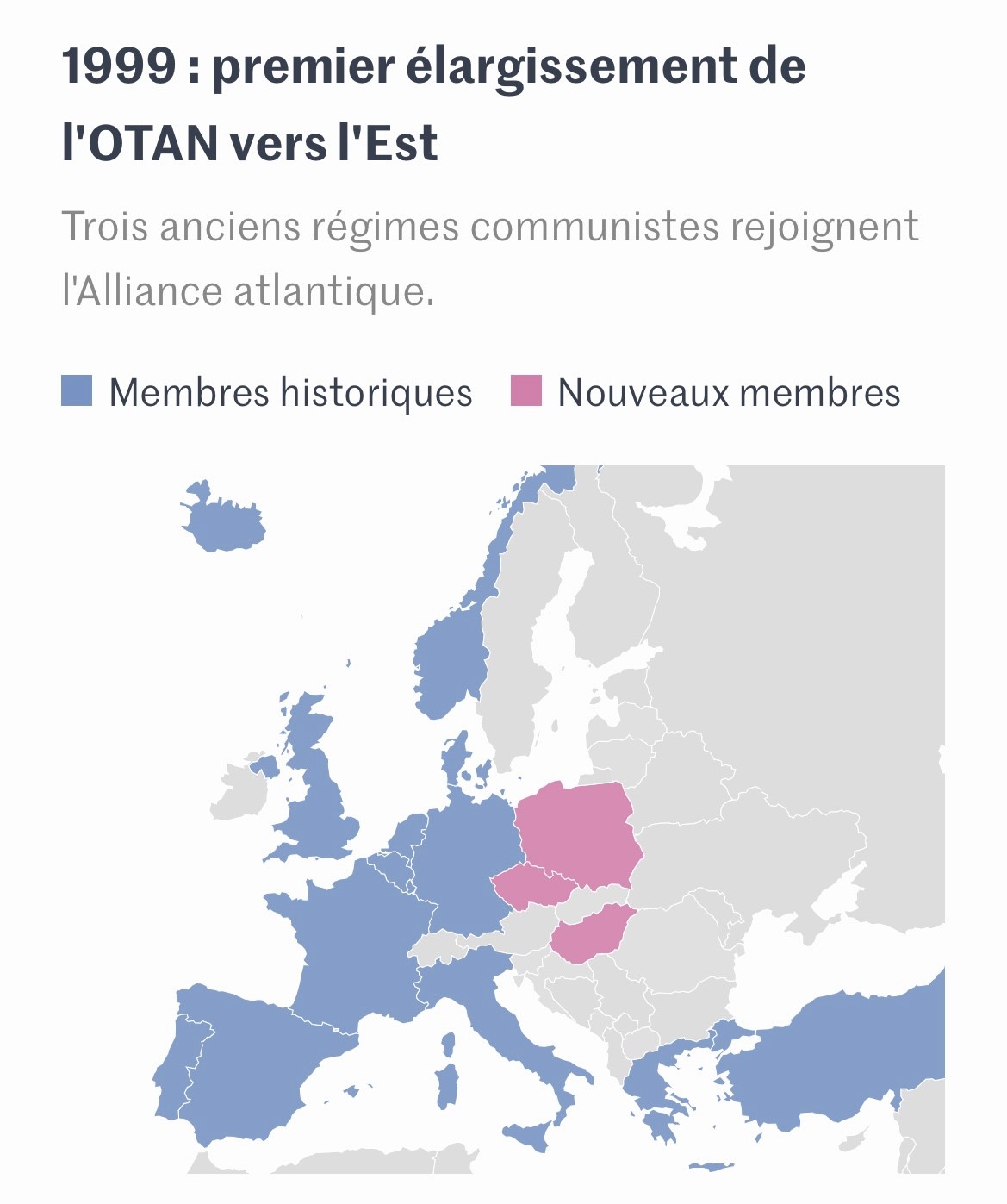
1999: NATO’s first eastward enlargement
Three former communist regimes join the Atlantic Alliance.
Historical members in blue New members in purple
See also First wave countries greet ‘historic event’
The Russian government, on the other hand, is not so enthusiastic. Immediately after the announcement, Russian Foreign Minister Yevgeny Primakov condemned a ‘grave mistake, perhaps the biggest since the end of World War II’.
This first enlargement has a taste of failure for the Russians.
Boris Yeltsin ‘s many attempts to dissuade Bill Clinton did not work. But the Russian president himself knew the process was inevitable, at least for some countries like Poland, which had shown a constant determination to anchor itself to the West. Thus, in 1993, the Polish prime minister managed to wrest a joint communiqué from Boris Yeltsin, which signalled that Poland’s entry into NATO ‘would not be contrary to the interests of other states, including Russia’.
See also Clinton and Yeltsin in Helsinki discuss disagreement over NATO
The Russian protests, however, are not without concern for Western diplomats, who are divided on whether NATO should be further expanded to the east, despite the repeated and insistent demands of ten countries, which formed the Vilnius Group in spring 2000, including:
- Estonia, Latvia and Lithuania, long-standing candidates;
- Slovakia, which was rejected in 1997 because it did not meet certain criteria;
- Romania and Slovenia, rejected in 1997 for not offending the Russians;
- Bulgaria;
- Croatia;
- Albania;
- Macedonia, whose candidature is blocked by Greece because of a dispute over the country’s name.
Discussions with these ten countries are beginning, but the Alliance is trying to prioritise applications in order to slow down the process as much as possible, as it did in 1997 when it rejected nine of the twelve applications received. The negotiations culminated in 2002 at the invitation of seven new states, whose integration came into force in 2004.
2004: NATO’s second eastward enlargement
Six former satellites and members of the USSR (the three Baltic countries, Slovakia, Romania and Bulgaria) join the Atlantic Alliance together with Slovenia.
Historical members 1999 enlargement New members
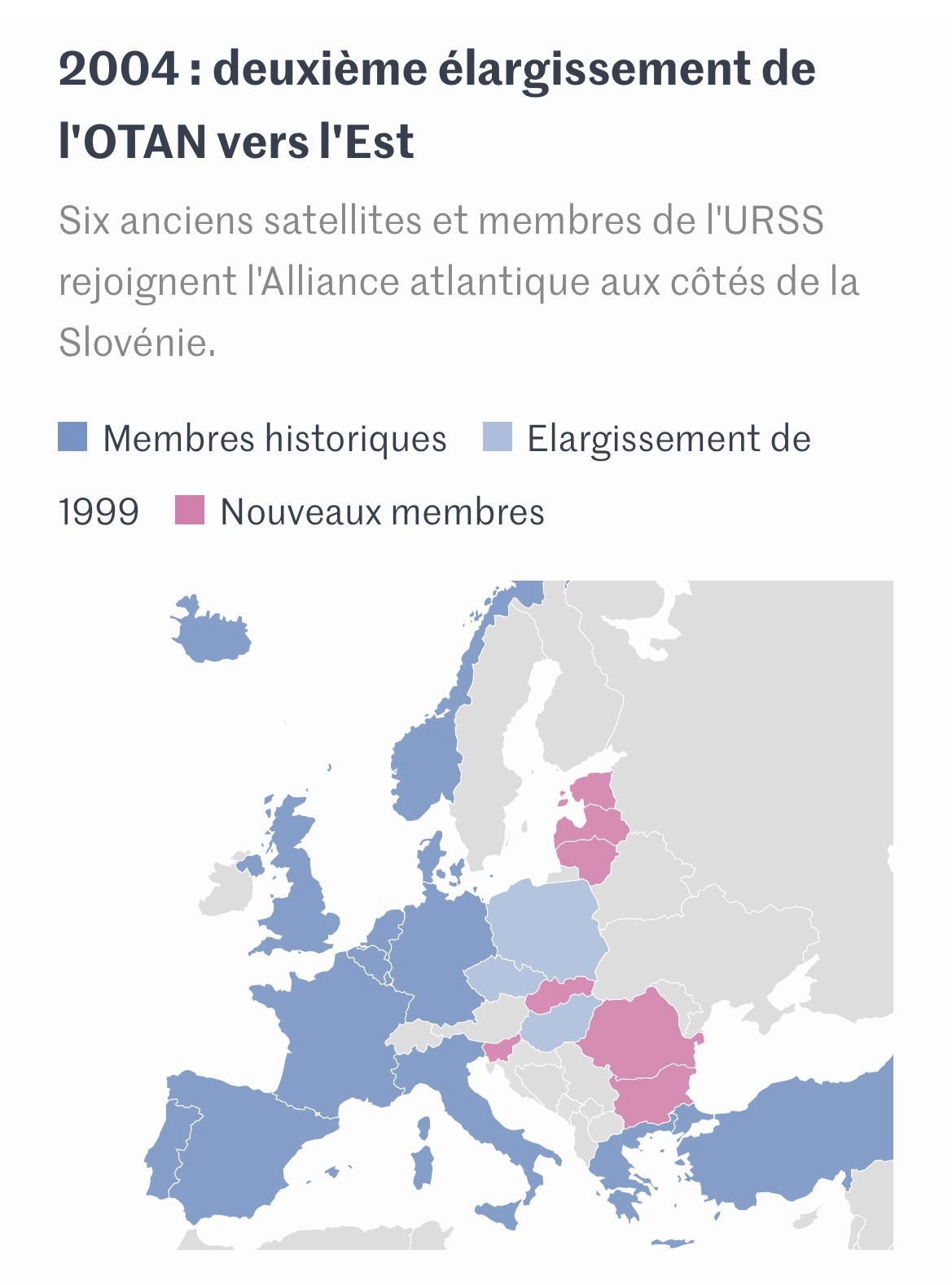
This second enlargement provoked new protests from some Russian politicians. Duma Defence Committee Chairman Viktor Zavarzin is calling on the government to review the country’s military defence arrangements, fearing that the West will mass troops near the Russian border.
Which they will not do (except for the arrival of four Belgian F-16 planes in 2004).
For its part, the Kremlin, which has never shown firm opposition to further enlargement, downplays the Baltic countries’ membership in NATO.
Two years earlier, Vladimir Putin had already declared that the Baltic states’ accession to NATO would not be a ‘tragedy’.
Enlargement will therefore only continue in the Balkans. Croatia and Albania joined in 2009, Montenegro in 2017 and North Macedonia in 2020, after resolving the dispute with Greece.
Read also: Who did Russia lose?
Ukraine: an accession that remained uncertain for a long time
The case of Ukraine is different. The candidature of Russia’s ‘brother’ country, which has been independent since 1991, was repeatedly rejected by some NATO members, who were afraid of permanently angering the Russians. In 2008, at the Bucharest summit, US President George W. Bush proposed to the rest of the Alliance to officially invite Ukraine and Georgia, a decision that France and Germany vetoed.
However, the Alliance indicated at the end of the summit that these two countries are destined to become NATO members in the future and that intensive discussions should prepare for their integration. Although the Ukrainian constitution prohibits the stationing of foreign troops on national soil, the news brings Vladimir Putin out of the woodwork. ‘But what is Ukraine? Not even a state! he exclaimed at the Russia-NATO Council meeting. Part of its territory is central Europe, the other part, the most important part, is us who gave it to them! “.
The Russian head of state warned his European and American partners that if the country joined NATO, it would cease to exist in its current form, referring to Crimea, a peninsula in the south of the country offered to Ukraine by Nikita Khrushchev in 1954.
Populated by a large majority of Russian-speakers hostile to a rapprochement with the West, the peninsula offers above all strategic access to the Black Sea for the Russians via the military port of Sevastopol. A link that the Ukrainians were to resume by 2017 at the latest, according to the agreement reached with Kiev (3).
The Russian military intervention in Georgia in 2008, which marked Vladimir Putin’s first (4) show of strength, will significantly cool Western desires to continue talks with the Ukrainians.
The illegal invasion of Crimea in 2014 and Russian support for the Donbass separatists then buried Ukrainian hopes of joining the Atlantic Alliance.
(3) Perhaps the author is referring to theagreement signed with the Budapest Memorandum of 1994 by whichUkraine agreed to give up the nuclear weapons in its possession that it had inherited following the dissolution of the USSR, and acceded to the Treaty on the Non-Proliferation of Nuclear Weapons.
The nuclear warheads (1,900) were consequently sent to Russia for dismantling over the next two years. In return, Ukraine obtained assurances from Russia, the US and the UK, later also from China and France, for its security, independence and territorial integrity.
The agreement was subsequently violated by Russia with the invasion of Crimea and the Donbass.
(4) Here I disagree with the author: the previous demonstrations of force, in Transnitria and Chechnya, were no small matter. And now we are paying the bill for this short-sightedness of ours.
Conclusion
wHEREAS :
- one of Putin‘s first acts as president was the restoration of the Soviet anthem
- concerning the fall of the USSR Putin declared: ‘The collapse of the USSR was the greatest geopolitical catastrophe of the century’
- Putin has never lived in a Western country (only in the GDR, when it was part of the Warsaw Pact)
- his policy seems entirely aimed at a ‘restoration’ – with weapons – of the greatness of post-Soviet Russia
- his methods have remained those of the USSR, reconfirmed with the most recent massacres
It thus seems that the Cold War, West against East, has never been archived. Only a part of the West did not want to see reality in the face.
As a European and an Atlanticist, I rejoice that NATO was never dismantled.
But I think the question: “Does NATO make sense?” should not be asked of the extreme left or the extreme right in Italy, who are structurally ‘No NATO’, but of those who are close to the Russian border. And perhaps had to face the Red Army.
To the citizens of Warsaw or Tallinn, the capital of Estonia, for example.
I am sure their answer would be ‘we want freedom, which only NATO can guarantee us’.
A bit like what the Finns and Swedes have been saying lately.
By the way, the Russian-Finnish war of 1940 has many similarities with the present one. It was short but very bloody: 26,000 Finns and at least 126,000 Soviet soldiers perished in it.
P.S.: Putin’s second thesis that Russia was promised that there would be no NATO enlargement to the East is refuted by the historian Mary Elise Sarotte. Putin tends to want to rewrite history as he pleases.
“The collapse of the USSR was the greatest geopolitical catastrophe of the century,” Vladimir Putin.
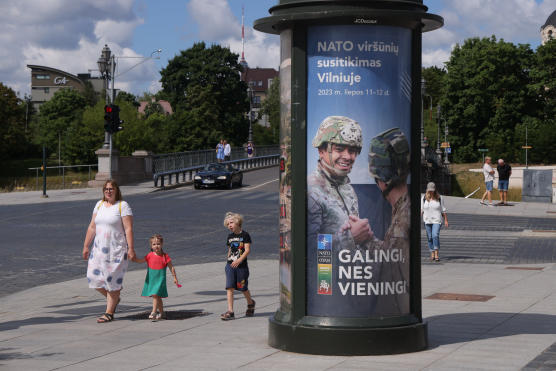
Below: a poster announcing the NATO summit in Vilnius on 9 July 2023
Regarding Ukraine’s membership in NATO:
- The United States leads NATO. So NATO policy will ultimately be decided in Washington, not in Brussels or Vilnius.
- Behind the formal American objections is the concern that any commitment to accelerate Ukraine’s entry into NATO could have prolonged the war and introduced dangerous complications into a future peace agreement.
- The Biden White House is probably the most pro-Ukrainian and NATO administration the US could produce. The Republicans are the party of Donald Trump, not the late John McCain. Any move to accelerate Ukraine into NATO could easily have become an issue in the US presidential election. Ratification of Ukrainian membership by the Senate would not have been guaranteed.
- The confrontation between Trump, Vance and Zelensky in Washington on 28 February 2025, seems to hint that NATO could be dismantled and in essence the West-East game would end with a total Putin victory, not least because NATO command is firmly in the hands of the US
- europe that absolutely must become autonomous, with its own common army.
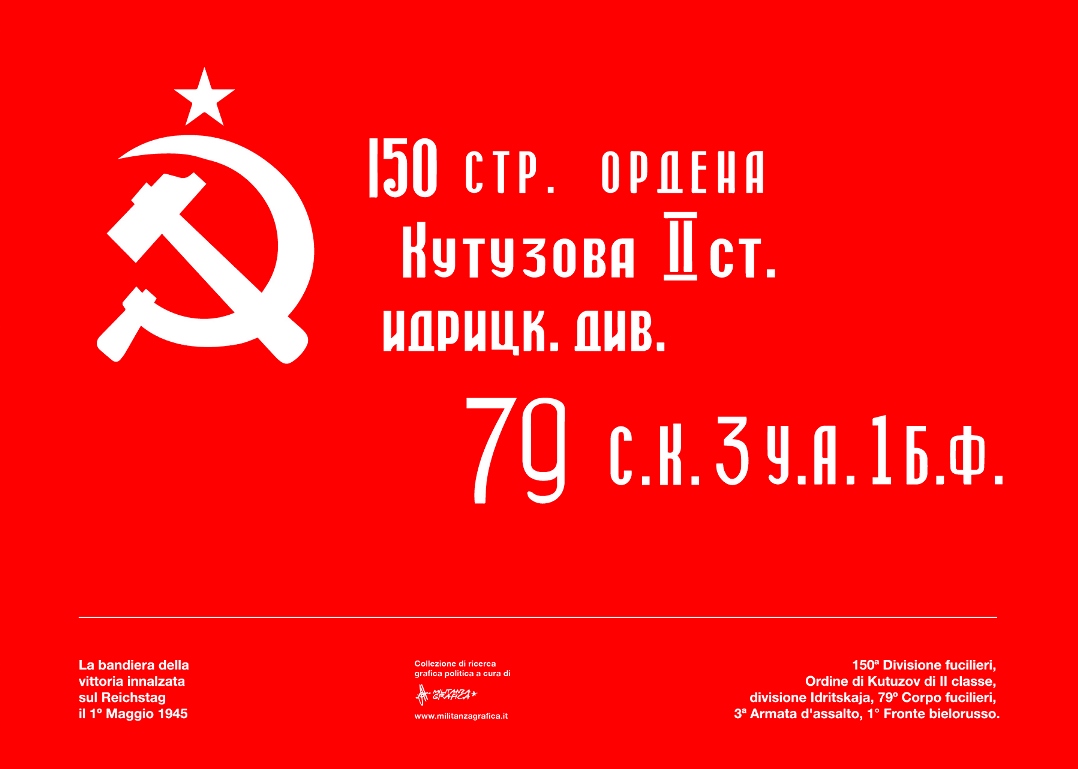
Below: the flag of the‘great patriotic war of the USSR against Germany’ (World War II) that is still used by Russia on each anniversary, 9 May.