The story of what was a close friend of Pope Francis is astonishing. I stumbled upon it while writing about the affairs of Conad, of which Mincione was a partner.
But it is interesting to know that Becciu, unfortunately, is still very much present and is trying to influence the election of the new pope : The Becciu rebus looms over the Conclave: ‘My prerogatives intact’.
In 2020 Francis suspended him, taking away the ‘rights attached to the cardinalate’. But not the duties. And among the duties incumbent on a cardinal is the election of a new pope.
On the subject of Raffaele Mincione, Conad’s partner in BDC, find this article from L’Espresso
(L’Espresso has removed many articles from its archive but fortunately we had transcribed it).
New crime hypotheses from the Swiss rogatory which we publish exclusively. Pivot of the network that managed the operations in the shadow of the Secretariat of State of former Cardinal Becciu, Enrico Craso, the financier who in thirty years made so much money that, they write: “It has not been possible to reconstruct the commissions totally collected”
The hypothesis of “criminal conspiracy to the detriment of the Holy See” also crops up in the Vatican investigation into operations in the shadow of the secretariat of state: “A hypothesis that cannot be ruled out,” the investigators write in the rogatory that we are able to publish exclusively.
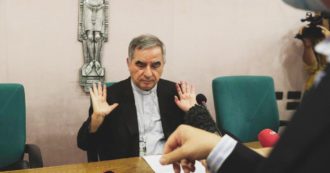
After a month since the resignation of Cardinal Angelo Becciu [photo below],following the Espresso investigation, the investigations are proceeding and the promoters of justice await the findings of the international rogatory, sent to Switzerland almost a year ago, which reconstruct the system of power that the former cardinal of Pattada had created to manage the finances of the Secretariat of State: a network composed of financiers, brokers, fixers, employees of the Secretariat of State, lawyers and consultants in general, whose names we have met in recent weeks, from Enrico Craso to Raffaele Mincione, Gianluigi Torzi, Fabrizio Tirabassi, Luciano Capaldo and Nicola Squillace.
All subjects for whom the Vatican investigators are hypothesising not only the crimes of abuse of authority, embezzlement, corruption and money laundering, self-laundering and use of proceeds of criminal activities. The complexity and vastness of the plot makes the investigators formulate one more hypothesis. In fact, they write: “Given that the links between the various persons inside and outside the Secretariat of State took place over a substantial period of time, through the preparation of articulated legal instruments with offices in various countries, including on the ‘black list’, and with the implementation of multiple criminal activities, the crime of conspiracy to commit crimes to the detriment of the Holy See is also configured”.
The pivot of this system, which politically was headed by its head, former Cardinal Becciu, appears more and more, despite his constant denials, to be Enrico Craso, a leading figure in the management of the finances of the Secretariat of State. Born in Rome in 1948, a life in Credit Suisse, since 1990 the sole and unchallenged manager of the money of the second Vatican institution, mentor of unethical operations, in perpetual conflict of interest.
A powerful man who has set up his base of operations in Switzerland, of which he is a citizen, and where he lives barricaded inside his villa overlooking Lake Lugano, from where he has told the newspapers multiple versions of his extraneousness to the facts, preferring to talk to the press than to the investigators. They portray him as an almost infallible professional, one who combines the wit of a boy who grew up on the streets with the competence of his studies at the Luiss University: a golf enthusiast, they say he used to arrive in Rome on a private jet and, once he had taken care of Vatican business, he would fly away to play on the green in Monte Carlo.
Crassus is the contemporary evolution of the ‘Roman generone’, a man placed in the upper echelons of Capitoline society, who does not betray in his gait, movements and cultural stratification a certain arrogant, cunning and unscrupulous way of being.
A man who records everything, every phone call, every meeting, and who has strategically discharged responsibility by the drop of a hat, first by giving the investigators the queen proof of the responsibilities of Gianluigi Torzi, the Molise broker in charge of closing the deal on the Sloane Avenue building in London, a recording in which Torzi meticulously explains the extortion plan against the secretariat of state. In recent weeks he has then tried to place all responsibility for the financial disaster of the London palace on the businessman Raffaele Mincione: but the investigators’ papers show how the three acted in complete agreement, univocally seeking to divert funds in a predatory manner from the Obolo di San Pietro and other funds. According to the Holy See’s investigators, Crassus would have repeatedly ‘helped to use funds other than institutional ones and for unprofitable speculative investments’.
A mountain of money that the Roman financier managed with nonchalance and, for the investigators, ‘with an obvious conflict of interest and a possible risk of fraud to the detriment of the Secretariat of State’. A modality resulting from thirty years of experience that earned Crassso, between fees and consultancies, an amount of money that is difficult to identify even for the promoters of justice: “It has not been possible to reconstruct the commissions totally cashed by the same for his activity”, they write. A treasure that Enrico Craso, according to indiscretions, would have transferred to some Swiss current accounts in Santo Domingo, through a fund controlled by Banca Zarattini, which, over the decades, would have been used as a piggy bank. Money not only from his consultancies, but also distracted with perfectly accounted cash transfers even in recent months, which would presage, as the Swiss rogatory also reports, further developments: “Despite the fact that the Secretariat of State has been alerted, it has continued to give him confidence and not take away his authority to operate on his current accounts. The very connection he has with the employees of the Secretariat of State deserves further investigation’, the investigators write.
It is worth noting how the Roman financier, in recent days, has left various positions such as that of board member of ‘Italia Independent’, a company headed by Lapo Elkann, the Cristallina Holding, a company in the mineral water sector, and is also about to resign from the board of New Deal srl, the company that manages ‘Giochi Preziosi’, all companies that we remember being at the centre of investments by the Secretariat of State.
In these agitated hours Crassus is playing a chess game, made up of omissions, declarations of innocence in the press and only a theoretical willingness to cooperate with the investigators. Who knows if the ace of finance, a Roman with Swiss citizenship, will still manage to shuffle the cards or for once he will be forced to explain thirty years of Vatican finances, accounting tricks and investments in tax havens made in the shadow of the Dome, under different pontiffs. Not even he will have taken into account the ‘Bergoglio factor’ that has changed his playing field from a golf course to a minefield.