Drafted 8 February 2021, updated 25 February 2025
The pitfalls for consumers in packaging and labelling are many: we will talk about them shortly. In the meantime, we publish this press release which we find very interesting:
European Commission – Press release
“Greenwashing”: website screening reveals that half of all green claims are unsubstantiated
Brussels, 28 January 2021
Today, the European Commission and national consumer protection authorities published the results of a website screening, i.e. the sweep carried out every year to detect breaches of EU consumer law in online markets.
This year, for the first time, the sweep focused on ‘greenwashing’, the practice of companies claiming to do more for the environment than they actually do. The sweep survey analysed online green claims in various economic sectors, such as clothing, cosmetics and household appliances.
In the opinion of national consumer protection authorities, in 42 % of the cases there was reason to believe that the claims were exaggerated, false or misleading and could potentially constitute unfair trade practices under EU law. Greenwashing’ has increased as more and more consumers want to buy products that are
environmentally friendly products.
Didier Reynders, Commissioner for Justice, said: “More and more people want to live an environmentally friendly life, so I congratulate those companies that are striving to produce environmentally friendly products or services. However, unscrupulous traders who mislead consumers with vague, false or exaggerated claims cannot be ignored.
The Commission is firmly determined to equip consumers for the green transition and
to fight against greenwashing. This is one of the main priorities of the new consumer agenda adopted last autumn.”
Main achievements
After a general screening, the Commission and consumer protection authorities took a closer look at 344 apparently dubious claims, finding that:
- in more than half of the cases, the trader had not provided consumers with sufficient information to assess the truthfulness of the claim;
- in 37 % of the cases, the claim contained vague and generic wording, such as ‘conscious’, ‘environmentally friendly’, ‘sustainable’, aimed at giving consumers the unsubstantiated impression of a product with no negative impact on the environment;
- moreover, in 59 % of the cases, the trader had not provided easily accessible evidence to support his claims.
Overall, taking into account various factors, in 42 % of the cases the authorities had reason to believe that the claim might be false or misleading and could potentially constitute an unfair commercial practice under the Unfair Commercial Practices Directive.
Next steps
The national authorities will contact the companies concerned to report the problems found and ensure that they are resolved, if necessary. The results of the sweep will feed into the impact assessment to be prepared for the new legislative proposal to empower consumers for the green transition, a proposal announced in the new Consumer Agenda.
Background
A ‘sweep’ involves a series of simultaneous checks on different websites to identify possible breaches of EU consumer law in a particular sector. This year’s sweep focused on companies claiming to sell environmentally friendly products.
The sweeps are coordinated by the European Commission and carried out each year by national authorities in the EU, brought together in the Consumer Protection Cooperation (CPC) network.
This year’s sweep was coordinated not only with consumer protection authorities in Europe, but also with authorities around the world, under the auspices of the International Consumer Protection and Enforcement Network (ICPEN). ICPEN is also publishing the results of its survey today, which show similar trends.
Screening websites for ‘greenwashing’ is one of several initiatives undertaken by the Commission to equip consumers with the means to make more sustainable choices.
Other initiatives include the Green Consumption Pledge, an initiative launched by Commissioner Raynders on 25 January 2021, and the legislative proposal to strengthen the role of consumers in the green transition, which aims to provide consumers with better information on the sustainability of products and greater protection against certain practices such as ‘greenwashing’ and premature obsolescence.
This will be followed by a legislative proposal on demonstrating the veracity of green claims based on environmental footprint methods.
As part of its ‘producer-to-consumer’ strategy, the Commission will propose the introduction of arequirement for a harmonised nutrition label on the front of packaging, so that consumers can make informed, healthy and sustainable food choices.
For a number of household appliances, the EU energy label already provides a clear and simple indication of the energy efficiency of products, which makes it easier for consumers to save money on their household electricity bills, while at the same time reducing greenhouse gas emissions
greenhouse gas emissions across the EU.
According to a recent consumer market monitoring survey, 78 % of consumers
say that in their choices the likely environmental impact of household appliances is very
important or fairly important.
Thanks to Franco Mari
2025: The new Directive 2024/825/EU of the European Parliament and of the Council (source) is part of the attempt to make purchasing responsible.
Unfortunately, however, there is important news on food labelling, which is still on the high seas (*). This greenwashing directive therefore starts off lame.
One can only add that if Europe has not decided anything , Italy has played a fundamental role in blocking any possibility of a single, harmonised labelling at EU level, and that there are no proposals with an overall, shared vision on the subject (read more on this: Does the decree against disguised inflation – shrinkinflation – in labelling make sense?).
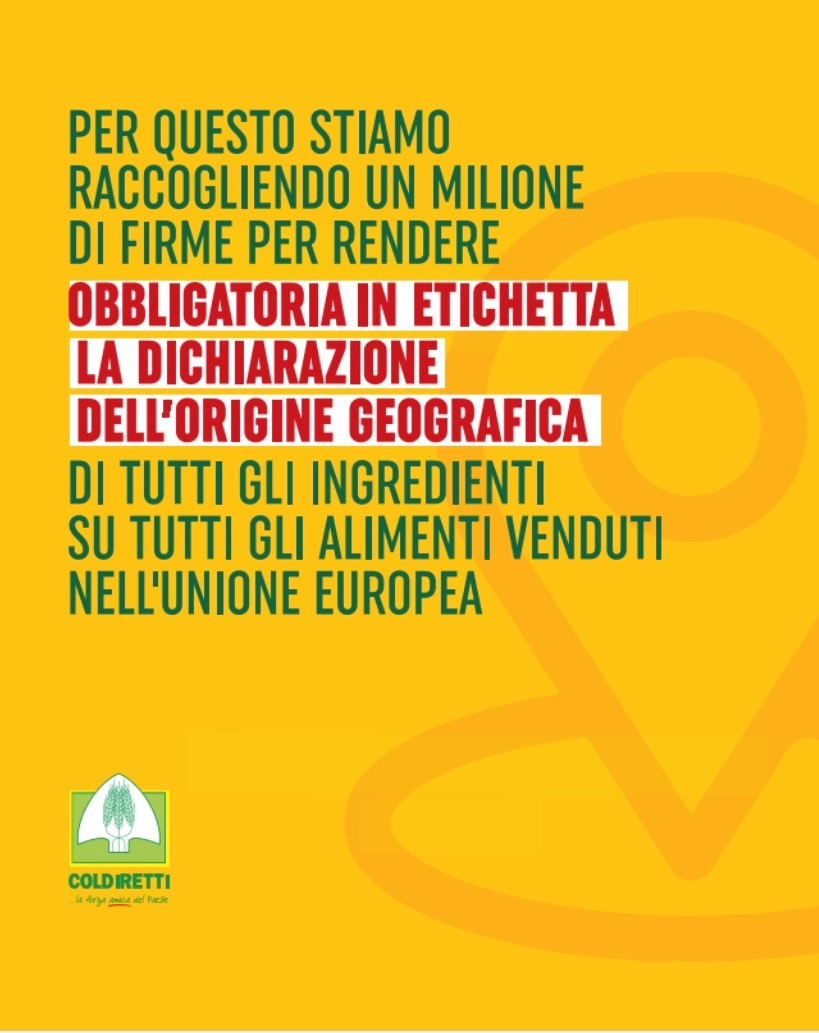
Below a sharable but totally unhelpful claim by Coldiretti