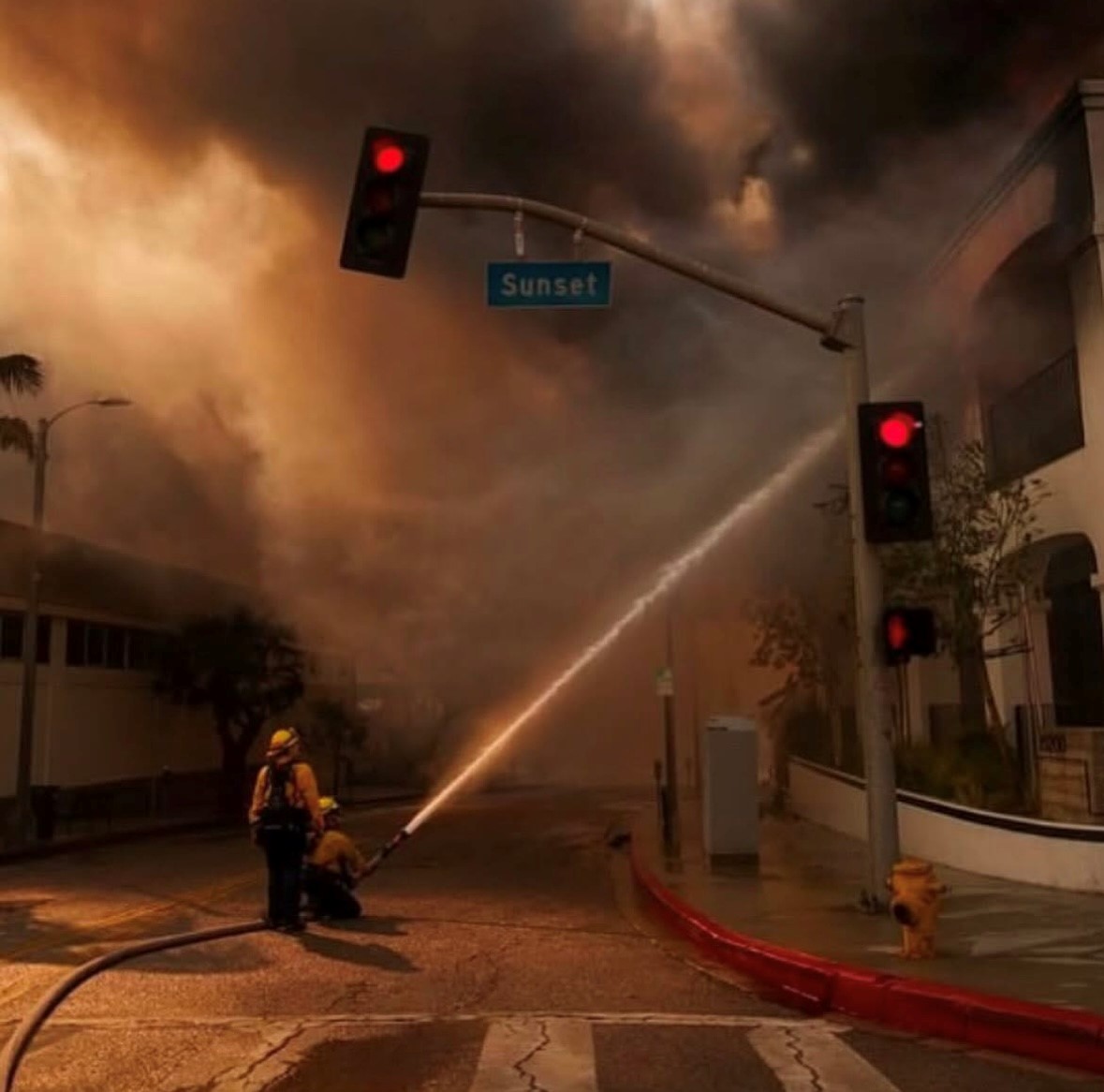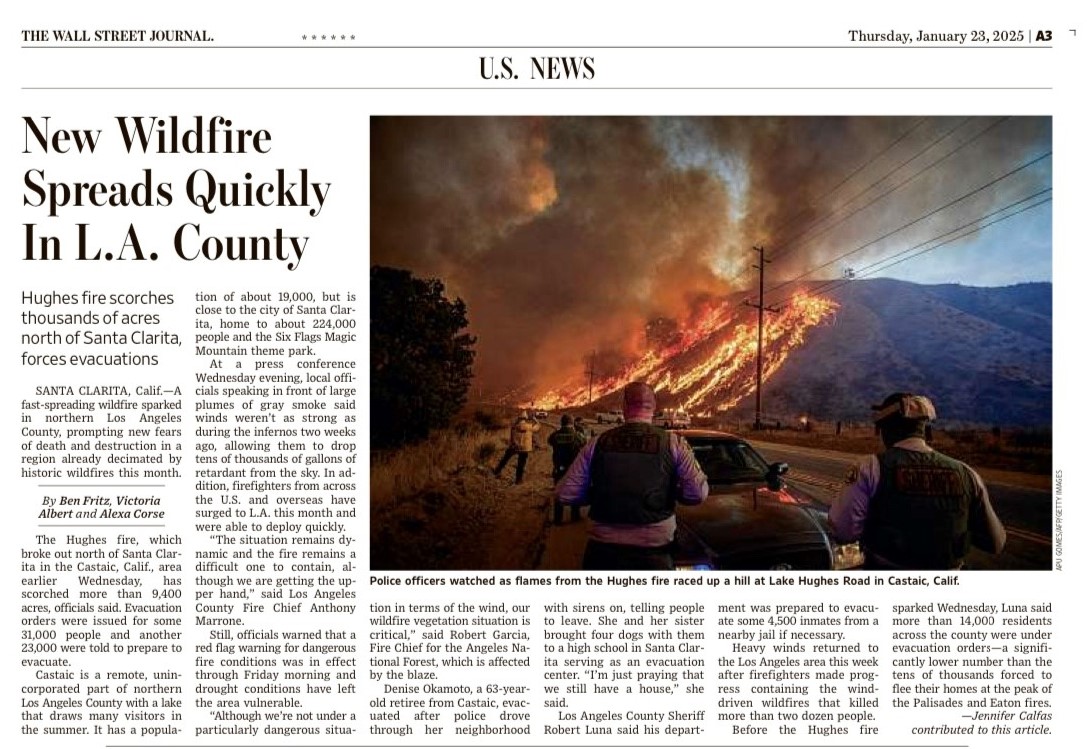
Compiled 22 January, updated 26 January 2025 . The WSJ cover of 24 January : the fires do not stop in California.
On this site we have been talking about California fires since 2013 and what has happened in California does not surprise us . This piece echoes the thoughts we have just had on Los Angeles and nature.
“No human technology, no matter how sophisticated, can defeat a mega-fire”.
Los Angeles was designed ‘off-the-ground’, trying to nullify the natural elements. But the fires that have ravaged it since the beginning of January show that the city, in the end, does not escape the laws of nature, analyses, in a piece in Le Monde, the author of the essay ‘When the forest burns’.
“How could such a disaster affect a city called ‘Paradise’?” wondered the victims of the mega-fire that devastated California in 2018. The same question arises about Los Angeles, the ‘City of Angels’. In the face of the mega-fire, would angels turn into demons and heaven into hell? The mega-fire, however, is not a divine punishment, retribution, or even a sad misfortune. It can be explained by various factors, such as extreme weather events, the deception of forests, the cultural destruction of peoples who had been intelligent for thousands of years of nature, the introduction of highly flammable decorative or profitable plants (eucalyptus, laurel, oil palm, Douglas pine, etc.).
All these factors can be summarised in one, more general one: the city. …
… On the other hand, the city was conceived as a paradise. Its ideal is not to owe anything to the Earth. In Los Angeles, we hijacked water, chased the natives and cemented it. Everywhere, we would like to nullify the natural elements; we bury rivers, ‘condition’ the air … . The ideal of the city is the land above the earth, the tower of Babel, this biblical construction intended to allow humans to leave the earth and transgress the limits of their nature as mortal beings; it is the city of the Birds, this fortress provided floating in the airs that Aristophanes mocked, it is still the city of Thomas More or Thomas Campa.
We would like to see the city out of time, governed by a superior intelligence, that of the omniscient expert, soon replaced by artificial intelligence. We would also like to see, like the Tower of Babel, whose construction involved a people speaking one language, having one plan, pursuing one goal, determine the conduct of people and unconsciously harmonise them with each other. It would take a term in the city what ‘transhumanism’ is for human individuals.
The ecological turn
This city cut off from the ‘wild’, the dangerous and the unpredictable, … produces nothing of what it consumes, colonises the resource-rich territories it needs, enlists the necessary populations to supply and discard all its waste in the distance. There would have been no megafire if faith in the city of angels, in Babel in heaven, had failed to establish itself.
Four figures are important here: cities cover 1 to 3 per cent of the earth’s surface, but account for 78 per cent of the world’s energy consumption and produce 60 to 70 per cent of greenhouse gas emissions. Finally, by 2050, they will account for 70 per cent of the world’s population. In other words, the ecological tipping point will either pass through the city or it will not.
To end the ideal of a city of angels and a paradise-urbanism, we should recognise the role of climate change in the emergence of mega-fires. The link has been made for several years. First, there were natural fires due to dry storm flares; anthropogenic fires said by fire history expert, Stephen Pyne, to have existed roughly since Homo erectus, or 2 million years ago, in the form of surface fires, agricultural fires, direct fires, ecobubles, etc.; and finally, there was the burning of fossil fuels.
The technical solution
But now there is a fourth fire regime, the megafire. This type accounts for only 3% of fires, but generates more than half of the burnt areas. Characterised by its intensity, its strange behaviour (it recovers, retraces its steps, … due to its speed of spread, its incredibly destructive nature of ecosystems, including human ecosystems, its heavy contribution to the emission of greenhouse gases. It also has the terrible property of dying only from natural causes. The rain must fall en masse, the wind must run out, the sea must be blocked, or any fuel must be gone to make it out. In other words, no human technology, no matter how sophisticated, can defeat a mega-fire.
However, it is also up to the logic of the City of Angels to believe that there is a technical solution to all the problems we encounter. The mega-fire is a paroxysmal example. Faced with the disaster and the plight of the victims, we would like to see the heads fall from those responsible. One accuses here such a governor, there such a mayor, there such a nature park manager, such a wealthy category, etc. But, when it comes to megafire, there is no culprit; there are only scapegoats and a combination of extremely varied factors, including bad governance.
In Los Angeles, we could have multiplied the number of firefighters by ten and made sure we filled the tanks that would probably have changed. People are safe, that’s the main thing, but the forest and the house are burning. The violence of the accusations from the worst climate sceptics, including Donald Trump or his transhumanist ally, Elon Musk, are only matched by the aberration of beliefs to technical solutions…
But the city that really exists turns out to be very small and does not escape the laws of nature, which mechanically goes its own way without worrying about what it crushes or, on the contrary, invigorates.
Joëlle Zask is a philosopher, a teacher at the University of Aix-Marseille and a member of the Institut Universitaire de France. She is the author of ‘When the Forest Burns. Thinking about the new ecological disaster’ (First parallel, 2019) and ‘Second. Wild animals in the city’ (First Parallel, 2020).
but : when disaster strikes, we decide “it happened to them but it won’t happen to me”.
This is not climate denialism, it is a psychological survival technique
Justin Angle, co-author of “This is Wildfire”