Compiled 10 April, updated 13 April 2026
On the podium are Germany, France and Italy, with respectively EUR 17, 12.2 and 5.2 billion in retail sales. In terms of per capita consumption, however, Switzerland wins with an average expenditure of EUR 481 per inhabitant per year. Also in the Swiss confederation, organic food will reach 12.3% of total food sales in 2024: a world record. For comparison, in the European Union the organic market share is around 4.5 per cent.
In terms of organic agricultural area, the EU also plays a central role with 18.1 million hectares. In the 27 Member States, 11.1 per cent of the agricultural area is farmed organically, against a world average of 2.1 per cent. The leading European country in terms of organic agricultural area is Spain with 2.9 million hectares, followed by France (2.7 million), Italy (2.5 million) and Germany (1.9 million). The growth recorded in the last year, however, is almost imperceptible. So much so that, at the level of the Continent and not only of the European Union, there has been a slight decrease in the areas cultivated organically. A figure that clearly clashes both with that of consumption and with the growth targets for organic farming desired by the institutions.
In Italy this decline seems deliberate: on 1 January a ministerial decree came into force in July 2024 that is unreasonably punitive towards the organic world. These are measures that control bodies must enforce against operators found to be non-compliant (Massimo Govoni Director BioqualitàSG Srl)
Coming to a few examples on more significant aspects, the operator who does not adopt an appropriate traceability system and records to prove compliance with the regulation, as well as those who use substances not allowed in organic production, receive a fine of up to 5% of the previous year’s turnover, with a minimum of €6,000 and a maximum of €100,000.
In addition to a fine of €10,000, the operator who does not allow or prevents the inspection body’s checks automatically receives the withdrawal of the certificate, the removal of references to organic in product labelling, and the obligation to inform customers.
There is also the corollary of additional measures limiting or preventing the continuation of the activity: limitation of the scope of the certificate and suspension from 6 to 12 months or withdrawal.
In all cases of suspected non-compliance, pending the results of the investigation, the control body is obliged to adopt the ‘precautionary suppression of references to organic production’ with the temporary suspension (40 days, extendable for another 40) of placing on the market.
It is evident that when it comes to fresh produce (fruit and vegetables, milk, eggs, meat…) a few days severely affect the commercial life of the product, which in the end, even in the event of a positive result, inevitably ends up at the disposal site.
These are sanctions that find no analogies in other agri-food sectors: just remember the case of Prosciuttopoli raised by Il Fatto Alimentare or the scandal of the Bervini slaughterhouse reported by the RAI programme Report, which is still in operation despite the relevant facts that have emerged.
The new decree introduces elements that appear strongly misaligned with the rules for other sectors and with destabilising and punitive effects for operators and control bodies in the organic world.
… Of particular impact is the reversal of the burden of proof, enshrined in Article 14(3) of the MD. The provision introduces the operator’s guilt bias, overturning a fundamental principle of law: the presumption of innocence that considers every offender innocent until finally convicted and the burden of proof lies with the prosecution…
Ministerial Decree No. 323651 of 18 July 2024 risks becoming a regulatory paradox: an instrument created to protect the integrity of the organic that, in fact, undermines its survival. By imposing disproportionate penalties compared to other agri-food sectors and overturning the principle of the presumption of innocence, the decree not only hits the ‘clever’, but suffocates virtuous operators under the weight of unsustainable legal and economic uncertainty. If the control system becomes a minefield of punitive bureaucracy and rising costs, the flight from organic farming will no longer be a hypothesis, but a necessity for many companies. A corrective that restores balance and proportionality is urgently needed, so that supervision remains an added value for the consumer and not a death sentence for producers.
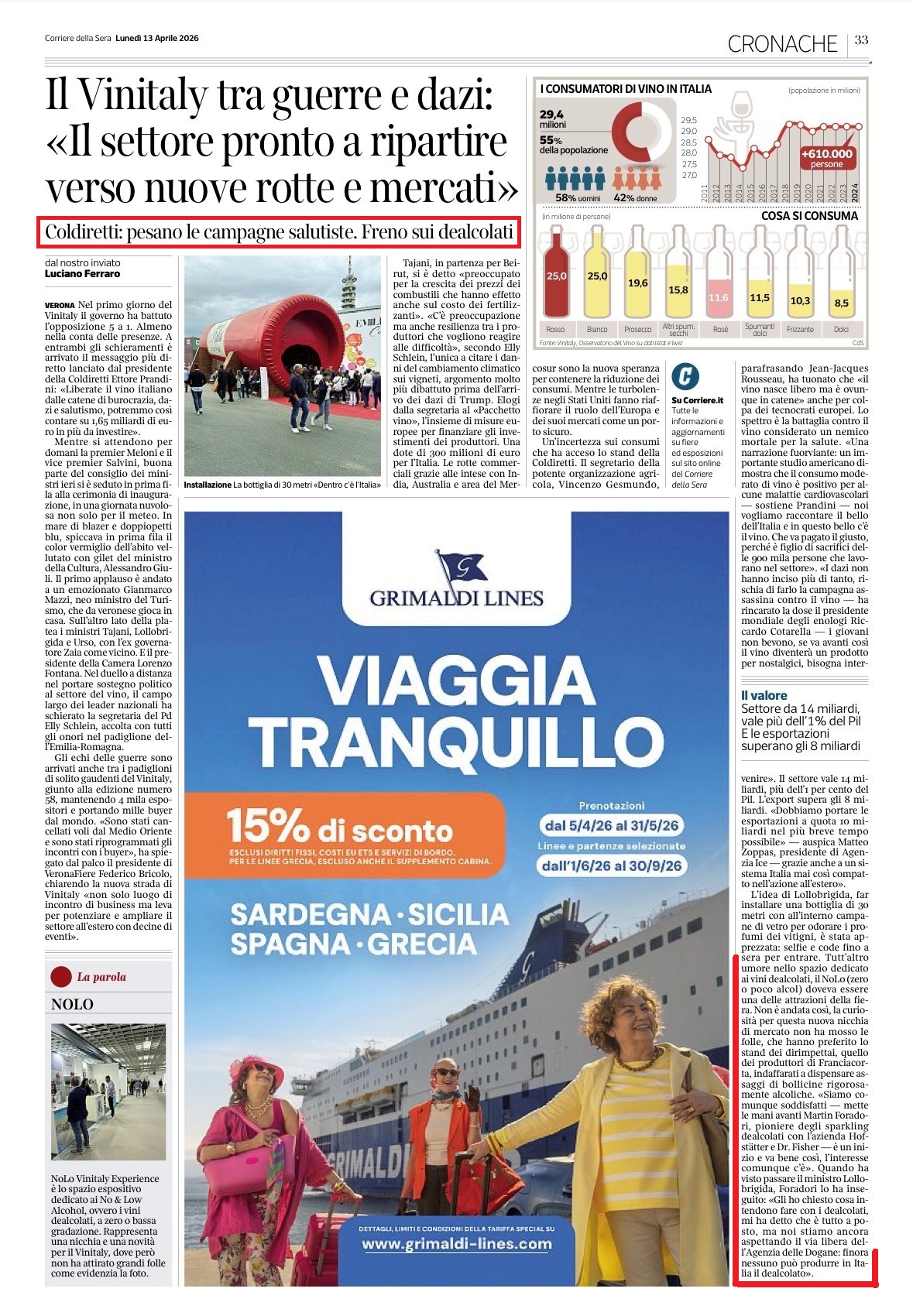
Almost simultaneously, the government launched a campaign to promote wine containing ethyl alcohol, a substance classified as carcinogenic to humans (group 1) by the World Health Organisation’s International Agency for Research on Cancer (IARC), the same category that includes tobacco and asbestos. Numerous scientific studies have shown the association between alcohol consumption and increased risk of various cancers, including: mouth and throat, oesophagus, liver, colorectal, breast
For this reason, more and more international health institutions emphasise that there is no such thing as a completely risk-free consumption threshold. To see a ministry promoting an alcoholic beverage with an advertising campaign is puzzling to say the least.
Below: Coldiretti, as on renewables, makes an ideological battle about dealcoholised wine that ‘so far no one can produce in Italy’ (even though a decree was signed in December 2025).
In a nutshell: do we put a spoke in the wheels of organic farming, encouraging the ingestion of pesticides, and promote wine, the abuse of which is carcinogenic?
More attention to the health of citizens would not hurt.