Hole in the water. Why there will be a water crisis in Sicily even if it has rained for months
After commissioners, extraordinary funds and institutional promises, the Region still finds itself unprepared. Desalinators are behind schedule and the underground network is losing forty-two per cent of its flow
Keep this article carefully. Save it as a favourite or print it out and fold it neatly. We will get it out in July, maybe even earlier, when the headlines about Sicily collapsing for lack of water will be everywhere. Despite the rain. Despite the announcements. Despite the ‘never again’. Despite the emergency commissioner. Despite the good intentions. Despite the technical tables. Despite the desalinators. Despite a year of decrees, notices, special powers. And yet March is coming to an end, summer is approaching – if the average temperature of the last few days on the island is not already over twenty degrees – and on the drought front, Sicily is in the same situation as before. Or rather, worse.
The extraordinary national commissioner for the water emergency, Nicola Dell’Acqua, also puts his hands out , speaking in no uncertain terms of a worse situation than last year: ‘Next summer will be particularly hard. And to think that there has been no lack of investments and announcements in recent months, starting with those for three desalinators, plus two ‘mobile’ ones, with the declared objective of the President of the Region, Renato Schifani, to ‘defeat the drought’ at the modest sum of two hundred and ninety million euro. The League, on the other hand, extols the work of minister and leader Matteo Salvini, who has earmarked ninety-four million euros for ‘six strategic works that will largely solve the emergency,’ says a note from the Sicilian Carroccio. A few days ago, Renato Schifani, commenting on this winter’s heavy rain, said he was ‘confident’ about a summer that would not be dry.
However, the optimism of the Sicilian government and its majority is counterbalanced by what emerges from the data of the Region’s technical offices. The Sicilian Region’s Basin Authority has painted a picture that verges on collapse, with just one hundred and forty-two million cubic metres of water available in the main ‘mixed-use’ reservoirs, i.e. for both agricultural and drinking use. The actual usable volume, net of sludge, leaks and lack of infrastructure, even drops below one hundred million. It ranges from minus twenty-one per cent to minus forty-seven per cent compared to the same period a year ago. A situation that, if confirmed by the updated data expected by the end of the month, would represent a real risk for the drinking and agricultural water supply of the entire island.
All this according to the data released by Cittadinanzattiva’s report on the integrated water service, on the occasion of World Water Day on 26 March. The average expenditure incurred by families in Sicily for water bills is four hundred and eighty-nine euros: water dispersion is forty-two per cent.
In many municipalities, water is already rationed. And we are still in the low season, as far as tourism is concerned, with Sicily being taken by storm for the holidays and the long bridge between Easter and the First of May, and with Agrigento, the Italian Capital of Culture 2025 (without peace, the director of the Foundation, Roberto Albergoni, the man who materially wrote the winning dossier, has just resigned), which, according to forecasts, should triple the number of presences. But with what water, if images of luxury B&Bs with water canisters at the entrance for visitors and instructions in three languages on how to ‘wash up’ were already doing the rounds on the web last year?
The Garcia Dam, which quenches the thirst of dozens of municipalities in three provinces, Palermo, Agrigento, and Trapani, is at very low levels, and Siciliacque, the company that manages the water network, has had to initiate the first reductions. The other dams continue to have the usual problem: since they have never been tested, even if it rains, they must be partly emptied, spilling the water to the sea, for safety reasons. An unacceptable waste, which has seen farmers on the warpath. Now the Ministry of Infrastructure has ‘granted’, after the protests of recent days, to raise the level of the Rubino Dam, near Trapani, by two metres, which has a series of structural problems that have never been resolved. A drop in the desert. For the trade associations, the level could rise another four metres. The excess water is spilled, while the fields remain dry.
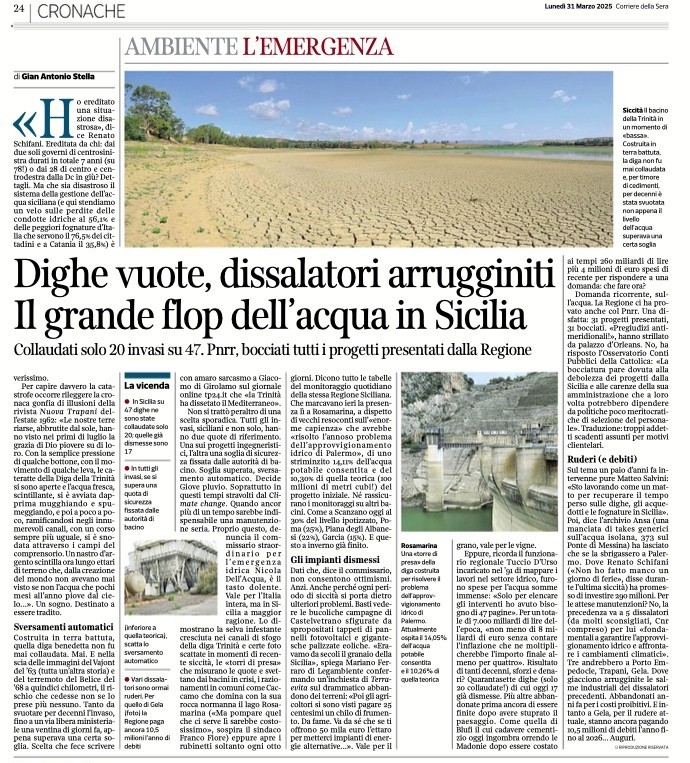
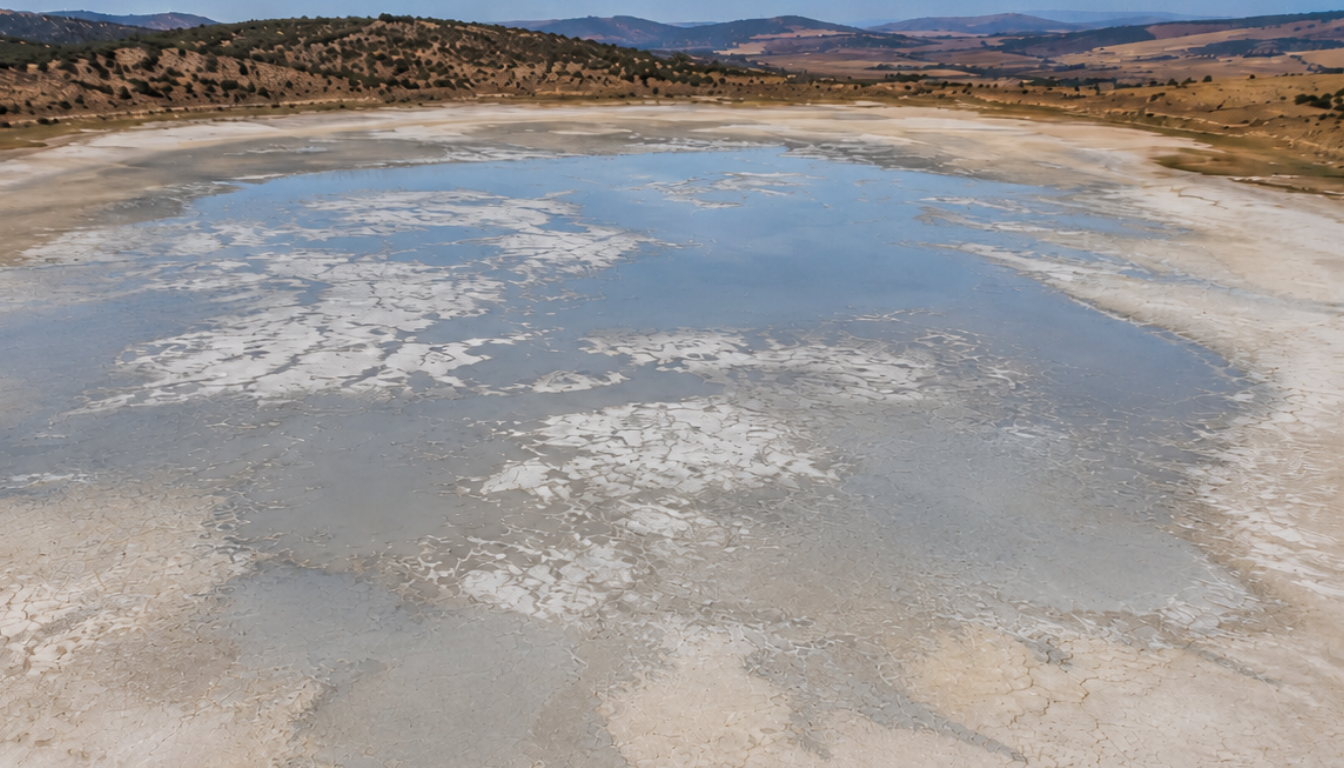
But all the dams in western Sicily have long been the symbol of a water system in disarray, of delays, of negligence. The most paradoxical situation is that of the Trinità dam, another large reservoir for irrigation purposes in the province of Trapani, emptied by order of the Ministry of Infrastructure because of the condition of the dam face, which does not guarantee its tightness, especially in the event of an earthquake. One hundred thousand cubic metres of water per day spilled into the sea. Until discovering, only last 10 March, that in fact, after the Civil Protection’s checks – which no one had ever done – the dam does not have to be emptied, as has been the case every year for half a century. And so water can be kept up to a height of sixty-two metres, i.e. 2.5 million cubic metres.
All the Sicilian dams need maintenance. Out of forty-seven reservoirs, twenty-six are out of operation or in operation with limitations or, again, awaiting testing and therefore limited. A large number of these limited reservoirs are for irrigation purposes and would be those intended to guarantee the availability of the resource for the agricultural and livestock sectors, so much so that in recent years the Sicilian Region has been allocated funds aimed precisely at managing the dams. Most of these funds have, however, been diverted to the resumption of work on the Pietrarossa dam, another unfinished work.
What is more, the Pietrarossa dam is precisely the emblem of the limits of Sicilian bureaucracy and politics. It is located in the province of Enna. It was 1956: Anna Magnani won an Oscar, the first Italian in history; in Marcinelle, Belgium, one hundred and thirty-six Italians died in a mining accident. In Sicily, the drought emergency was being faced, and the first proposal to build this great dam, defined as a ‘strategic work’, was approved. In 2025, its realisation is still awaited. So much for strategy.
Brief summary: the executive project dates back to 1983, the funding of one hundred and forty-five billion lire, with the beloved Cassa del Mezzogiorno, dates back to 1988. Work was contracted and interrupted in 1993 due to a landslide. Then, due to construction errors, everything was stopped. Until 1997, with another forty-three billion lire. Then the construction site was seized. The work was ninety-five per cent complete. Then the dam was abandoned. Then in 2011 it was scheduled for demolition. Then in 2017 it was decided to restart the work. Then in 2022 the work was included in the National Recovery and Resilience Plan (NRPR) and the work was to be completed in 2025. They never started.
The construction of the dam has been announced a dozen times in these sixty-odd years. The last by the former governor, now minister of the Republic, Nello Musumeci, in 2019: ‘We are proceeding in forced stages to complete the plant’. Only in 2022, however, does the work go out to tender: eighty million euro. Between expropriations, appeals, commissioners ad acta, counter-appeals, archaeological findings, price increases, nothing is moving. The only hope, then, is to point our eyes to the sky and, like in Fabio Concato’s songs, hope that it will rain.