Compiled 16 April , updated 19 April 2026
Plant-based alternatives are gaining more and more space on supermarket refrigerator shelves.
Milk, yoghurt, steak, croquettes, salmon, tuna, shrimp and cheese (dubbed ‘fake cheese’ or ‘vegan cheese’, depending on the brand) are available in versions free of animal products, but rich in soya, peas and coconut.
Continuing along the supermarket aisle, one finds beers, wines, aperitifs and artificial soft drinks. Finally, in the sugar department, there is an increasing number of products… without sugar. Online and in some organic shops one can buy Papondu egg (laid by hen), produced in the Val-d’Oise region with broad bean flour(Le Monde).
These are no longer mere surrogates for niche markets, but a rapidly expanding sector that is redefining the global food landscape. According to Coop Switzerland’s Plant Based Food Report 2025, 30% of the population consumes plant-based alternatives several times a month, while only 1% have never tried them. In Italy, more than 51% have reduced their meat consumption for environmental reasons.
But there is more than that:according to a sociologist, substitutes “are part of a very strong trend made possible by technological advances: eating ‘without’ (without sugar, fat, gluten, lactose, additives, nitrites, etc.), which expresses consumers’ strong distrust of the agri-food industry “.
“It is also a form of social distinction: ‘I can afford to eat better than ordinary people…’
A billion-dollar market
According to Data Bridge Market Research, the global vegan cheese market was valued at $3.37 billion in 2023 and will reach $12.49 billion by 2031, growing at an annual rate of 17.80%. The phenomenon does not only concern vegans: 67% of the respondents combine vegetable alternatives and animal products in the same meal, shaping the profile of the ‘alternarian’ – a flexible consumer. For those under 29, environmental protection is the main reason (53%), followed by health (49%) and animal welfare (46%).
3D printed salmon and vegetable tuna
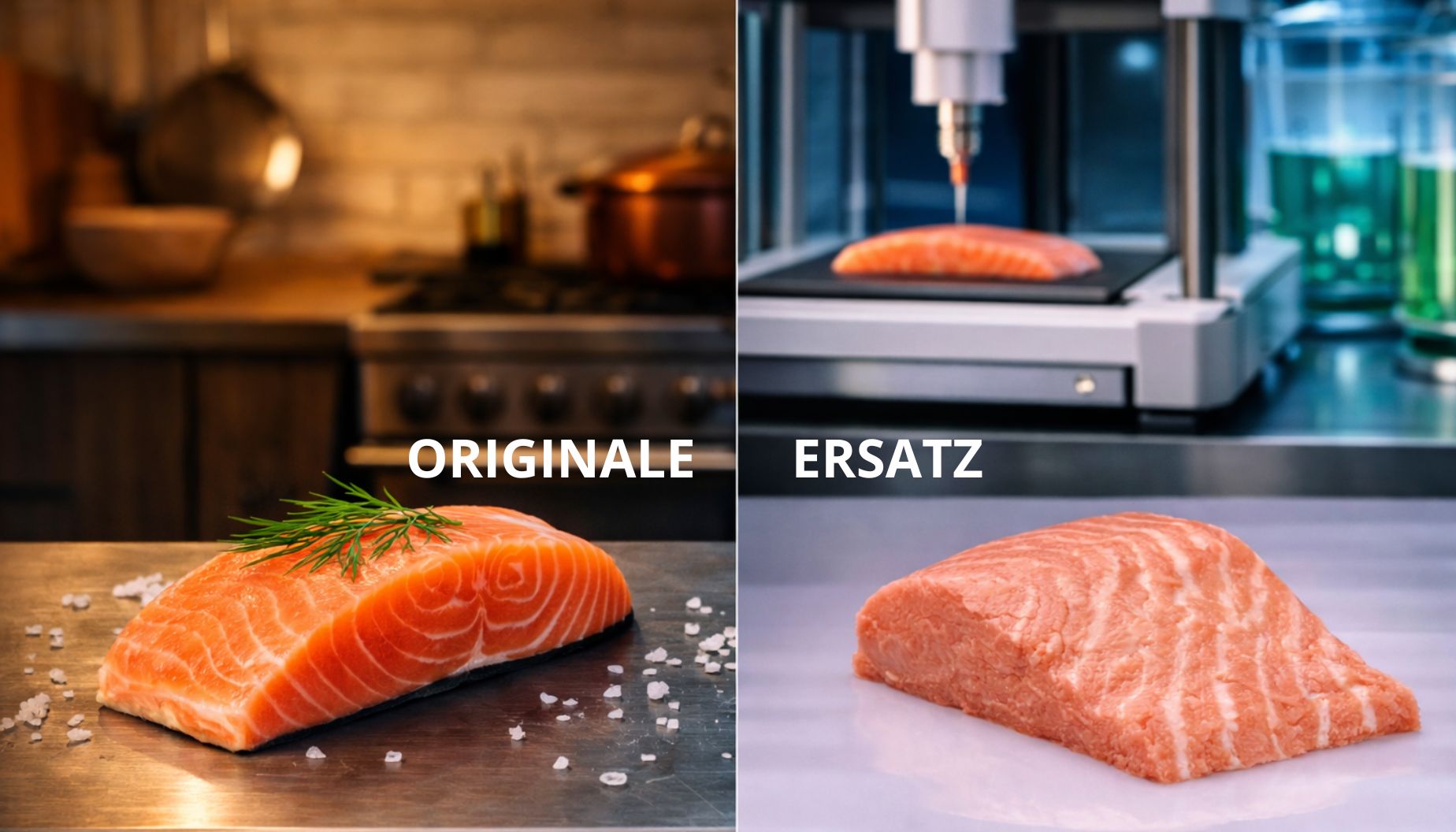
Viennese start-up Revo Foods has developed a 3D-printed smoked vegetable salmon using mushroom and pea proteins, starch and agar seaweed to reproduce tissue, flavour and provide Omega-3. Nestlé markets ‘Vuna’, a tuna alternative with pea and wheat proteins, while Ocean Hugger Foods has created a carrot-based salmon for plant-based sushi. According to the UN agency FAO, 64.5% of all fish stocks are exploited within biologically sustainable levels, while 35.5% of stocks are classified as overexploited. .
Vegetable cheeses: from fermentation to noble moulds
Vegan cheeses today use traditional fermentation techniques applied to cashew, almond and legume bases. In Italy, Pangea Food produces Gondino, a gratable vegan cheese made from potato starch and chickpea flour. Fermaggio uses cashew nut fermentation to create vegetarian mozzarella, smoked scamorza and mature cheeses such as Camembert and Gorgonzola, with flowery rinds and noble moulds just like traditional cheeses.
From carob to cellular cacao
The price of cocoa increased by 300% in 2024, with retail chocolate rising by 9% and a further 14% in January 2025. Global warming is making traditional growing areas unsuitable. Carob is proposed as an alternative: the Apulian start-up Foreverland has developed ‘Choruba’, which combines Italian carob flour with shea butter, requiring 90% less water and producing 80% fewer emissions. 93% of tasters identify it as chocolate.
WNWN Food Labs uses barley fermented with organic carob, while the Swiss Food Brewer is developing cocoa from cellular agriculture, growing the plant tissues of the cocoa plant in fermenters with fats from algae.
The ultra-processed debate
A controversial issue concerns the classification of these products as ‘ultra-processed‘ according to the NOVA system, the application and usefulness of which is the subject of debate in the scientific literature. In the EU, there is still no harmonised legal definition of this category. GFI Europe notes that plant-based meat, although often included among the ultra-processed, has in many cases a different nutritional profile from other UPFs and that some studies associate its replacement by animal meat with an improvement in indicators such as LDL cholesterol. However, a general caution remains valid: high consumption of ultra-processed meats is associated with higher health risks, so the issue must be evaluated in the overall dietary picture.
Regulatory battles
In October 2024, the Court of Justice of the EU ruled that, in the absence of a specific legal name, a member state may not generally prohibit the use of customary or descriptive names for plant products, unless it intervenes on a case-by-case basis if the labelling is misleading. In October 2025, the European Parliament then adopted a more restrictive position on names associated with meat, but this was not yet the final rule. In March 2026, the Council and Parliament reached a provisional agreement that provides for the protection of the term ‘meat’ and 31 meat-related names, with a potentially significant impact on the plant-based sector.
Hybrid products and private labels
An emerging trend is the growth of hybrid products, which combine animal and vegetable ingredients. In the Netherlands, Albert Heijn introduced a line of 15 hybrid products in 2025, including dairy drinks, meat products and sausages, formulated to offer less saturated fat, lower CO₂e emissions and competitive prices compared to equivalent all-animal versions. On the plant-based front, the weight of private labels is also growing: according to GFI Europe, the volume of private label products in Germany increased by 41.4% between 2022 and 2024, while brands declined by 8.3%; in Italy, private labels grew by 16.4% [as of 2022], compared to -1.5% for branded products. Price matters a lot, but taste and consistency remain decisive factors in consumer choice.
Substitute foods are a mature segment that responds to environmental, health, ethical and economic needs. Food technology has made extraordinary progress in replicating flavours and textures. Open questions remain about sustainability throughout the life cycle and the nutritional aspect. The future will depend on balancing innovation, accessibility, quality and sustainability within a regulatory framework that favours competition and transparency. Consumers will be the arbiters of this revolution.