Edited 12 April 2007 . Last updated : 19 April 2026
Original article title:
Supermarket, the revolution is 50 years old
(n.b.: I changed the title of the article because it has been almost 15 years since it was written)
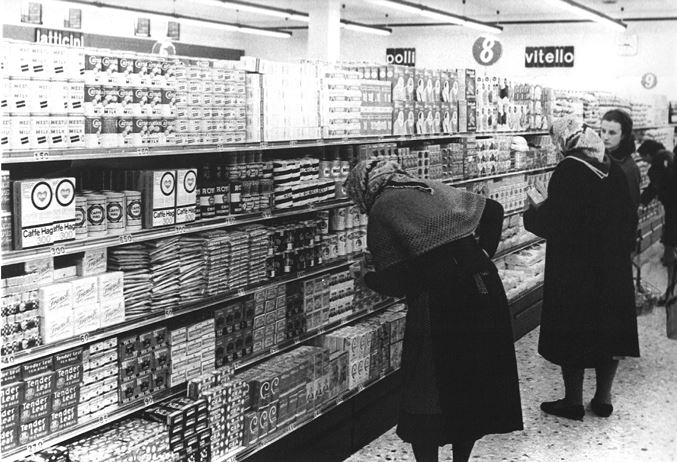
ROME – On 13 April 1957, an elderly woman, wearing a woollen shawl and black parannanza, spends the entire morning in front of a supermarket shelf. Motionless and astonished, the grandmother looks at the tins of tinned pineapple, the boxes of toothpaste, the bread in bags, the meat in cellophane. In the photos of the time, she looks like a peasant girl from Ciociaria who has emerged from the previous century, but no wonder: before that morning she had never seen a pineapple. Let alone a tinned pineapple. To tell the truth, until that day he had never even seen a supermarket shelf, with those hundreds of foreign goods, colours and brands.
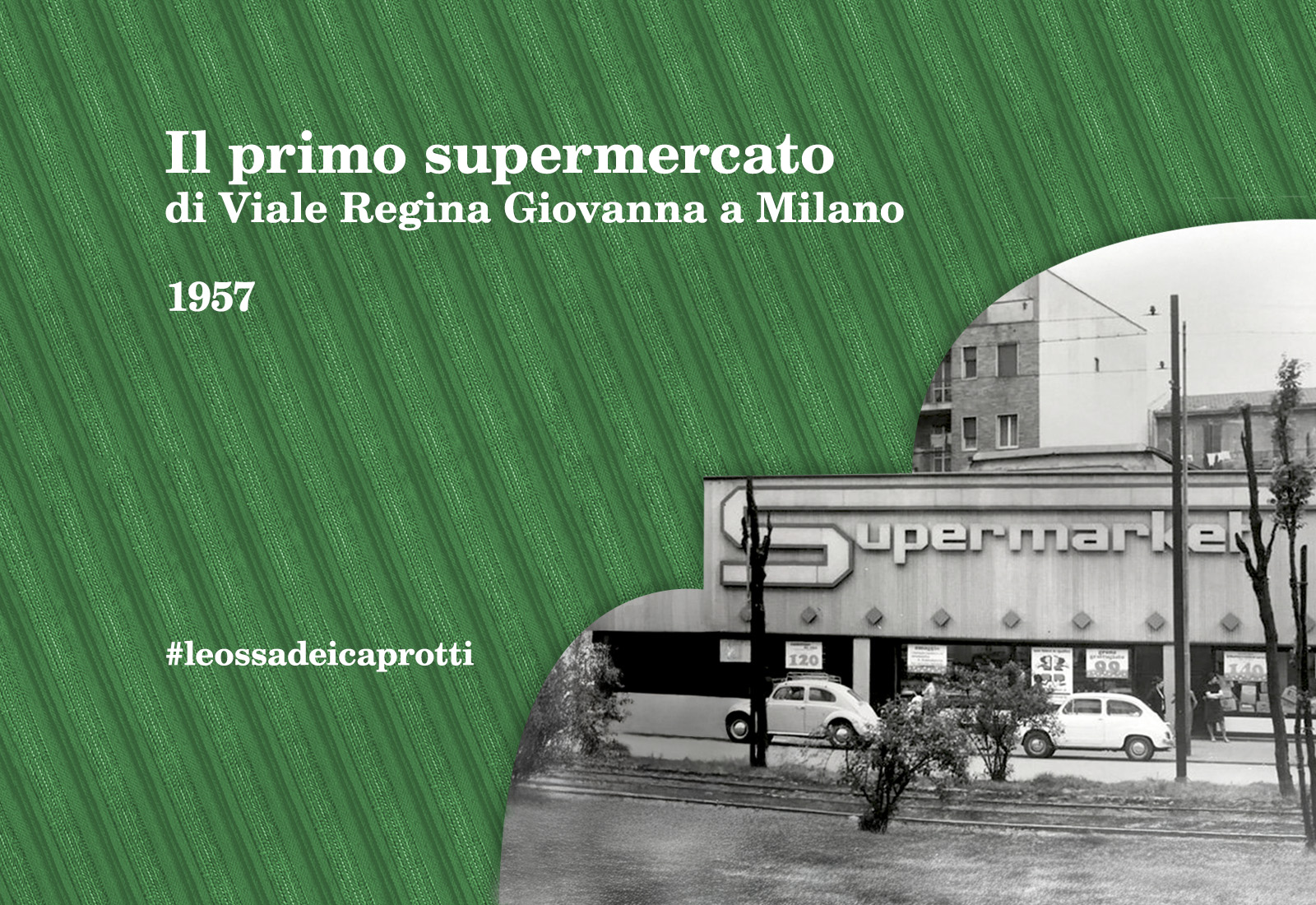
Come to think of it, no one in Italy had ever seen a supermarket before that 13 April 1957. That one, opened in Viale Regina Giovanna, in the Porta Venezia area of Milan, was the first.
1957 is a far-off place to imagine. In that year, Fiat presented its 500. In Algeria, French troops begin the siege of the casbah. In 1957, Antonio Cabrini is born, Arturo Toscanini dies, and the Italians who own a refrigerator are no more than 400,000.
This is to say that in 1957 a supermarket was a spaceship , and canned meat Manzotin food for UFOs. Supermarket (this was the sign) was founded with 300,000 dollars by the International Basic Economy Corporation (Ibec), Nelson Rockefeller’s company, whose aim was to develop large-scale distribution in our country.
The supermarket was, at the time, the symbol of the American Way of life, something utopian in its own way. A book now recounts this industrial adventure and more, written by historian Emanuela Scarpellini for Marsilio. In La spesa è uguale per tutti the author reports on many documents, including the speeches of the board of directors (the Italian partners included the then owners of Corriere della Sera, Mario and Vittorio Crespi):“We proposed to improve the standard of living with the ‘contribution of American capital, management and methods’,” Rockefeller explained to his shareholders, “But, in addition to this, I believe we have shown people, who are often distrustful of private initiative and foreign capital, that private enterprise can give each individual greater advantages than any other economic and social system can”.
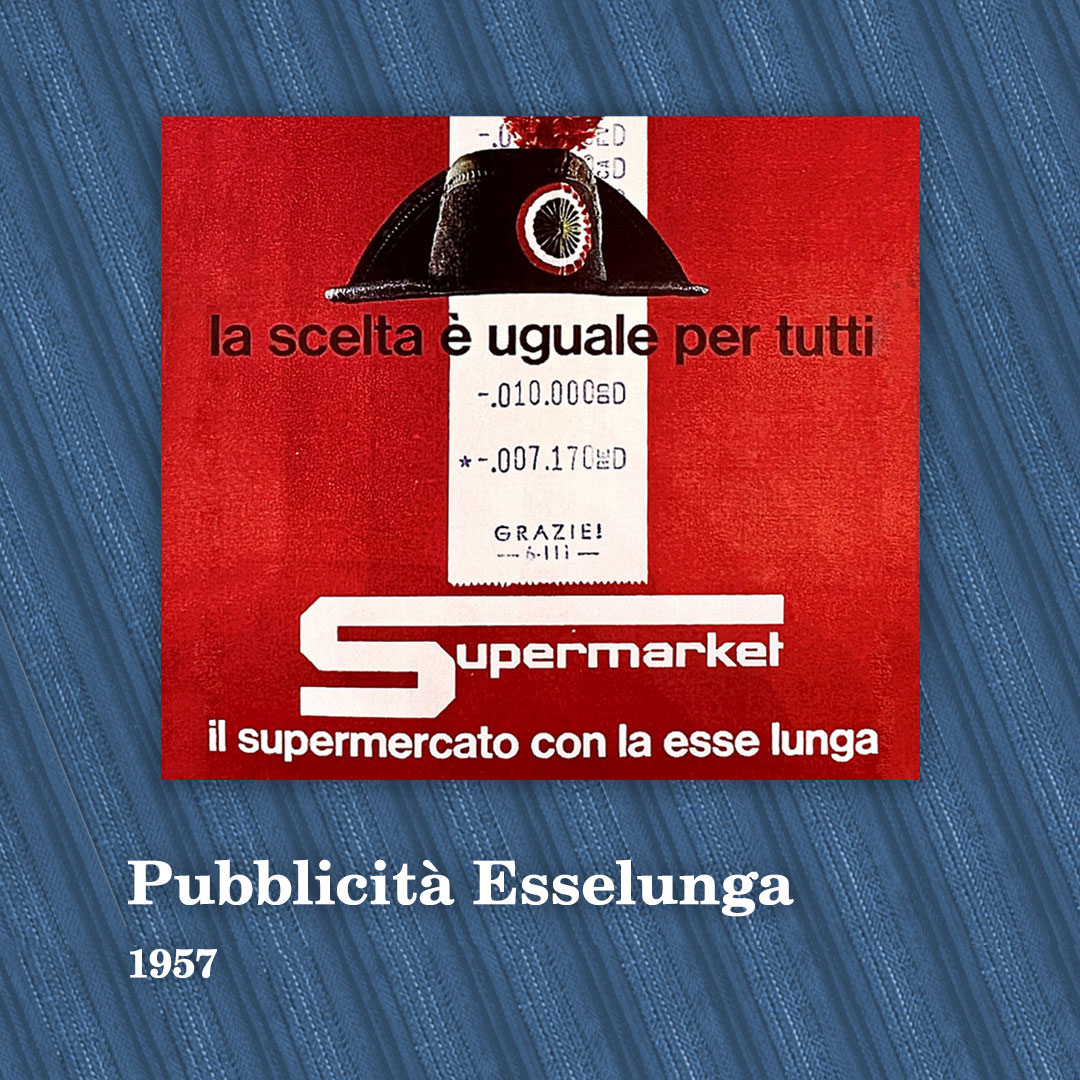
Rockefeller‘s Ibec also declared its philanthropic motives in the advertising it produced to make itself known to the inhabitants of the neighbourhood. The posters read: ‘Groceries are equal for all’. It sounded like a socialist slogan.
But people, in Milan as in the other cities where Ibec opened its shops after 13 April 1957, were attracted not so much by ‘discounts’ and ‘extraordinary offers’ as by things, by merchandise: the supermarket seemed a cornucopia of abundance in the eyes of a generation that had lived through the war. People wanted to see the meat cut into pieces and in trays, wanted to see the pineapple, and the five brands of American toothpaste. They wanted to touch the tins of peeled tomatoes, and dream.
Every time a new Supermarket opened, the police had to intervene, such was the crowd. There were reporters and ambulances, like at the stadium.
Richard W. Boogaart, the director of ‘Italian Supermarkets’, used to write long letters to his American bosses about the Italian way of life: ‘I had smaller trolleys produced. Here people spend less, they are poorer than here’. And he added: ‘I don’t know any family in Milan that has a garage for two cars, except mine and that of one of our partners’.
CARLOTTA MISMETTI CAPUA
As Alessandro Baricco says (*) :
“When Boogart opened his supermarkets he found a lot of people against him. Many were defending their interests (the butcher on the corner), many were looking for an axe to grind (a typical Italian quirk), and many sensed the ideological implications, i.e. the silent advance of the American cultural model… However, no one could find really convincing arguments against the supermarkets. The communists, who were adept at that sort of thing, could find nothing better than to denounce how, by not giving credit, supermarkets discriminated against the poorest, those who paid at the pizzeria when they could: little enough to stem the tide of modernity. Thus, the absurd idea of the supermarket proved to be a move for which there were no answers, and in the long run one of the moves that led the United States to win the cultural and economic game they played with us on the chessboard of Europe.
That game is now written in history, and to retrace it, as this book does (see below), is to understand how the invention of Rotary, the washing machine, detergents, westerns, advertising and 3X2 were just white pieces manoeuvred by a kind of invisible player, who nevertheless knew what he was doing, and would not stop until he won.
Whether he actually won, well, that’s another story’.
(*) about ‘The Irresistible Empire. La società dei consumi americane alla conquista del mondo’, Einaudi 2005, by the Italian-American historian Victoria De Grazia in Una certa idea di mondo, 2012 (La Repubblica).
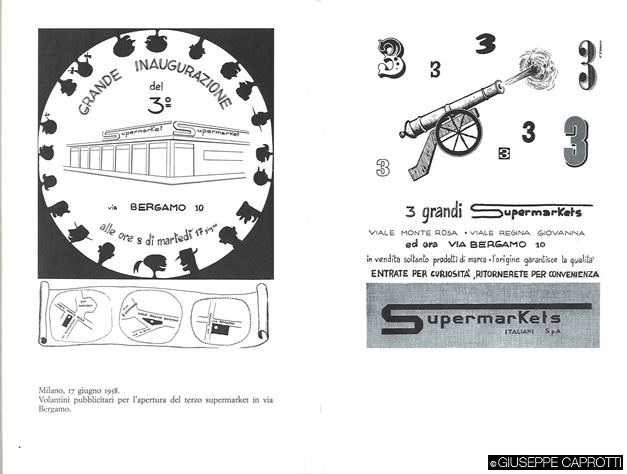
Advertisement for the opening of the Esselunga in Via Bergamo in 1958, the chain’s third supermarket, after Viale Regina Giovanna and Viale Monte Rosa.
Final note :
In distribution, the United States won withassortment, quality and prices.
Of course, the Americans were and remain masters in logistics. And of managerialorganisation.
On this topic you can read:
- this article on the birth of private label products in Italy, in 1959.
- this piece about the birth of the first supermarkets, in the USA and Italy.
- Esselunga: from 1957 to the early 1990s in the memories of a ‘grocer’s’ son.
- Le Ossa dei Caprotti
Thanks to Caroline Stefani. Below the advertisement: “the choice is the same for everyone.”