Compiled 6 May 2021, updated 14 September 2024
HOW TO RECOGNISE THE 6 ESSENTIAL CHARACTERISTICS OF A QUALITY PASTA.
29/04/2021
To help you make an informed choice.
The world of food today is confusing, to say the least.
In addition to a magnifying glass, reading product labels requires a certain familiarity in understanding numbers and data and a good dose of patience.
How to come up with this?
Surely we producers can give a big hand, by making simple, immediate and truthful the path behind our product: our supply chain.
But there are – at least in the world of dry pasta – also some simple characteristics that can help the consumer immediately understand whether what he has in front of him is a quality product or not.
Let us therefore begin by listing them one by one.
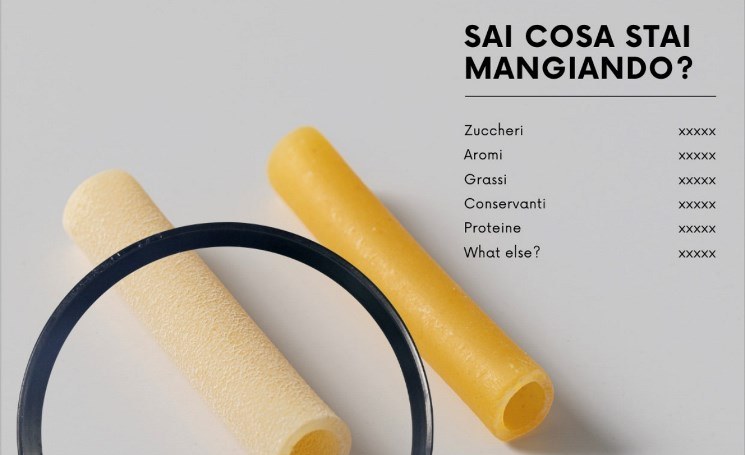
A good pasta should have a light colour, almost close to ivory.
But why?
Quite simply because that is the colour of the semolina (the durum wheat flour). When you find yourself in front of a brown or orange-coloured pasta, it means that that pasta has undergone a violent and artificial (i.e. high temperature) drying process. The starches contained within it have literally been burnt, changing from their light colour to a caramelised colour (the effect of the Malliard reaction).
The result is a paste with a sweetish flavour and a bitter aftertaste, typical of the caramelisation of sugars.
2: Surface
A good pasta should have a rough, matt surface.
But why?
The surface -or texture- of the pasta is given by the extrusion technique used.
A bronze-drawn pasta will have a rough, porous surface because drawing with a metal is subject to friction.
The friction between the surface of the bronze and that of the dough generates the classic abrasive effect typical of bronze-drawn pasta.
Conversely, a Teflon-drawn paste – which is a self-lubricating plastic material – will have a smooth, almost ‘plastic-like’ surface, due precisely to the total absence of friction.
3: Uniformity
A good pulp must not have any tumbling marks and slight red marks, nor white or black points.
Bottaturas (a slang term for micro-fractures within the structure of the pasta, visible even to the naked eye against the light) are defects resulting from an obvious drying problem.
Normally, the glutinic mesh, which is created between the wheat proteins and the water during kneading, consolidates in an average amount of time. If the dough is dried too quickly or undergoes excessive changes in temperature, then the gluten mesh may fracture. These can be found during cooking, when the dough flakes or breaks while you are cooking it.
Black or red or white spots, on the other hand, are indications of an unpure semolina.
4: Odour
Does a pasta smell?
A good pasta does!
If it is made with all the right ingredients, a pasta retains the typical smell of wheat. A smell very similar to what we call bread crust, of fermenting yeast. Slightly acidic but still fragrant.
If the dough is devoid of these odours then it means that everything ‘alive’ and natural that was contained in it has been destroyed. And that is not good!
5: Release of starch
A good pasta must have a controlled and controllable starch release during cooking!
What does this mean?
A glossy or sticky effect is never pleasant, but how come certain ‘artisanal’ pastas (warning! The term ‘artisanal’ is incorrect, it only serves here to help the reader understand the topic of discussion) release so much starch?
This too is a defect, this time caused by the poor quality of the wheat protein used.
As we have already mentioned, the glutinic mesh that is created during the mixing of water and semolina has the task of maintaining the shape of the dough but also of keeping the components of which it is composed at bay, among them starch.
If the gluten mesh is in shape and well structured, the release of starch will be controlled.
With greater stimulation (e.g. mantecatura or risotto) there will be a greater release, but without stimulation a good pasta will remain perfectly shiny and never glossy!
6: Keeping pasta al dente
Never to be taken for granted is the cooking test!
Good pasta does not necessarily have to have a long cooking time, quite the contrary!
Cooking times generally depend on the size and thickness of the pasta.
Sometimes the thickness is decided by the simple taste of the manufacturer, sometimes it is a necessity.
Thicker pasta is produced to give it more resistance, probably because the starting raw material is not excellent.
If a pasta is made from an excellent wheat, there will be no need to make it too thick. It will be the protein in the wheat that will keep it ‘in shape’.
Even the cooking, once finished, will amaze you!
A good pasta will in fact be able to ‘turn back’ during cooking again thanks to the strength and elasticity of its gluten mesh, which once the hydration by the boiling water is over, will shrink and then recompact.
We report that in 2023, according to Altroconsumo, the best pasta is Barilla, followed by Lidl’s Italiamo (to be evaluated for possible conflicts of interest, which there are, almost always).
Read also : Pasta, the industry loses at the Tar: ‘The origin of wheat remains compulsory on the label ‘ and our thoughts on the subject.