Drafted 3 August 2023, updated 10 July 2025
The title of the article refers to last summer but the topic, as will be seen in the conclusion is valid in summer and winter. With this article, the president of Confagricoltura got some publicity but also highlighted a real problem, confirmed in 2025: Milk, Calzolari (Granarolo): ‘Never seen such high quotations. It is the effect of global warming’.
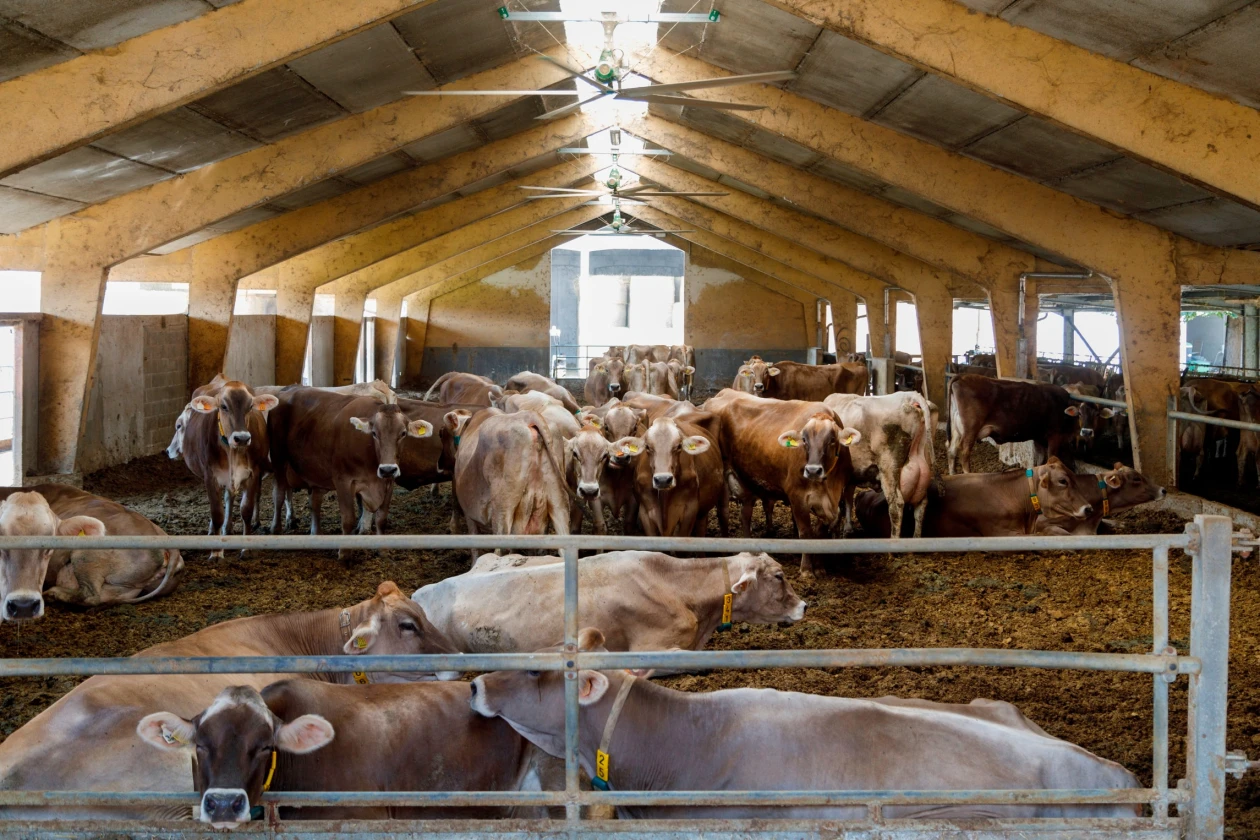
Cows are cooled by fans at the Caseificio Montecoppe dairy farm in Parma, Italy © Simone Donati/TerraProject for the Financial Times. You can find my thoughts at the end of the article.
Italian cheesemakers cool their cows [sounds like a joke but it’s not].
Farmers are increasingly using giant fans and sprinklers to help their cattle cope with the extreme heat.
Amy Kazmin in Parma
While Italy suffocated under a heat wave last week, Roberto Gelfi’s herd of cows enjoyed the privileges of being milk suppliers for Parmigiano-Reggiano cheese. From morning to night, giant fans whirred at full speed to cool the cattle, whose milk production can drop by 10% under heat stress.
Special machines, meanwhile, sprayed the cows with a fine mist. Gelfi, 58, the second-generation owner of the dairy Zecca del Carzeto, first installed his cow coolers more than a decade ago, then only using them during the hottest hours of the two hottest months. Now the cooling systems typically run five months a year for up to 16 hours a day, all at considerable cost. “Cows usually suffer when they reach more than 26°C,” said Gelfi, who is president of the Parma section of Confagricoltura, Italy’s oldest farmers’ and agribusiness association.
How to keep cows cool and comfortable in a warming world is a major concern for dairy farmers in the Emilia-Romagna region, where the world-famous Parmigiano Reggiano cheese is produced under a strict code almost 17 pages long. In addition to the flow of milk, cheesemakers warn that extreme weather conditions – from floods to drought – are affecting the local agriculture of alfalfa and other fodder that cows are required to eat.
Local farms also have to invest in new wells and other irrigation equipment to cope with the increasing demand for water and the scarcity of supply. “Cheese is a function of milk, and the great heat stresses the milk-producing animals, and stresses fodder production,” said Luca Rovesti, president and CEO of the Montecoppe cheesemaker, which has about 500 cows on its estate.“Less milk means less cheese.”
Cows drink up to 140 litres of water a day in the summer heat compared to 80-90 litres in winter, and they also eat less, which reduces milk production. Milk volumes are also affected after the heat peak subsides as the cows recover from the gruelling summer. Sleepless nights have become more common; hot cows find it difficult to lie down comfortably. “An incredible amount of energy is consumed in the summer by the cows to cope with this difficult heat and humidity,” Rovesti said, adding that even the lowest night temperatures in the region were now typically 2 to 3 °C higher than 15 years ago.
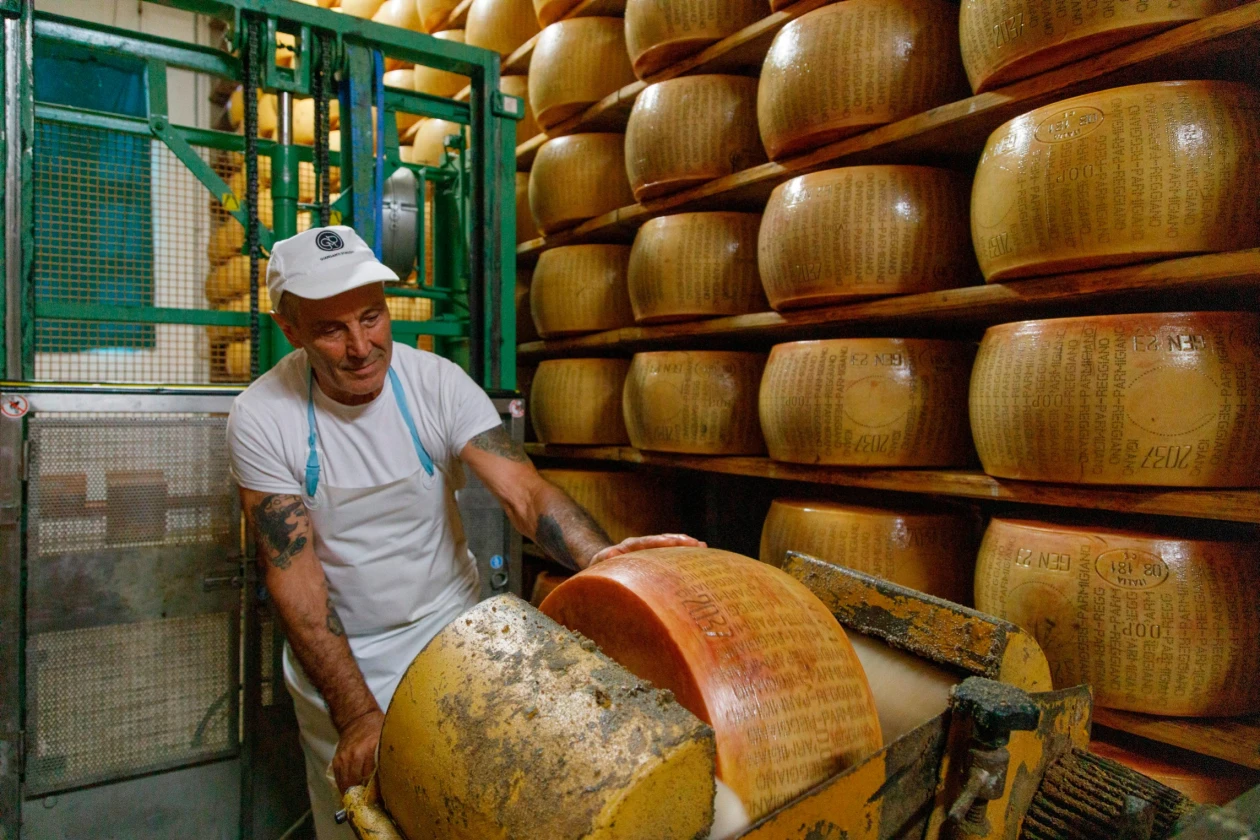
During the recent heat wave, Montecoppe’s cooling fans and irrigation systems ran 24/7, <>days on <>, to try to keep the cows comfortable. The dairyman now plans to install additional misting machines in the feeding area in the hope that the cows will eat more next summer. At the Giansanti Di Muzio farm, a 30-hectare artisanal cheese factory on the outskirts of Parma, summer milk volumes have dropped, reducing the production of 40 kg wheels of cheese from seven to six per day. Master cheesemaker Vincenzo Fanari, 71, who has been making Parmigiano-Reggiano since he was 16, said summer milk is thinner than winter milk, meaning more is needed to produce each 40kg wheel. ‘You need extra milk in summer to make the same amount of cheese,’ he added.
Marina Di Muzio: ‘The price of fodder has gone up, but the price of Parmigiano has not.’ However, milk producers’ concerns about encouraging cows to eat more have a downside. Many are also concerned about the security of fodder supplies to feed them after last year’s severe drought and this spring’s massive flooding in the Emilia-Romagna region.
According to the strict rules for the production of certified Parmigiano-Reggiano, cheesemakers can only use milk from cows that follow a strictly regimented diet, with at least half of their total feed coming from forage, mainly alfalfa. According to the rules, half of the cows’ fodder must come from the farm where they live, another 25 per cent may come from other farms within the designated Parmigiano-Reggiano production area, and only 25 per cent may come from beyond the district.
Vincenzo Fanari: ‘You need extra milk in the summer to make the same amount of cheese.’ But extreme weather conditions have hit fodder production hard, driving up prices. “The price of fodder went up, but the price of Parmigiano did not,” said Marina Di Muzio, matriarch of the family that owns the Giansanti Di Muzio estate.
At Montecoppe, forage production dropped by 20 per cent last year after a second consecutive year of extreme drought in northern Italy. This forced the estate to buy more at a significant cost as prices increased by around 40%. Rovesti warned that recent devastating floods threaten to push the cost even higher this winter. Cheesemakers say these complex challenges could leave some dairies and producers struggling to fill this year’s quotas, allocated by a consortium that regulates the production of Parmigiano-Reggiano.
According to an analysis by Confagricoltura on data from the Parmigiano-Reggiano Consortium, cheese production fell by 2.2 per cent last year as the region was hit by drought. Rovesti said many farmers are still unsure whether the recent extreme weather is a temporary phenomenon or an omen of things to come. “The great hope is that things will return to normal,” he said. “If this is the new normal, the industry will have to cope.”
Confagricoltura has managed to get this visibility with the Financial Times, congratulations [although this is a bit of a quirk for Italian producers]. But the phrase ‘the great hope is that things will return to normal’ for those who live the land every day is sincerely difficult to ‘swallow’.
Get better informed and use your power – you are very close to Fdi, as is Coldiretti – to then convince President Meloni that climate change exists and must be fought, even with the Pnrr.
Also because the inflation of some milk-related products is soaring, in fact the cost of butter has risen 83% year-on-year.
Butter is made from the fat of milk and cream and therefore its production requires a lot of milk, the global supply of which has decreased, partly due to the diseases that have affected dairy cow herds in Europe, and partly due to the high cost of feed.
Then there is the issue of climate change highlighted last summer by the analysis ‘The EU dairy sector: main features, challenges and prospects’ conducted by the European Parliament’s study centre.
According to the research, 13% of dairy cow herds could disappear in the next decade. The reasons are heat stress, which has a negative effect on milk production and milk fat content, as well as on the production performance of cows, especially those on pasture.
Extreme climatic conditions also facilitate the outbreak of diseases.