In 2024, Federico Fubini argued that Putinism was heading towards a North Korean model of militarised autocracy:
In recent days, a magistrate in Nizhny Novgorod has reopened the case of Kirill Smirnov and Yegor Starshinov, two teenagers imprisoned a year ago in that city in central Russia. Their offence: in November 2023, they had shared a video on a Telegram channel in which the two, sitting in a kitchen, discussed Ukraine and criticised the Russian army. The potential audience for the message: 26 schoolmates subscribed to their channel. The headteacher of the school, Nina Govorova, reported them, and they were sentenced to two and a half years in prison as soon as they came of age.
Now the Nizhny Novgorod prosecutor, Anna Belova, wants to review the trial. She considers the two-and-a-half-year sentence unfair.She means to say that it is insufficient. She will requestan extension and is likely to obtain it.
The persecuted
Smirnov and Starnishov are two of the 3,331 Russians currently facing state persecution for political reasons,according to the research centre Ovd Info (which is now considered by the government to be a ‘foreign agent’, i.e. a sort of enemy of the state). Of these, over 1,604 are in detention, including 600 in ‘correctional colonies’ and around 40 in forced labour camps. Someof them, such as the two high school students from Nizhny Novgorod, were reported by police officers, superiors or acquaintances. The political scientist Andrei Kolesnikov, who lives in Moscow, speaks ofan ‘epidemic of denunciations’.
Epidemic of denunciations
He himself is classified by the Ministry of Justice as a foreign agent, a label that prevents him from participating in public life, launching a book, receiving state funding, teaching minors, or having full control over his bank account;the latter can be seized at any time by a public official. And this happens to many “foreign agents”. “Every boss, investigator or judge today sees himself as a little Vladimir Putin,” observes Kolesnikov. “After years of the ‘special military operation’ in Ukraine, their authority is no longer limited in any way.”
The permanent conflict
After all, this seems nothing new. Putin’s Russia, pictured above with Patriarch Kirill, has always been aggressive. With him in the Kremlin, the country has fought wars in Chechnya (1999–2009), Georgia (in 2008, though the occupation continues to this day), Syria (2015) and in Ukraine since 2014. Russia has been at war for twenty-one of Putin’s twenty-five years in power; and the four years when it was not were exceptional: he was not president but prime minister, busy amending the constitution to return to the Kremlin.
The toll of war
With Putin as president, Moscow has always been at war. It has razed cities to the ground in Syria, Ukraine and within its own borders (Grozny). It continues to do so. Putin’s power is now so closely identified with the state of war that the state’s military and security budget has reached well over a thirdof public spending. And it is still rising. To ramp up arms production and the aggression against Ukraine,total spendingin the first four months of 2025rose tothe equivalent of €180 billion from €140 billion a year ago, at a more or less unchanged rouble exchange rate.
The war bonus
We know, however, that the signing-on bonus for signing a contract with the army and deploying to Ukrainehas risen: from the equivalent of around €5,000 a couple of years ago to €25,000 for the Moscow region, 28,000 for Magadan, and up to 39,000 for Sverdlovsk.Death benefits have also increased, in many cases from around 80,000 to 140,000 euros. Putin does not want another mobilisation like the one in September 2022, so as not to provoke Russian aversion to the Ukrainian venture. He prefers to shower his citizens with gold so that they will agree to destroy themselves in the furnace of the Donbass, in exchange for a few metres of land to gnaw away at in a devastated plain: today Russiacontrols less Ukrainian territorythan it did three years ago (19.4% today, compared to around 27% at the start of April 2022).
The North Korean model
What kind of regime is capable of such madness?Andrei Yakovlev, Vladimir Dubrovskiy and Yuri Danilovwrite in ‘Foreign Affairs’that Putinism is heading towards a North Korean model of militarised autocracy. This is relevant to us in Europe because, over the last two years, Putin has increasingly presented the war as a struggle of Russian civilisation against the arrogance of the West. We are the enemies; he presents Ukraine almost exclusively as the current theatre of this struggle, which will continue even in the event of a truce. Putinism now revolves around the idea of perpetual conflict with a debauched, decadent and colonialist West– on which it depends – and is structured in this mission with the traits of a personalist totalitarianism. Thus, every internal transformation is reflected in its external actions, and vice versa. This is why it is important to understandthe metamorphosis currently underway. Starting precisely with denunciations.
Lifetime achievement awards
In Russia,lifetime achievement awards for public officials based on the number of denunciations area tradition dating back to the Tsarist era. It has never been abolished but – according to Ovd Info’s calculations – since the start of the full-scale war in Ukraine, the number of politically motivated charges has doubled to an average of around ten new cases a week. There are 52 possible violations of the Criminal Code, ranging from ‘treason’ to ‘secret dealings with foreigners’ to ‘public insult to religious feelings’. Denunciationhas taken on the characteristics of a social phenomenon. A few years ago, some dissidents set up a ‘unified automated reporting system’on the Rosdonors.rf website, offering the option to report to the Kremlin, the Duma and six other high-level authorities. It was a hoax, but thousands of reports poured in.
Alexander Baunov is convinced that totalitarianism is the direction in which the system is heading.
Totalitarianism is the direction in which the system is heading
His book ‘The End of the Regime’ (published in Italy by Silvio Berlusconi Editore)recounts the downfall of dictators in Spain, Portugal and Greece, but with that title it flew off the shelves among Russians. It earned the author the label of ‘foreign agent’. Among the consequences was the transfer of proceeds from his book sales to a Sberbank account effectively under government control. “InRussia,we didn’t experience this level of repression even in the days of Nikita Khrushchev or Leonid Brezhnev,” Baunov told me. “The men of the Soviet nomenclature tended to be less harsh,” Baunov continues. “Putin, on the other hand, does not share their fears and is not subject to the same system of collective decision-making: he relies on the fact that his regime will not come to an end, so he does not spare anyone else long prison sentences.” Less than a fifth of sentences for political offences are limited to four years’ imprisonment; around half of the sentences are for at least seven years, with dozens of cases involving sentences of twenty years or more.
The spectre of Prigozhin
The dictator must surely harbour a sense of insecurity regarding the elites, for Yevgeny Prigozhin’s revolt in June 2023 revealed their potential disloyalty. Whilst the Wagner chief marched on Moscow, meeting no resistance,very few within the administrative, business or even militaryelites voiced their condemnation. Suddenly, the silence of the propagandists had become deafening. The system, in all its rigidity, showed that, under pressure, it can suddenly snap.
The claim to control
Perhaps this is why, since then, Putin has extended his totalitarian grip – that is, the expansion of state control into private life, even that of the elites. At the end of 2023, Anastasia Ivleeva, an attractive and politically aligned television presenter, hosted a party for wealthy Muscovites whose dress code was: ‘Almost naked’. She wore jewellery worth over two hundred thousand dollars on her backside, whilst a crowd of senior bureaucrats, businessmen, celebrities and influencers had found other solutions. In the days that followed, the usual candid photos appeared on gossip sites and glossy magazines. All orchestrated, as always. Because all the protagonists were figures of the regime.
Elite parties in Moscow
Only this time, there was a backlash. Putin himself commented: “The country’s elite should consist of people taking part in the special military operation, not those parading about showing their backsides and genitals.” The apologies from the party guests or donations to the Orthodox Church – the one that preaches the total expiation of sins for those who sacrifice themselves in Ukraine – were to no avail. Ivleeva faced a tax audit, whilst others had their television and film contracts cancelled. Months later, some of the participants in the ‘nearly naked’ party were still performing at shows for troops in occupied Ukraine, by way of atonement.
Loyalty is not enough
The episode features in a book on the Russian elite in wartime, to be published in the coming months by Alexandra Prokopenko. A former Russian central banker, in exile since 2022, she too has been declared a foreign agent. Before leaving Russia – perhaps for good – she noticed that a large photo of Putin and the Kremlin had appeared on a wall in her granddaughter’s nursery school, replacing the children’s drawings. Passive loyalty is no longer enough; one must demonstrate commitment and willingness, even without knowing exactly how. Prokopenko writes: ‘In Russia, the rules of the game have been rewritten, but no one has been told how. Before, it was enough not to criticise the war or to support it quietly, not to challenge the Kremlin, not to leave Russia or, if you did, to do so discreetly. Now,’ Prokopenko continues, ‘no one in the ruling class can say what might trigger the next punishment: imported clothes, going to the wrong concert, a tasteless joke?’
School spies
In a sense, it is easier for those two or three levels down the ladder. There, you know what to expect.Every major university has its own internal agent from the FSB, the secret service, who observes and collects reports. Every smaller university has an official with the same remit. From Year 1, children practise reciting Putin’s phrases, and the school system has switched to standardised textbooks across all humanities subjects. The history textbook is authored by a senior official directly serving Putin, Vladimir Medinsky. The Second World War is portrayed as a heroic struggle for Russia’s survival on its own, omitting the Western allies or the weapons supplied by Roosevelt’s America. The war in Ukraine is increasingly presented as the continuation of that same struggle to finish the job.
Total mobilisation
The ambiguous nature of this choice remains. Firstly, because ‘if this is the narrative,’ notes Prokopenko, ‘then there is no picture of what victory is’. Also because totalitarianism implies a total mobilisation of society. But to quell public anxiety, Putin even denies that this exists, preferring the euphemism ‘special military operation’ even after all the deaths and injuries. This is why Kolesnikov describes the system as ‘hybrid totalitarianism’. He says: ‘Putin has found an effective way of alternating between the military, but above all emotional, mobilisation of society and the demobilisation of the majority, allowing them to live private lives in which the war does not feature’.
Red notice
This does not detract from the brutality of the system. Baunov and Prokopenko have fled and now work at Carnegie Eurasia, a think tank that moved from Moscow to Berlin in 2022 and is headed by Alexander Gabuev. Gabuev, 40, travels the world to keep Carnegie going and keep the spotlight on the regime. He knows what he is risking. “If a red notice were issued from Moscow – a request to Interpol for my arrest and extradition – the police in the West wouldn’t act on it, but I’d have my doubts about other countries,” he told me. A few days later, the red notice was indeed issued. Gabuev is now an international fugitive. He lives outside Russia, theoretically safe. But for years he will not know at which airport in the world he might be arrested.
Below: Chinese leader Xi’s visit to North Korea in June 2026 is an important signal regarding North Korea’s role, but also regarding Russia’s status.
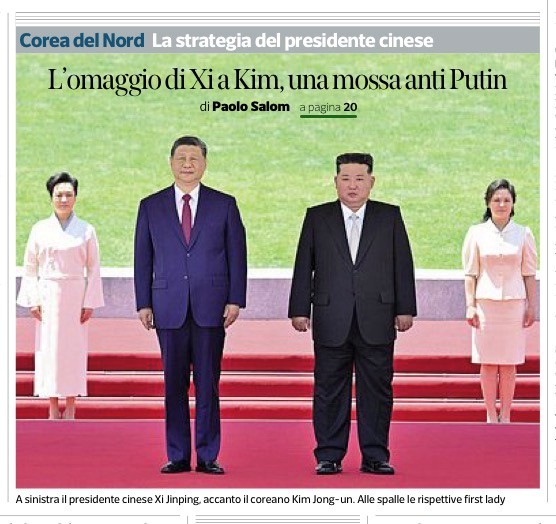
Certainly, Russia and North Korea are very similar; they are both ruthless dictatorships, but Chinese leader Xi’s current visit makes it clear that whilst Putin’s economy and power are in decline, Kim has profited from his intervention in the war in Ukraine and from the possibility of possessing nuclear weapons.
A ‘miraculous transformation’: how Kim Jong-un has fortified North Korea by Choe Sang-Hun for the New York Times
He used the pandemic to ruthlessly tighten his grip on the country. Then he boosted his economy by capitalising on Russia’s war in Ukraine.
During the pandemic, North Korean leader Kim Jong-un, who had long portrayed himself as invincible, made a startling apology on national television.
“I am truly sorry,” he said, as the coronavirus, coupled with food shortages and international sanctions, was ravaging his country. “My efforts and sincerity have not been enough to free our people from the hardships of their lives.”
Kim apologised to North Korean citizens in 2020, as the pandemic ravaged his country.
But whilst ordinary North Koreans were suffering, Mr Kim, 42, seized the crisis as a unique opportunity. Now, he is brimming with confidence. He is recognised at home and abroad as North Korea’s most powerful leader to date, surpassing even his grandfather, the country’s founder, because he has achieved de facto nuclear power status.
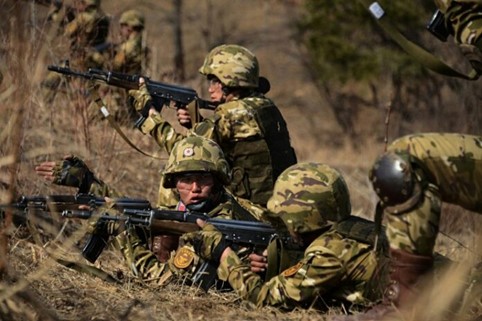
Kim has also seized an unexpected opening abroad. Whilst Russia was struggling in its war against Ukraine, he supplied it with weapons and troops. Moscow reciprocated with weapons technology to help modernise North Korea’s air defences and other vulnerable parts of its military, along with food, oil and even much-needed tourists.
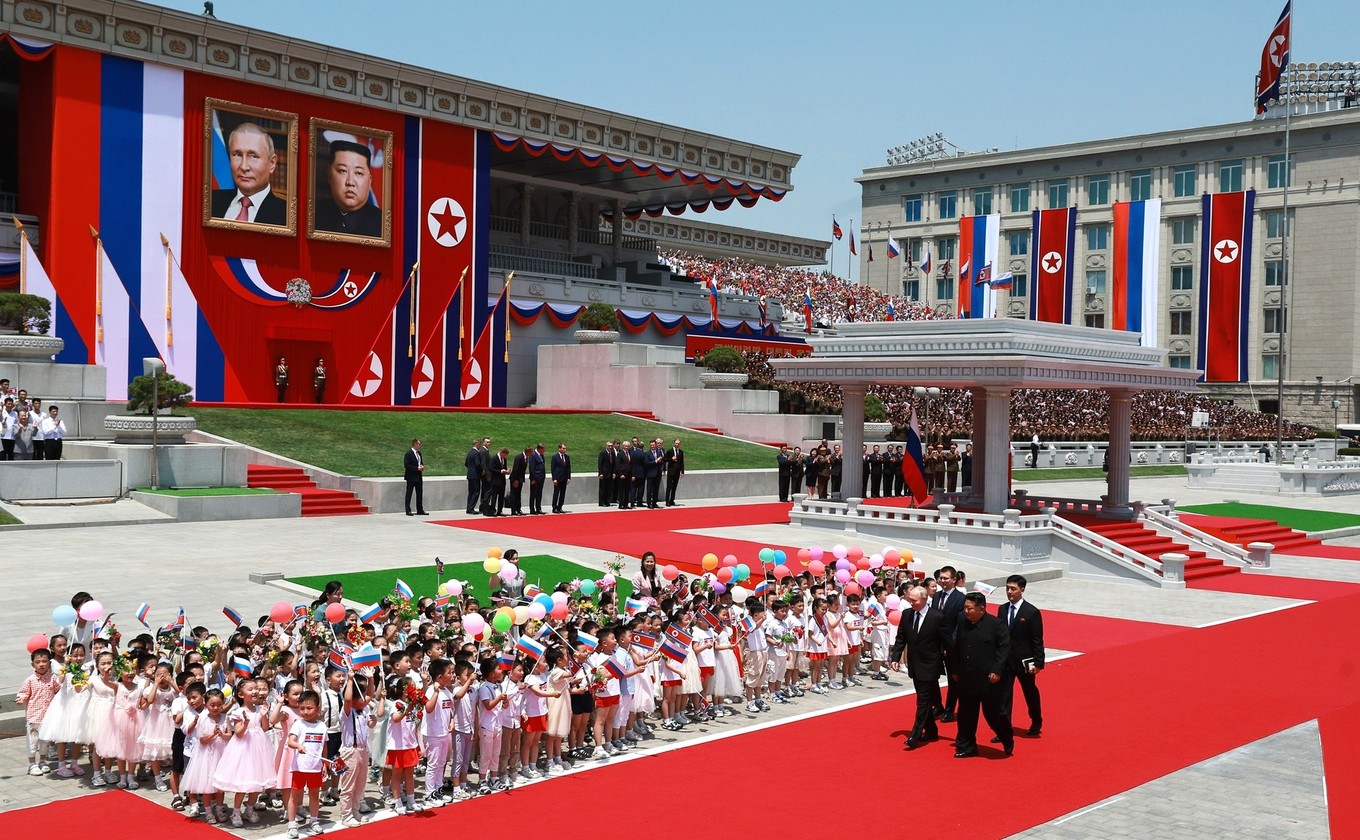
The two nations signed a mutual defence and cooperation treaty, easing Pyongyang’s economic isolation and restoring its international standing.
Since then, he has rejected any notion of resuming talks with President Trump or reconciling with South Korea.
And its shift towards Russia has prompted China to reach out to North Korea, a neighbour that Beijing views as difficult to manage, but whose hostility towards Washington gives it diplomatic leverage.
Chinese leader Xi Jinping arrived in North Korea on Monday [8 June] for a two-day state visit, his first in seven years. He is expected to emphasise China’s indispensable position as North Korea’s dominant trading partner.
The two countries are already expanding trade once again, resuming rail services and adding more flights between Beijing and Pyongyang. They are close to completing a new modern road bridge across the Yalu River border, which is expected to facilitate bilateral trade, including an influx of Chinese tourists and aid….
Below: North Korean soldiers deployed in the war against Ukraine.