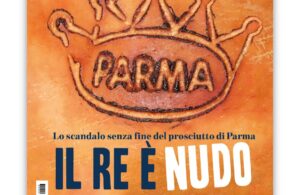
Written on 12 June 2022 and updated on 27 July 2026
Then we come to these sad and convoluted events: “The new regulatory body , theCSQA , suspended” (2022)
The news resurfaced in June 2022 following a ‘saga’ that would last a total of eight years (from 2016 to 2024).
This affair involved Assica (Confindustria), Coldiretti and the Parma Quality Institute ( *) with the following outcomes:
- “The Parma Quality Institute (IPQ), having been suspended for six months in 2018 for failing to realise that nearly a million counterfeit Parma raw hams were in circulation ….”
- “2 million legs – equivalent to 20 per cent of national production – would have been re-admitted to the Parma and San Daniele PDO schemes without meeting the requirements“
(*)The IPQ was subsequently replaced by the CSQA, which in turn was suspended.
The assessment of ‘Prosciuttopoli’ (2024) is interesting , in a never-ending saga: “Even in the case of the 2019 ‘Prosciuttopoli’ scandal, brought to light by*Il Fatto Alimentare*, the Consortium had not noticed a thing, yet it involved a fraud worth 80 million euros, with 300 individuals referred to the judicial authorities, 810,000 ham legs seized, 480,000 hams withdrawn from the market and over 500,000 ham legs stripped of their labels by individual farmers”.
P.S., in 2023 I wrote: if the market has ‘always behaved badly’, there is no point in continuing.

Above is an old advert featuring Ugo Tognazzi, who said in 1976:“Parma ham. You used to have to recognise it by its flavour. From today, this label is all you need.”
Unfortunately, the label may no longerbe enough if the sector’s poor management persists.
The short-sightedness of the aforementioned bodies and associations involved suggests that the aim has been to try, by every possible means, to destroy the reputation of a quality product – Italian prosciutto – whilst favouring foreign competitors.
Will ‘our heroes’ succeed in their endeavour, thereby damaging the entire ‘Made in Italy’ brand?
This is the dilemma that seems to be unfolding, with the scandal of counterfeit hams, the ongoing mismanagement of the sector and the underestimation of the swine fever that is now spreading throughout Italy, with devastating effects.
And it is obvious that this pandemic will have extremely severe effects on our exports – which are being boycotted by many countries – on our image – see below – but also on inflation (the increased costs of this crisis will, inevitably, be passed on to consumer prices) and on our country’s competitiveness.
Take it from someone who, more than twenty years ago, after consulting Juan Roig of Mercadona, introduced Spanish ham – under the Campofrío brand – into Esselunga’s delicatessens.
Even back then, ‘Jamón’ was far ‘more fashionable’ than our Parma ham!
Below: ‘Ham under threat’, in the Financial Times. Both this authoritative newspaper and *La Repubblica* suggest that the solution to the wild boar problem lies in barriers, which fall under the remit of the Ministry of Transport and Infrastructure. Not the culling of wild boars, as Coldiretti claims. Probably both measures would be effective. Is it perhaps a lack of ‘political will’?.
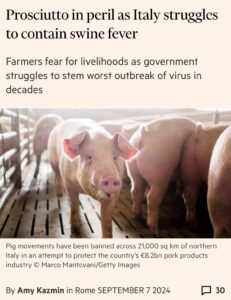
And I would add that not talking about it, not writing about it – as, for example, the Corriere della Sera does – but instead finding the news in the Financial Times, is not good for the country: the swine fever outbreak concerns food, health and, by now, public order too (see below).
In France, sheep farms are affected by three types of animal disease and it is being reported in all the newspapers. Just as in the US, there has been widespread coverage of the nine deaths caused by listeria in cured meats.
This is also because epidemics in Italy have followed one after another, and the media should be obliged to keep the public informed: a bluetongue alert has been issued for Italian sheep and cattle farms, with hundreds of outbreaks and thousands of animals dying from the disease, which is spreading across Sardinia, Piedmont, Lombardy and Calabria, as well as other parts of the country.
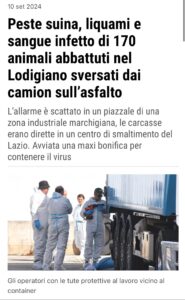
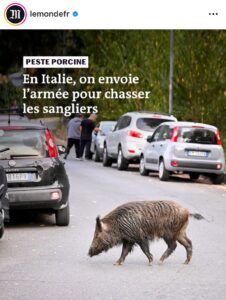
Below: in May 2024, the government announced that it had deployed the army to cull wild boars: negative publicity abroad and zero consequences in Italy, where the situation, unlike in Belgium, for example, has worsened.
Meanwhile, our ministry was preoccupied with propaganda and appointments.
Conclusion:
- the fake ham scandal has been resolved.
- The swine fever situation has improved considerablybut persists, beneath the surface, in some regions.
- We must not forget the lessons learnt.
- The consumption of Parma ham, as well as San Daniele ham, should be revitalised (with a high degree of transparency, starting with the processed raw materials). Certainly, incidents such as this one – involving rodents and piglet carcasses at La Pellegrina farms (AIA Group, November 2025) – continue to damage the image of PDO ham.
See also:
The decline in meat production and Nestlé’s strategies
The harsh reality: the never-ending Parma ham scandal.
Parma ham: new production regulations – yet another ploy?
‘Prosciuttopoli’: swine fever in Langhirano (2024)
“Prosciuttopoli”: trial concludes with 2 convictions and 3 acquittals
Prosciuttopoli: the many accomplices in the Parma and San Daniele scandal
Swine fever: red zone declared – 60,000 animals culled, 26 outbreaks
Swine fever: the number of pigs culled now stands at 120,000. Coldiretti’s oversights
18 million in compensation for farmers
Swine fever: Coldiretti knew since 2018 but did absolutely nothing
Swine fever: over 100,000 pigs culled
‘Prosciuttopoli’: the San Daniele Consortium’s peculiar stance
Sardinia has defeated swine fever; all restrictions lifted: ‘A historic day’ The European Commission decided today to remove the last remaining restrictive measures still in force on the island, which has been ravaged by the terrible disease for over 40 years
Pork products contaminated with the swine fever virus, originating from farms in the Aia-Veronesi group’s supply chain, have reached the shelves ofLidlstores
Swine fever, the infection map: over 3,900 wild boars killed by the virus