[vc_column_text” Drones and AI played a small but significant part in the very early stages of the conflict in Ukraine; they were new technologies with distinctly asymmetric potential that bridged the gap with a much stronger aggressor…
the conflict in Ukraine is an epoch-making turning point, as it demonstrated how quickly a relatively untrained military force can train and arm itself using commercially available and relatively inexpensive technologies ‘.
Mustafa Suleyman in ‘The Wave to Come’, Garzanti 2024, pages 130 and 131

Kiev conquers a stronghold with a never-before-tried assault: droids guided by artificial intelligence
At first, everything was supposed to remain secret, so as to prevent the Russians from devising countermeasures for the future. Then the news started to circulate, albeit in a fragmentary manner, and only now is there the belief that something unprecedented in history has happened in the vicinity of Lyptsi, in the Kharkiv region: an attack conducted exclusively by robots. In fact, the Ukrainians are said to have succeeded in seizing a series of positions along a line of hills thanks to a synchronised operation involving ‘a large number’ of ground and flying drones, which exchanged information on the enemy’s moves with each other and coordinated until victory was achieved.
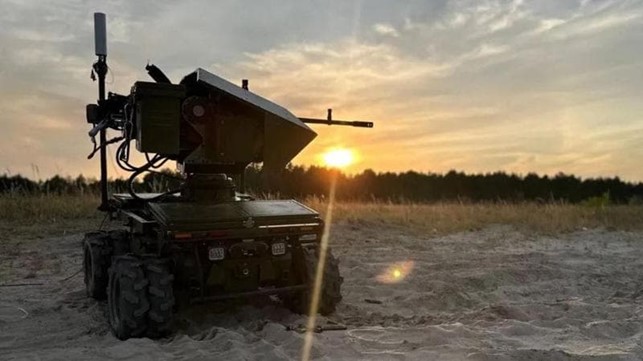
The tracked and wheeled vehicles – abbreviated as UGVs or unmanned ground vehicles – broke through the minefields, creating a ‘cleared’ path on which a dozen automatons armed with machine guns and grenade launchers then advanced and opened fire. There is footage showing them advancing in random order through the artillery craters and firing tracer volleys. During the fighting, other ‘unmanned vehicles’ sowed mines behind the trenches to prevent the influx of reinforcements and the escape of the defenders. All under the cover of swarms of quadricopters and remote-controlled aircraft that monitored the Russian moves, bombing those who tried to stop the march of the land incursors.
Some of the machines had artificial intelligence to carry out part of the functions automatically – such as avoiding obstacles in the snowy terrain – while it was not clear whether it was remotely human beings or directly the electronic brains of the warrior robots that ordered the firing. For some time, Ukrainian companies have been developing warfare systems capable of completing the mission themselves: a choice born out of the difficulty of managing guidance in the presence of instruments that jam radio frequencies and erase GPS satellite coordinates.
All the major western states had foreseen that armies with a large number of warrior machines commanded by artificial intelligence would come to be. However, no one imagined that it would happen so quickly and that in less than three years, the battles in the Ukraine would mark such a dramatic evolution in war technology, filling the front lines with killer automatons. We have entered the era of the unmanned warrior machines, which many believe should be translated as ‘inhuman’.
The apparatuses designed by the Kremlin have similarly advanced equipment. But the Ukrainians have one overriding need. Indeed, the protagonist of the Lyptsi fight was the Thirteenth Khartia Brigade, a National Guard unit chosen as a laboratory for new technologies. These are the units that are in control of the borders and are destined to receive massive quantities of ground drones: in 2025, Ukraine plans to produce 25,000 of them, which should make it possible to transfer as many soldiers to the hottest fronts to solve the frightening shortage of infantrymen in the Kiev army.
The basic problem, however, was to understand whether these squadrons of automatons would be able to cope with Moscow’s troops. And so in the first week of December, ‘operation droids’ began in great secrecy. ‘Our goal was to save the lives of the men by replacing them in battle with robots whenever possible,’ explained Colonel Maksym Holubok, Khartia’s chief of staff. This required meticulous planning, the constant search for new engineering solutions and the dissemination of a culture of innovation in our unit’.
The Ukrainians consider the operation a success: it allowed them to measure Russian reactions and update tactics. During the drone advance and subsequent infantry intervention to occupy the trenches, Moscow troops reportedly had at least 140 casualties. Today, some of the Kremlin’s propagandists – such as the ‘Two Major’ Telegram channel – deny that there was ever such an assault, but in reality it seems that the Russians did not even attempt to rescue the wounded for fear of coming under fire from the killer drones or running into the minefields created by the robots.
Hans Petter Midttun argues that the technological superiority of the Ukrainians is one of the reasons why Russia is losing the war.
Moscow is in an untenable position on several fronts: economic, military and strategic.
Its human and material resources are dwindling rapidly, and the pace of losses makes it unlikely that it can sustain the conflict in the long term. The Kremlin only prevails in the Western narrative of who is winning.