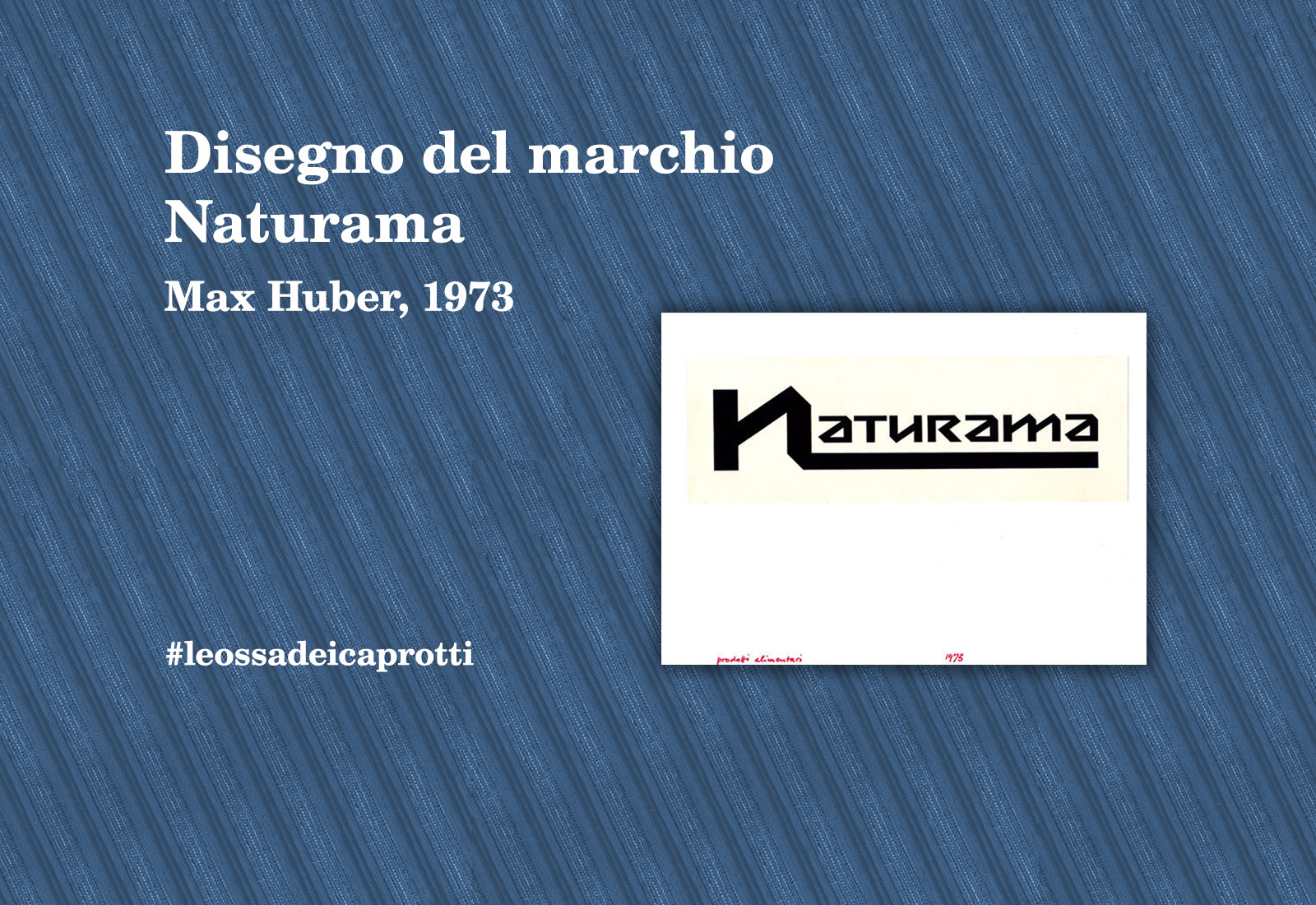
With the passage of time and the spread of other operators (…), the name ‘Supermarkets’ began to create some problems, because being unregisterable exposed the company to not being clearly identifiable by customers. However, its weakness is countered by the strength of the brand name, the elongated ‘Esse’ designed by [Max] Huber. The success was such, our father would tell us, that an industrial giant of the time such as Carlo Erba, when it tried to enter the large-scale distribution business, also used a sign recalling ours. He reacted by opening a legal dispute to claim exclusivity and, at the same time, asked Huber to think of an alternative, in case we lost in court. This is how ‘Naturama’ was born: a brilliant intuition, which our father liked perhaps more than ‘Esselunga’ itself, but which was immediately put away in a drawer, because the Court of Milan agreed with us and so the need to change was no longer necessary (…) The Naturama brand will remain in the house and, even if until my arrival it will not be exploited as much as it could have been, the fact remains that our father had guessed that the ‘naturalness’ of a product was a way to enhance its quality, a principle from which he will never deviate. And it was he again, again together with Armando Testa, who launched the first Esselunga branded products in 1979, alongside the fancy names that had been invented by the Americans. (pp. 133 – 134).
“Also in 1999, after the ‘mad cow disease’, which catalysed Europe’s attention for a decade, the dioxin chicken crisis broke out. But we are well placed: for years now I have been working to relaunch the Naturama brand. And the ‘Naturama chicken’ allows us to pass through these new difficulties without repercussions. We thus reap the benefits of a choice that, at the end of the 1990s, pushed us towards organic products and gave us a way to differentiate the Esselunga brand on products, giving it a connotation of quality that its competitors struggle to match. Ever since I took my first steps in the company I had been discussing organic with our father, in the kitchen at home, always in a sterile manner. In that 1999, however, the moment came where there was no turning back. I’m in the car with two executives on a long trip and we decide to make a private label ‘Bio’ line. It comes out after seven months: a record. Obviously our action is facilitated by the need to cope with the continuous food crises, but the basic idea is to focus on three different market segments: the highest with organic, the medium with the usual Esselunga products, and the lowest with the ‘first price’ brand, which at the time is called Fidel and which must respond to the need for ‘good-for-all’ products. These decisive steps were possible thanks to the work I had done after returning from Chicago. At that time, I had found intact the brands that had been introduced by the Americans thirty years earlier. There were the Khan and Kegusto coffees and various other products that used fancy names such as Briciola, Nutron, Beetle and Kekasa. These were often very successful products, which were part of our history but which were beginning to show the wear and tear of time, and above all did not allow us to communicate in a uniform and effective way the fact that Esselunga had to be associated with quality. So we decided to abandon them to make way for the work begun with Violetta and the Armando Testa agency on communicating quality, which accompanied the establishment of the Esselunga, Esselunga Bio and Naturama brands, flanked by Fidel for the lower price bracket.” (pp-184 – 185). ‘In 2003 (…) Naturama and Esselunga Bio now account for 10 per cent of turnover.’ (p. 206).
Cover: The ‘Naturama’ brand sketch designed by Max Huber